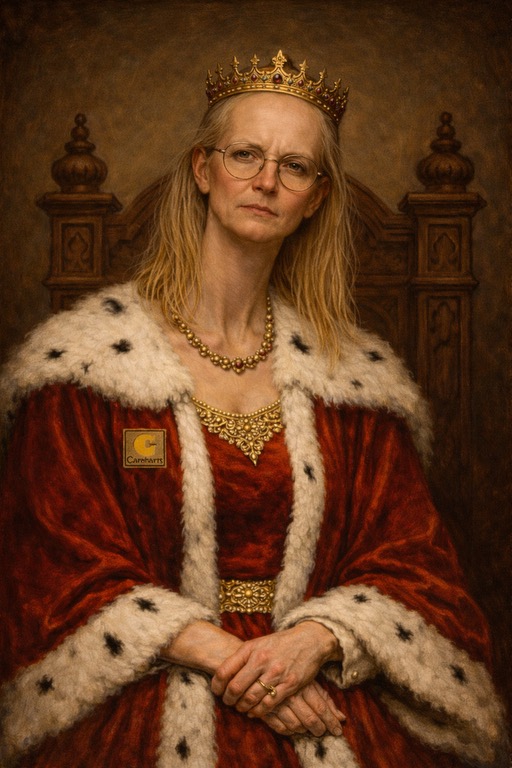
When anyone in the Realm of Solipsia first meets the Queen Consort Brystal, your immediate reaction is to pity her. Pity her for her blatant servitude to the Beaver King. However, This Minstrelle and many others, have come to the realization that once you peel back the layers of the Onion Woman, she is not just a victim in the orbit of King Robert, she is a key player in his vast network of dysfunction.
Queen Brissy is in her late 40’s. She is tall. Taller than the Beaver King. Their contrasting sizes are not often reflected in the royal portraiture due to the Kings insecure nature. She is oddly shaped and has an unusually tiny head for her largely boned frame.
When the Queen Consort enters a room, she does not command its presence. She does not become the anchor of a room. She does not alter its temperature. She is present in the most technical sense only- a quiet figure already seated, already folded into the background. Her absence of presence is so complete that people often finish speaking and realize too late, she was never truly listening.
There is no emotional gravity around her.
No reassurance. No resistance. Only space.
Queen Brystal’s appearance is plain but orderly, and deliberately forgettable. She has pale stringy blonde hair with hints of gray around her temples. She wears it simply, despite the widening of her forehead, likely due to receding from age. She dons round glasses that suggest observation without engagement. Her general expression is a mild, non committal one, neither warm nor cold. Her hands are always folded or resting, never reaching or expressing.
Her robes are properly royal, and she prefers nothing flashy. She specifically dislikes the gold embellishments that her Grace insists on applying to her wardrobe. One uncharacteristic thing that is surprising is her brand loyalty to one specific designer in the Realm. She has never publicly given a reason for her endorsement of the tailor, but she has rarely ever been seen in a garment that has not been made exclusively by the House of Karhärt. Even though she wears this popular brand, she still somehow manages to wear it without conviction. The crown sits upon her tiny head, more symbolic than it is a claim to her her status.
Queen Brystal is emotionally unavailable by habit.
She does not escalate. She does not soothe. She does not intervene.
She responds to distress with silence or polite deflection. She allows conversations to trail off unresolved. When confronted with pain, conflict, or contradiction, she offers vague phrases that neither confirm or deny her reality. She isn’t cruel, but is isn’t kind either. She is just…well, absent.
You see, Queen Brissy is an enabler via vacancy. She does not actively suppport wrongdoing, she simply just never interrupts it. Her defining trait is non-engagement, perfected to the point that responsibility cannot land on her. She values distance over involvement, quiet over clarity, and continuity over correction. She believes that participation creates problems, and that the disengagement keeps her safe. She lets the Beaver Kings lies exist. She doesn’t acknowledge them. She treats truth as something that will “sort itself out” if left alone. Her most common responses are evasive and empty.
- ”I really don’t remember.”
- “I wasn’t there for that.”
- ”I don’t want to get involved”
- ”That’s between you and His Grace”
This Minstrelle believes it is not the truth that frightens her, it’s her true accountability that does.
The Queen Consort was physically present in the Little Lords lives, but was emotionally absent from all of them. According to descriptions from Baylor The Brave, she did not protect them (specifically from the abuses of King Robert), she did not guide nor challenge them, and she did not particularly attach to them. It is widely known in the Beaverton Kingdom that each child responded differently to their upbringing. One learned to not need her. One learned to not feel. One learned to not exist. One learned to leave. She notices none of this.
The canonical truth? Queen Brystal is not evil. She is weak. She is missing and has been for a long time. She is a captive with decorum. Her marriage to King Robert is defined by total domination disguised as tradition. She is expected to serve, anticipate, and submit emotionally, physically, and logistically – all while remaining outwardly composed and grateful. Her absence is not indifference. It is exhaustion and learned survival.
Despite the presence of the Log Cabin Castle’s staff, the Queen is required to prepare all of King Robert’s meals herself, exactly two his specifications and serve them personally. Should a meal displease him in any way, he may publicly criticize it, discard it, or throw it outside in a display of dominance. The point is not the food, the point is control. The Queen is not permitted to take her leave to sleep independently. She must remain awake until the King is ready retire to his quarters regardless of her workload, exhaustion, or her responsibilities the following day. Over time, as one would imagine, this has destroyed her internal sense of self.
Her aloofness is not a moral failure, its disassociation. She has learned that presence invites punishment, opinion invites conflict, and resistance invites escalation. She has learned to withdraw and minimize. This has left her unremarkable and forgettable.
The Little Lords have never experienced her comfort because there was nothing left to give. The rare times she did show visible attention to her sons, it would be weaponized by the Beaver King. The absence has greatly harmed them, tho those in the Kingdom only recognize one son that identified this and the many other egregious dysfunctions within the Beaverton Household and fled, leading to The Turning. We will discuss The Turning in depth after we meet the other main characters in our story.
Despite the misogyny, emotional abusive, and blatant control King Robert imposes on her, she is not to be viewed as a sympathetic figure. Just because she is restricted and humiliated by the Beaver King, she is most certainly not absolved by that suffering. She is an adult that understands harm, recognizes patterns, and repeatedly chooses non intervention when it’s possible. She knows exactly how the system works. She understood the damage being done to the children. She recognizes King Robert’s cruelty. She has moments of choice, but consistently chooses silence. This leads This Minstrelle to believe she is not ignorant or confused. She is complicit thru inaction. Her suffering explains her behavior, but does not excuse it.
She completely enables the Beaver King by normalizing His Grace’s behavior thru routine and continuing rituals that reinforce his dominance. She taught the Little Lords that endurance is virtue. She models submission as stability. In her minds eye she does not need to agree with him, she just needs to continue.
And she has done and will continue to do just that.
 The Beaver King, Cautionary Tales of Medieval Dysfunction
Leave a comment