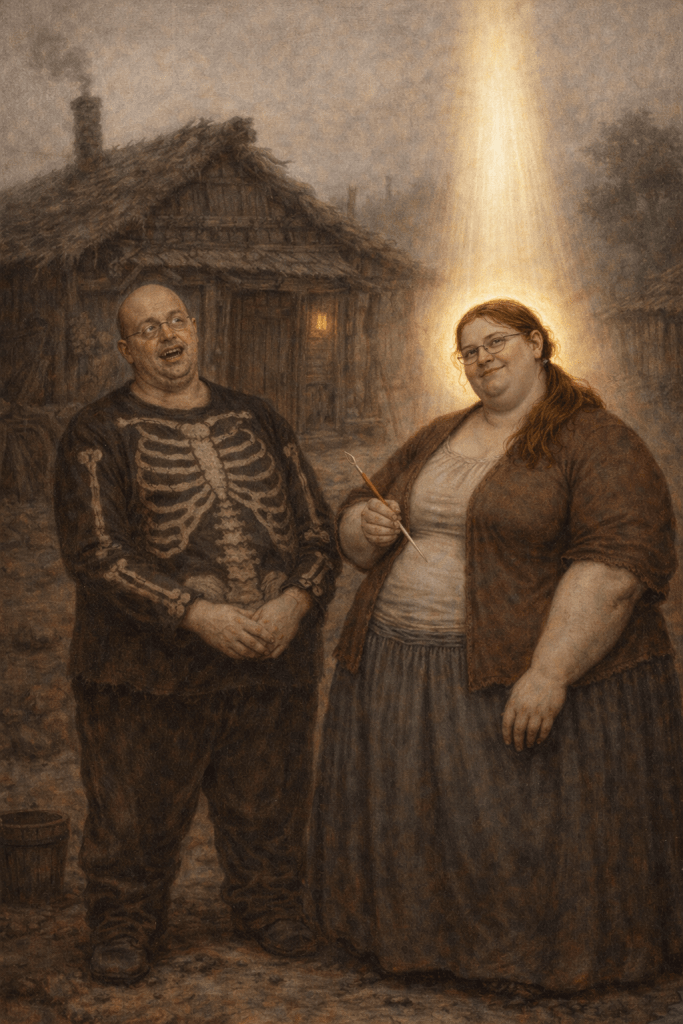
The Griers
The Griers entered Beaverton not by merit, labor, or invitation, but by marriage and endurance. Billdong the Bone-Clad Grier became uncle-by-law to the royal line through the Beaver King’s sister, binding the family to the court in name only. From the beginning, their presence was tolerated rather than welcomed.
They were granted a small, undesirable holding on the outskirts of Beaverton: an old hand-me-down hut passed along thru the family after no one else wanted it anymore. The structure was already failing when it came into their possession and worsened steadily under their care. It leaned. It leaked. It smelled permanently of damp wood, old feed, and neglect.
Animals lived inside the hut alongside them, not by plan but by habit. Chickens roamed freely outside, beneath the floorboards and through the yard, scratching at whatever would give way. Eggshells rotted where they fell. Feathers collected against the walls. The line between living space and animal space was never clearly drawn.
Beside the hut stood a small collapsing shed, filled with broken tools and objects Vast Sister Grier insisted would be “fixed someday.” Nearby sat a rusted, run-down trailer, long past usefulness, its wheels sunk into the ground, its interior stripped and fouled. It remained only because no one had the discipline to remove it.
Despite their proximity to the royal family, the Griers lived poorly, not from persecution but from habit. Money that came to them through charity, foot-shelter handouts, or temporary assistance was burned through quickly and without result. No repairs followed. No debts were settled. Each influx ended the same way: with nothing to show for it and renewed expectation of more.
They made periodic attempts at self-sufficiency, usually announced loudly and abandoned quietly. Gardens were planted more than once. Each effort followed the same course: poor planning, neglected soil, untended growth, and eventual rot. Seeds were scattered without order. Weeds overtook what little sprouted. Harvests, when they occurred at all, were meager and mishandled. These failures were blamed on weather, fate, or Beaverton itself never on neglect.
Vast Sister Grier claimed infirmities that excused her from labor. She cited her size, the Sugar Affliction, and vague weakness as reasons she could not work, travel, or hold position within Beaverton. These explanations were tolerated because confronting them required more effort than ignoring them. She spoke often of restriction—dietary, medical, spiritual—but followed none with discipline. Her religiosity grew louder as her responsibilities diminished.
Children stared openly at Vast Sister whenever she appeared. By common agreement, she was the largest woman in the kingdom, and her size made her unavoidable. From this watching grew a saying, whispered first and then spoken aloud:
“If you suck the sweet juice from the clover flowers in Vast Sister’s yard, you’ll get fat too.”
No adult corrected the belief. Some smiled at it. Others repeated it themselves. King Robert chanted it to his boys when they were younger. Clover near the Grier hut was avoided. When a child grew heavier, the rhyme was repeated. When one did not, it was said they had been careful. The court did not address the rumor. It was deemed harmless superstition and quietly allowed to persist.
Billdong the Bone-Clad Grier contributed nothing of consequence. He was widely regarded as useless by the Beaver King and ignored by the court. Instructions were simplified for him. Expectations were abandoned entirely. He was never trusted with tools, money, secrets, or care of others.
Against advice and common sense, Billdong repeatedly interfered with the hens during laying, convinced eggs should not be left to nature alone. He persisted even as losses mounted. Many chickens died of internal injury and stress. Vast Sister did not stop him. She cited ignorance. She cited belief. She cited “how they’d always done it.” The coop grew quieter each season.
While the Griers resisted work for themselves, Billdong was regularly summoned by the Dowager Queen to perform grunt labor at her home in Beaverton. These tasks were menial and physical—hauling, lifting, clearing, repairing what others would not. Billdong complained constantly. He resented the summons. Yet he always did the work. If you listened closely, you could hear him muttering foul words that sounded like plans for the Dowager Queen and her son’s demise, though he would deny if asked. Refusal of these tasks was never truly an option.
Billdong cultivated small habits of pride. He favored smoking pipes, not for taste but for spectacle, delighting in producing the largest smoke cloud possible and watching for reaction. Visibility itself was accomplishment.
He also rode a small two-wheeled bike, too low to pedal properly. Instead, he scooted along with his feet, pushing himself forward in short, determined bursts. He believed the bike made him look tough. Vast Sister never rode with him. The bike would not support her, and no alternative was ever sought. The image became familiar: Billdong moving, Vast Sister stationary.
Over the years, many people came and went through the Grier hut, arriving under the pretense of helping maintain the property. Each left poorer than they arrived. Work remained unfinished. Funds disappeared. The pattern never changed.
Among those who stayed was a girl, taken in well into her teen years. She was not pliable, not grateful, and not fooled. The Griers were afraid of her—not because she was violent, but because she saw clearly. What followed was neglect and abuse sufficient to draw court attention. In a rare act, the Beaverton court intervened and the girl was removed from the transient woman and adopted properly by the Griers. Her name was Sharkeesa Wellpenny. She left the holding when she turned of age.
Due to their poverty status, The Beaver King repeatedly offered to “help” by paying the taxes on their land, structuring each offer so the holding would quietly become his. The Griers refused, clinging to the hut as the only proof they owned anything at all. The stalemate persisted.
King Robert openly mocked Vast Sister Grier for her size. The Dowager Queen diminished her more quietly, framing contempt as concern. Vast Sister absorbed both without change, retreating further into idleness and entitlement.
In later years, the Grier name became shorthand within Beaverton for habitual dependence. It is recorded—quietly, and without argument—that Vast Sister Grier and Billdong the Bone-Clad Grier possessed good hearts.
Not strong ones. Not disciplined ones. But kind, unguarded, and fundamentally gentle.
Had Vast Sister not been born into the Beaverton betrayal, and had Billdong not married into it, the court believes they might have lived differently. In another place, unmeasured by ridicule and untouched by hierarchy, they would have been generous to a fault. They would have fed others before themselves. They would have been easily taken advantage of—and accepted that, believing it the cost of being decent.
Beaverton is not kind to such people.
Their failings were not born of cruelty, but of softness in a world that rewards hardness. They were not suited to a system that demands performance, vigilance, and constant self-justification. What Beaverton interpreted as laziness was, in part, an inability to harden.
It is also noted—without judgment—that Vast Sister Grier never bore children.
Some in the court believe this was accident.
Others call it mercy. A few whisper that it was the universe intervening, sparing her from bringing another gentle soul into a lineage that would have broken it.
Had she borne a child, Vast Sister would have loved them fiercely and without protection. She would have given them everything she had and nothing she did not. In Beaverton, that is not enough.
The court does not declare this fate tragic.
Nor does it call it just.
It records only that the line ended, and that perhaps—quietly, finally—that was the kindest outcome available to them
 The Beaver King, Cautionary Tales of Medieval Dysfunction
Leave a comment