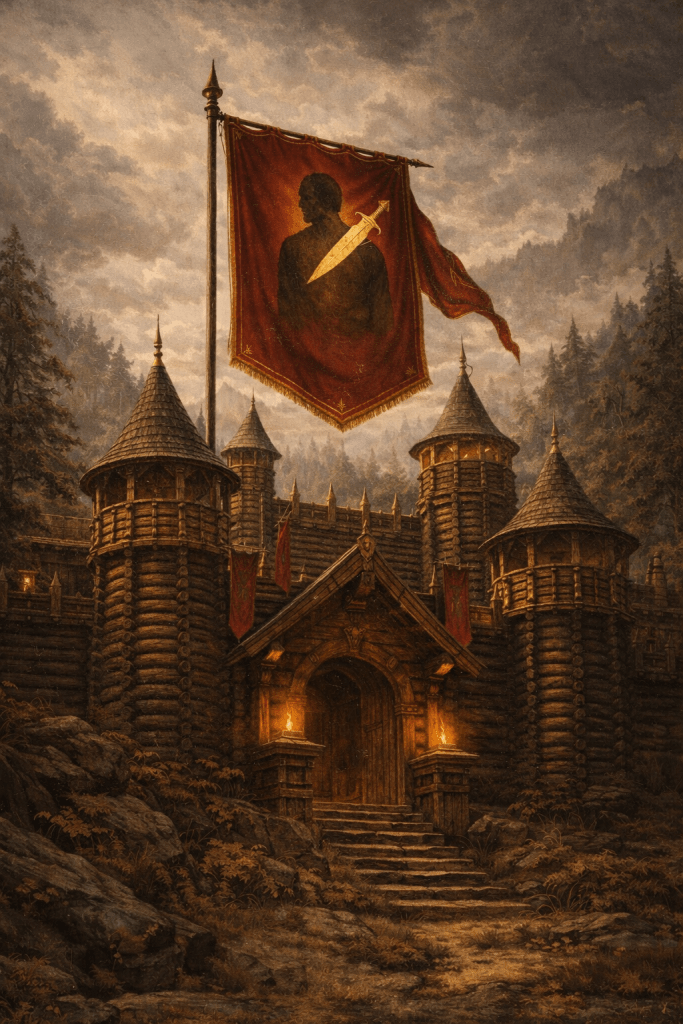
The structure now known—loudly and repeatedly—as the Log Cabin Castle was never a log cabin at all.
Nor was it ever a castle.
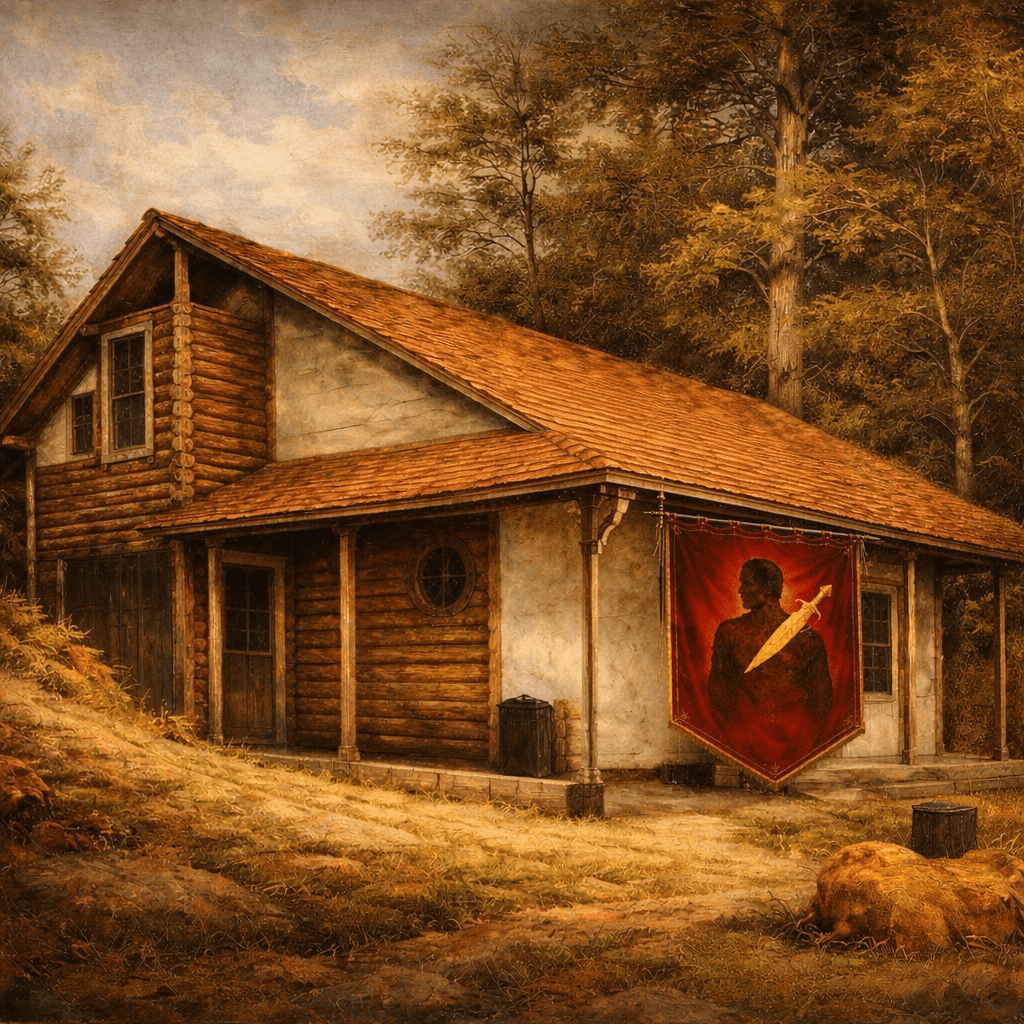
It began as a regularly sided home, unremarkable in construction and modest in footprint, situated on land that would later be exaggerated far beyond its recorded boundaries. When severe weather damaged portions of the exterior, King Robert did not rebuild, expand, or meaningfully improve the structure. Instead, he applied log-style finishing to one or two visible sides of the house and declared the transformation complete.
From that moment forward, the lie was born.
What should have been recorded as a partial exterior repair became, through insistence and repetition, a “log cabin.” What should have remained a house became, through fantasy and ego, a “castle.” And what should have been an embarrassment quietly corrected became a cornerstone of King Robert’s self-mythology.
The truth is simple: any observer willing to walk around the building can see the contrast. One wall presents rough-hewn logs meant to evoke rustic virtue. The others remain plainly sided, lighter in color, and unchanged. The building contradicts its own legend from every angle but the one The Beaver Lord prefers.
This contradiction was not accidental. Certain approaches are encouraged. Certain views are favored. Certain questions are met with hostility. The façade is curated as carefully as the story that accompanies it.
Despite maintaining staff, the interior of the Log Cabin Castle is never decorated with care. The Queen shows no interest in cohesion, warmth, or hospitality. Furnishings are mismatched, maintenance is uneven, and a set of visibly mismatched curtains hangs in prominent windows—unchanged for years—not from poverty, but from indifference. Nothing inside suggests stewardship. Everything suggests neglect.
Robert, however, speaks endlessly of upkeep and cost. He claims immense personal sacrifice in maintaining the domain, recounting expenses that do not appear in any ledger and labor he does not perform. He boasts of generosity to neighboring kingdoms, of aid given and burdens borne, none of which can be substantiated. These are not deeds he has done—they are deeds he wishes he could claim.
He projects relentlessly.
At the armory, before subordinates expected to listen and not question, King Robert recounts his imagined benevolence as though it were history. He speaks of land worked, buildings maintained, and systems sustained by his hand. In reality, the work is done—when it is done at all—by others, quietly and without acknowledgment.
He takes particular pride in claiming that his sons “run things.”
They do not.
Bucker is too lazy to contribute meaningfully, incapable of sustained effort or follow-through. Brentin does the bare minimum when observed and nothing when not. Neither of the Little Lords is capable of, nor willing to perform, indoor labor, which they regard as beneath them—an attitude learned and reinforced by a misogynistic household standard that treats domestic work as invisible and unworthy.
The Queen does not engage in outdoor labor. The boys refuse indoor labor. Robert claims credit for both.
Thus, the kingdom functions around them, not because of them.
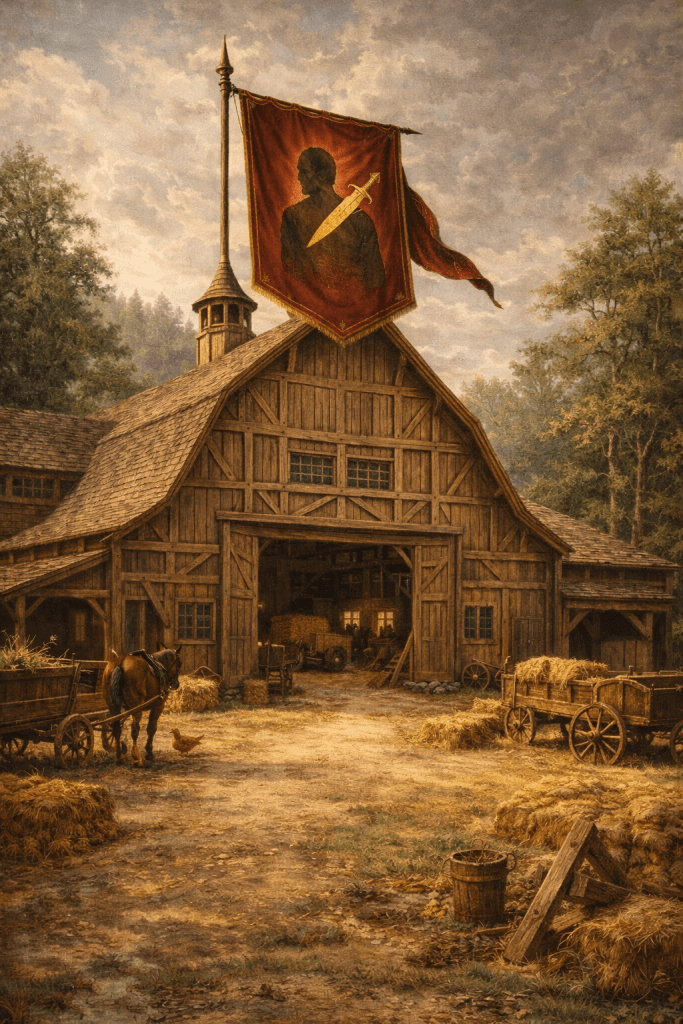
The so-called barn is another pillar of the lie. Robert boasts of livestock and agricultural capability, yet there are no animals. His brief attempt to keep goats failed—not due to misfortune, but incompetence. He was too stupid to even teach the goats how to eat the stray grass on his land. The “barn” itself is nothing more than a ramshackle chicken coop repurposed as storage, left behind by previous occupants of Beaverton and never meaningfully improved.
Still, he names it. And in naming it, he pretends it exists.
He inflates acreage. He exaggerates square footage. He speaks numbers so boldly and so incorrectly that any idiot could verify the truth by consulting the Solipsia Record Book. Yet he continues, undeterred, because he does not expect belief—he expects deference.
The greatest irony is this:
Robert truly believes everyone believes him.
They do not.
The staff knows. The armory knows. The courtiers know. The neighboring kingdoms know. The records know. Even the walls of the Log Cabin Castle know, by virtue of their mismatched surfaces and unfinished truths.
They let him speak. They nod. They correct quietly. They work without credit. They manage him.
King Robert is not feared. He is not respected. He is endured.
He is a legend in his own mind, ruling over a façade so thin that sunlight passes through it—if one only bothers to look from the other side.
 The Beaver King, Cautionary Tales of Medieval Dysfunction
Leave a comment