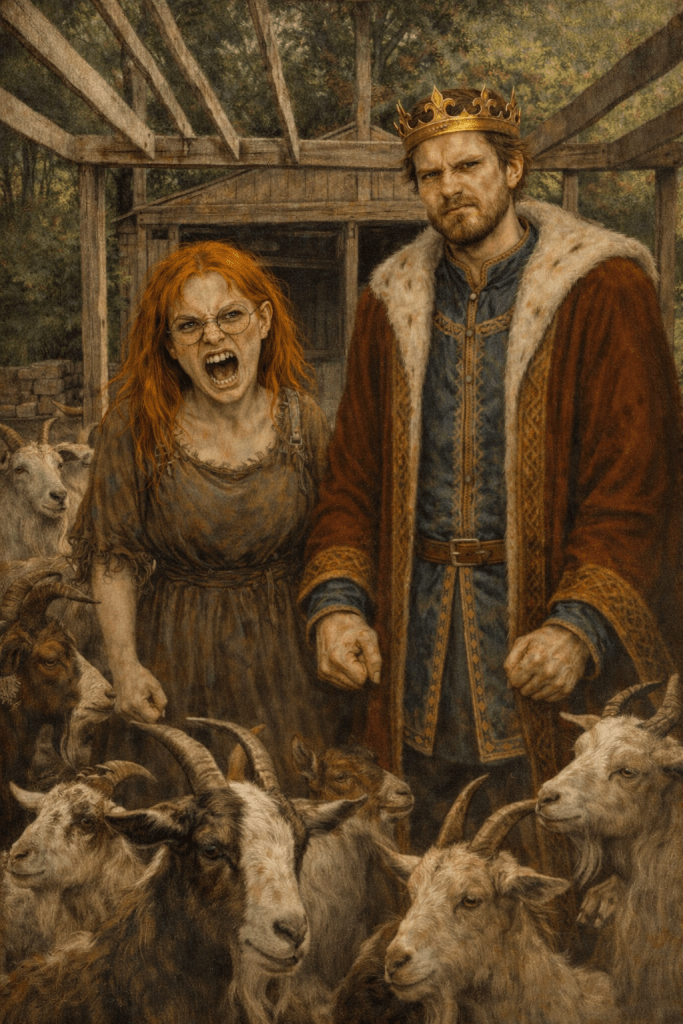
It is a defining trait of Beaverton—so consistent it may be mistaken for instinct—that when wrongdoing is exposed, the people do not confront the crime itself, but instead redirect their fury toward an irrelevant detail. When the mirror is raised and the reflection reveals cruelty, corruption, or moral decay, the Beaverton response is not shame, repentance, or even denial. It is deflection. Precision deflection.
When accused of betrayal, they argue tone.
When confronted with abuse, they debate wording.
When presented with evidence of sociopathic behavior, they protest context.
The greater the offense, the smaller the chosen battlefield. This is not confusion. It is strategy.
From an early age, Beavertonians learn that outrage is most effective when misdirected. Elders survive exposure not by accountability, but by obsession—fixating on manners, phrasing, timing, goats, banners, seating arrangements, or any sufficiently trivial matter that draws attention away from the rot itself. These details are not defended because they matter, but because they distract. The argument is pursued viciously and without end, until the original accusation is buried beneath noise.
Thus, Beaverton transforms moral reckoning into procedural debate. The question is never “What did we do?” but “How dare you say it like that?” Once the conversation is dragged into minutiae, the larger crime is rendered untouchable, safely ignored, and free to repeat itself.
This trait is passed down like a family heirloom. Children watch adults argue the smallest point to the death while the greater harm goes unaddressed. They learn that survival depends not on innocence, but on endurance—the ability to outlast truth by exhausting it.
A recorded instance illustrates this defect with perfect clarity.
It was not the exposure of their sociopathic tendencies that finally unseated Drucelia and Little Lord Brentin, nor the unmasking of the family’s secrets, betrayals, and inherited cruelty. These truths slid off them as all truths do. What sent them fully over the edge was something far more obscene in their minds: the alleged misrepresentation of goats.
As This Minstrelle of Masondonia sang openly of Beaverton’s filth—its silences, its rituals of harm, its willful blindness—they did not rage at the mirror held before them. They raged instead at the livestock. That the goats, present during the songs, had not been framed to their liking. That while ballads were sung of broken vows, corrupted bloodlines, and moral vacancy, attention might linger too long on the animals themselves.
And so, amid stamping hooves and bleating witnesses, Drucelia and Little Lord Brentin lost what little pretense of sanity they retained—furious not at the truth, but at its framing. Furious not at what was revealed, but at a detail small enough to argue.
This is why exposure alone never breaks Beaverton. Truth may arrive fully armed, but it is met with a swarm of minutiae, each one weaponized. They will argue the smallest thing to the death if it allows the greater crime to remain untouched.
In Beaverton, the goats are always the problem—
Never the hands that dirtied the barn.
(The Beaver Kings fantasy of the barn or the reality version.)
 The Beaver King, Cautionary Tales of Medieval Dysfunction
Leave a comment