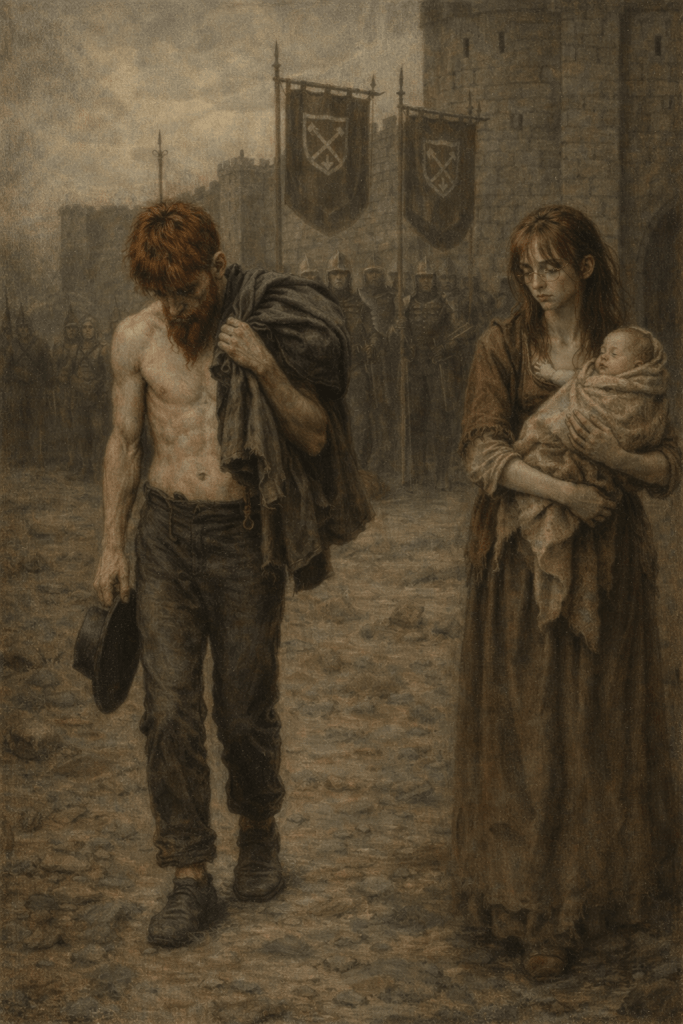
King Robert’s fixation on the Concordant Standard long predated his son’s enlistment.
The Beaver King desired service not for duty, but for identity. To be regarded as a man who had endured the Forge. To be spoken of as disciplined, proven, and legitimate. He never attempted it himself. King Robert understood—accurately—that he could not pass the Concordant Forge. He could not submit to command, withstand scrutiny, or survive evaluation against a standard not of his own making.
Instead, he told people he had served. The lie persisted quietly for years, until it was suspected on that fateful night for the Beaver King that the Standard itself ended it, likely on the order of The Three. Then it became clear that the fiction could not sustain itself, King Robert required one of his sons to fulfill the role he could not.
Baylor the Brave was injured and physically unable to enlist. His exclusion was permanent and involuntary.
Brentin the Beneficiary had no interest. His beliefs were openly self-serving, and he refused any discipline that did not benefit him directly.
Bucker The Unburdened One remained.
Bucker was pliable, eager for approval, and wanted worth without understanding cost. The pressure placed upon him was not explicit, but constant. Praise followed any mention of service. Approval hovered, implied but never granted. King Robert did not command Bucker to enlist—he made it clear where worth resided. Bucker absorbed this expectation without comprehension.
After the deterioration of his marriage and under constant fear of abandonment, Bucker reached a conclusion he believed to be responsible. He would support his family. He would become a source of pride. He would make himself un-leavable. Military service appeared to him as the only path capable of accomplishing this. He enlisted not out of duty, but desperation.
Bucker entered the Concordant Standard and was sent to its training camp, the Concordant Forge.
He joined not to serve the realm, but to secure his place within his marriage—and within his father’s regard.
Upon enlistment, Bucker lied by omission to the commanding authority. He did not disclose a chronic respiratory condition—understood in Solipsia as a breath-bound weakness, marked by severe breathing fits and episodes of immobilizing distress brought on by exertion and stress. At the outset, these limitations went unnoticed, and the ruse was afoot.
The Forge Period
While Bucker endured the Concordant Forge, Lady Jessalyn resided at the Log Cabin Castle with the King and Queen, recognized as a military spouse and receiving the stipend allotted for that purpose. Initially, she felt relief. She believed stability had arrived. The Lady Jessalyn, however, had no understanding of money.
She had never been taught saving, planning, or household accounting. She did not know how to build toward independence or future stability. The Queen Consort, who possessed both the knowledge and authority to instruct her, offered no guidance. No teaching was given. No oversight was imposed or correction followed.
Instead of saving the stipend to establish a home or secure independence, Lady Jessalyn Slumthumb spent the money impulsively, often on trivial or unnecessary things. This was not malice, but ignorance left unaddressed. The opportunity for stability existed briefly, and was lost.
During this same period, Bucker spent money irresponsibly on nonsense, concealed his worsening health out of fear, and failed to meet the physical and procedural demands of the Forge.
He did not excel.
He did not adapt.
He persisted only through concealment.
The Child
During Bucker’s service, Jessalyn gave birth to their first child, a healthy, perfect daughter, beautiful and strong, born within Beaverton and fully legitimate under Solipsian law.
Her arrival stands as the single unambiguous good of this period.
Little Lord Bucker was granted temporary leave to witness the birth. In Solipsia, fathers are expected to be present; male attendance is customary, not exceptional. His leave was routine. He returned home briefly to witness the birth. He held the child and took the allotted leave in full. Then he returned immediately to the Concordant Standard. For once, he followed procedure.
Exposure
While Bucker was away for the birth, reports reached the Concordant Standard establishing that his respiratory condition predated enlistment and had been deliberately undisclosed. Upon his return, he was summoned immediately.
He was brought before the High Marshal of the Standard and publicly chastised. There was no hearing. There was no mitigation. The Standard does not debate fact, it only enforces alignment. Bucker was formally expelled. He was excommunicated from the Concordant Standard and his standing was stripped. He was declared unfit.
This was not a discharge. It was repudiation. His name was removed from the rolls. and his service was nullified.
Consequence
The disgrace was immediate and lasting. In Solipsia, to fail the Concordant Forge is humiliation. To lie to the Standard is disgrace. To be expelled after enlistment is worse than never having tried. The stain was not private.
It attached to Bucker, The Beaver King and The House itself, and it did not fade.
Canonical Truth
Bucker entered the Concordant Forge carrying his father’s unfulfilled identity and his own fear of abandonment.
He returned a father, and left the Standard without legitimacy, standing, or future.
The Concordant Forge did not make Little Lord Bucker worthy. It revealed what he could never be.
 The Beaver King, Cautionary Tales of Medieval Dysfunction
Leave a comment