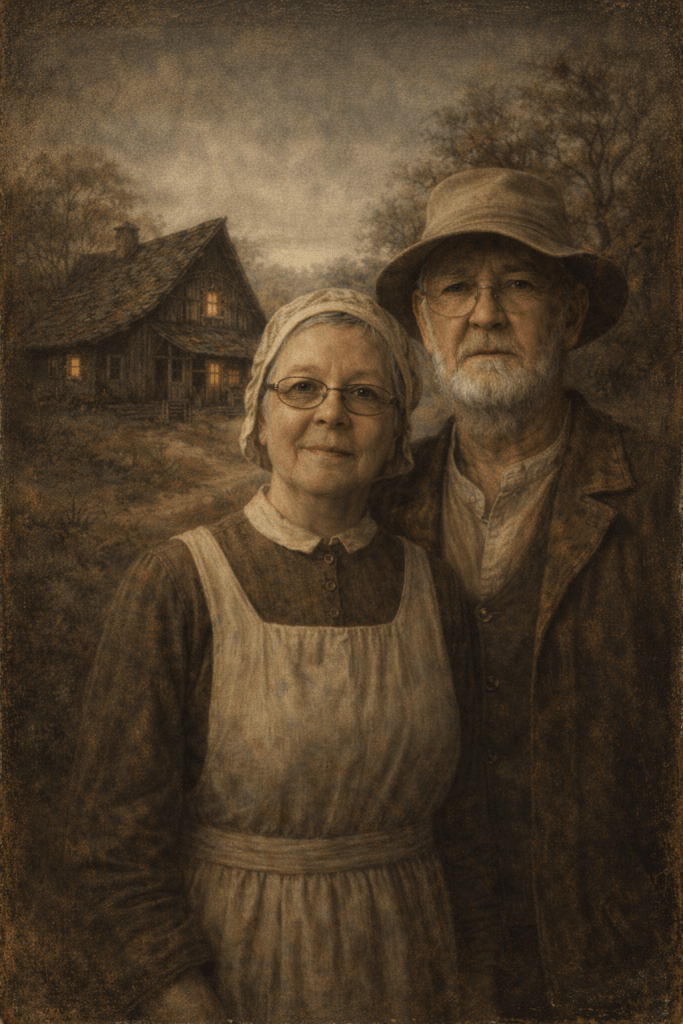
Donnelia Moor was not born into softness, but she learned it.
She came from work-worn hands and early mornings, from flour on skirts and ink on fingers. She could speak plainly with farmers and just as easily discuss music, letters, and distant places with those who had never dirtied their boots. She carried both worlds without shame. It made her rare.
She and Richen Moor built their life west of MoorsFork, in a low, crooked farmhouse that always smelled faintly of bread, hay, and smoke. Richen was a man shaped by labor, sun-creased skin, rough voice, a constant cigarette burning between his fingers, but he was not cruel. He worked. He provided. He laughed easily when Donnelia teased him for bringing mud into the kitchen again. They were, by all accounts, happy.
And then there was Brystal, their daughter. Their pride. Their careful joy.
They saw the Beaver King long before others did. They saw the way he watched instead of listened. The way he pressed instead of persuaded. Even when Brystal was young, still unsure of herself, they felt the wrongness in him like a cold draft through a closed room. They did not scheme to break the match. They had manners enough to know that was not an appropriate thing to do, as it might fuse them closer together.
When Brystal confessed…hesitant, frightened that she wished to see other suitors, Donnelia encouraged her gently. Richen said nothing, but nodded once, firmly. They believed in choice. They believed in time. Young Prince Robert did not.
He did something that was spoken of only in whispers, because it was usually left to women, and even then spoken of with shame. He trapped her—with a child she did not choose, at a moment when her doubt was loudest. Donnelia wept when she found out. Richen broke a chair against the wall of the farmhouse and then went very quiet.
They knew then. This was the end of their closeness to their daughter. Marriage came quickly. Isolation came faster.
Once the children arrived, the Dowager Queen ensured the distance became permanent. She did not shout. She did not forbid outright. She spoke instead in warnings, delivered gently and often, the way one cautions a child about spoiled food or unsafe water. She told them the Moor farmhouse was dirty. She said the animals were unpredictable. She said Donnelia cried too much and made children uncomfortable and Richen smelled of smoke and anger and that men like him were not safe.
She framed cruelty as concern. She told the babes that their grandparents resented them, that visits were obligations, not invitations. That Donnelia would guilt them if they stayed too long. That Richen watched too closely and asked too many questions. Fear was planted early.
By the time visits were permitted, the children arrived already guarded. They had been instructed on what not to touch, where not to wander, how long was polite to stay. They were warned not to accept food too eagerly. Not to repeat things they heard. Not to linger. Donnelia noticed everything.
She baked anyway. She made their favorite treats, even when they were not allowed to eat them. She set out toys she had carved or sewn herself, knowing they might never be touched. She kept a box in the spare room filled with things meant for later: small boots, books with inscriptions already written, wooden animals sanded smooth by Richen’s hands.
The children were different each time. They grew quieter. More careful. They watched adults the way prey watches the treeline. When Richen laughed too loudly, they stiffened. When Donnelia reached for them, they hesitated, glancing first toward the Dowager Queen. Once, when the eldest boy scraped his knee, Donnelia reached for him without thinking. The room went cold. Robert stood. The Dowager Queen smiled thinly. The visit ended early. After that, Donnelia kept her hands folded in her lap at all times.
She wrote letters she never sent. Birthday wishes tucked into drawers. She marked the children’s heights on the inside of the pantry door anyway, measuring ghosts.
Richen spoke less during those years. But when he did, it was always about the boys. What they might like. What they might become if given room. He fixed things that did not need fixing, just in case they ever came back. They rarely did.
As the children grew older, the visits stopped altogether. The explanation was always reasonable. Busy schedules. Distance. The children’s discomfort. The Moor farmhouse, they were told, was not a safe place.
Donnelia stopped asking aloud. At night, she imagined the sound of their feet on the stairs. The weight of a child asleep against her shoulder. She wondered how many generations it took to undo this kind of harm, and whether anyone would ever try.
She still believed, stubbornly, that adults must be allowed their choices. Even when those choices broke her.
Some in MoorsFork would later say it was heartbreak that invited the Mourning Ash into Donnelia Moor’s body. They said sorrow settles where it is given room, and that grief, when denied its natural expression, turns inward and roots itself deep. That Donnelia had carried too much for too long—love with nowhere to go, names she was no longer allowed to speak, grandchildren she was made to forget out loud while remembering them in secret. The Mourning Ash did not arrive suddenly. It bloomed slowly.
All Donnelia wanted was her family together again. Not reconciliation. Not forgiveness. Just proximity. A table filled. A room with voices in it. Her daughter beside her, unafraid. The grandchildren close enough to touch. King Robert knew this. And because he knew it, he denied it. He delayed visits. He shortened stays. He invented obligations, illnesses, dangers. When Brystal asked, he reminded her of her duties. When she insisted, he reminded her of her failures.
Publicly, he performed devotion. He told the world how much they were doing for Donnelia Moor, even as he made certain Brystal’s chair at her mother’s bedside remained empty.
Donnelia heard these stories secondhand. She smiled when told. And then she turned her face to the wall, where no one could see the truth leave her body a little more each night.
She died in the night. There was no call for help. No witness. No hand to hold. Somewhere between the bed and the door her strength failed her. She went down quietly, as she had lived.
On the floor, the house familiar around her, Donnelia Moor thought not of illness or injustice. Her mind returned to the last place she had felt whole. The grandchildren came to her as they were when she had known them best. Small hands dusted with flour. Bare feet on the farmhouse floor. Laughter she had memorized because she was afraid she would forget it. They ran to her without fear.
Brystal was there too—not bent, not bruised, not quiet. Just her daughter, young again, sitting at the table while bread rose and the kettle sang. It was the family together.
The only way it had ever been allowed to exist.
When Richen found her in the morning, she was already gone. Her face was calm. One hand rested against the floor as if she had simply paused there, listening.
After Donnelia died, Richen did not remain in the farmhouse. The rooms were too full. Every surface held her shape. He left it standing and moved east into a ramshackle hut barely fit for living. He ate little. Sometimes nothing at all. Smoke rose constantly from the hut, pipe after pipe, as if he were trying to replace warmth with habit. It was widely suspected he drank.
What happened next was never officially recorded. Only that one night the smoke rose thicker than usual. Only that the pipe was found burned down to nothing. Only that Richen had made no effort to save himself. Some said it was an accident. Most did not.
The farmhouse west of MoorsFork remained standing. Empty. Waiting.
There was one truth Donnelia and Richen never spoke aloud. Brystal was their greatest regret. Not because she had been cruel by nature. She had been young. She had been frightened. But innocence does not absolve permission. They watched her excuse what should never have been excused. They watched her stop questioning, then stop seeing. They watched her become indispensable. She became the cog in the gears of dysfunction. A soft voice carrying hard orders. A necessary piece of the machinery.
They loved her, and yet they despised what she chose to become.
Baylor the Brave would understand later. He would learn his mother had been trapped, then he would learn she had stayed. He would realize that the two greatest people he would never know had been erased to keep the system intact. He had been allowed to believe they were dangerous. He had been robbed.
And one day, long after the damage was done, Brystal would finally know it too. She would find the letters never sent. The love that never accused. The waiting that never ended. She would weep and would despise herself for staying in the orbit of the Beaver King. That knowledge, arriving far too late, would be the only truth no one could take from her.
 The Beaver King, Cautionary Tales of Medieval Dysfunction
Leave a comment