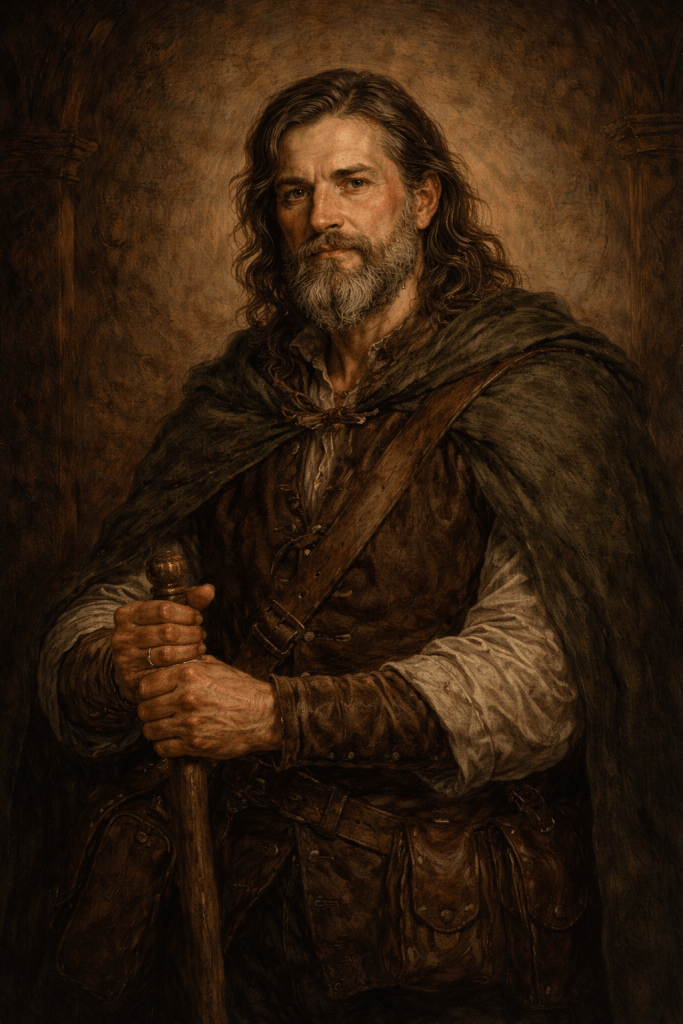
Eldric of the Roadmark
A Masondonian Account
Eldric was not born to the road. He was trained away from it.
He came from a Masondonian household where trade was treated as stewardship rather than conquest. His father kept accounts for small caravans and taught Eldric that a ledger was a form of witness; that numbers, when kept honestly, could prevent cruelty by limiting interpretation. Eldric learned early that clarity was not kindness, but it was the closest thing to fairness most dealings ever received.
By early adulthood, Eldric had become known for reliability rather than ambition. He brokered exchanges between Masondonia and neighboring realms with little fanfare, preferring repeat agreements to expansion. His contracts were conservative, his margins modest, and his reputation steady. When Beaverton entered his route, it did so loudly and with assurances of good faith supported by paperwork. Eldric believed them because the documents appeared to support it.
At first, the dealings were uneventful.
The contract that ended Eldric’s standing was unremarkable in form. Goods were delivered on time, inspected, and accepted. Signatures were given. Payment was delayed for reasons described as temporary. Then the terms were revisited, not renegotiated, but reinterpreted. Clauses long treated as settled were suddenly elastic. Eldric was informed that clarification was required before settlement could proceed.
Clarification never came.
Instead, Beaverton exercised discretionary authority retroactively. Goods were placed on administrative hold. Eldric’s inquiries were acknowledged, then stalled. No accusation was made, but no defense was offered either. Correspondence thinned. Familiar intermediaries stopped responding. Within months, Eldric discovered that his name no longer opened doors it had opened the year before.
He appealed once, formally, through the appropriate channel. The appeal was logged. It was not answered.
Eldric understood then what Beaverton excelled at: resolving matters without resolution. By refusing to conclude, the Kingdom avoided responsibility while achieving its outcome. There would be no tribunal, no judgment, no clear wrong, only loss distributed quietly enough to resist correction.
He sold what remained of the caravan inventory, paid his drivers personally, and dissolved his operation. He did not litigate further. He did not publish grievances. He left.
Since then, Eldric has traveled without formal trade papers. He keeps no ledgers bearing anyone else’s seal and carries no contracts that require interpretation by power. Instead, he relies on memory and presence. In Masondonia and along the Roadmark, he is sometimes asked to witness exchanges, not as an enforcer, but as a deterrent. His reputation discourages revision. No one wants to be remembered inaccurately by someone who does not forget.
Eldric speaks rarely at gatherings. When he does, it is not to persuade but to clarify. He does not argue with falsehoods; he allows them to exhaust themselves. Among Masondonians, his single statement often ends a debate, not because he is feared, but because he has already paid the cost of being precise.
The Final Refusal
The last letter Eldric sent to Beaverton was brief. It acknowledged receipt of their notice of continued review. It thanked the office for its time. It withdrew all remaining claims and granted full abandonment of expectation.
There was no accusation in it. There was no plea. It concluded only with this:
“I will not revise my memory to make this easier for you.” Beaverton never replied. Masondonia remembers.
 The Beaver King, Cautionary Tales of Medieval Dysfunction
Leave a comment