Beaverton: We Do What We Want
In Beaverton, banners are not decorative. They are not celebratory. They are warnings.
Where other realms stitch their hopes into cloth—lions for courage, wheat for prosperity, saints for mercy—Beaverton chose something colder, quieter, and far more honest.
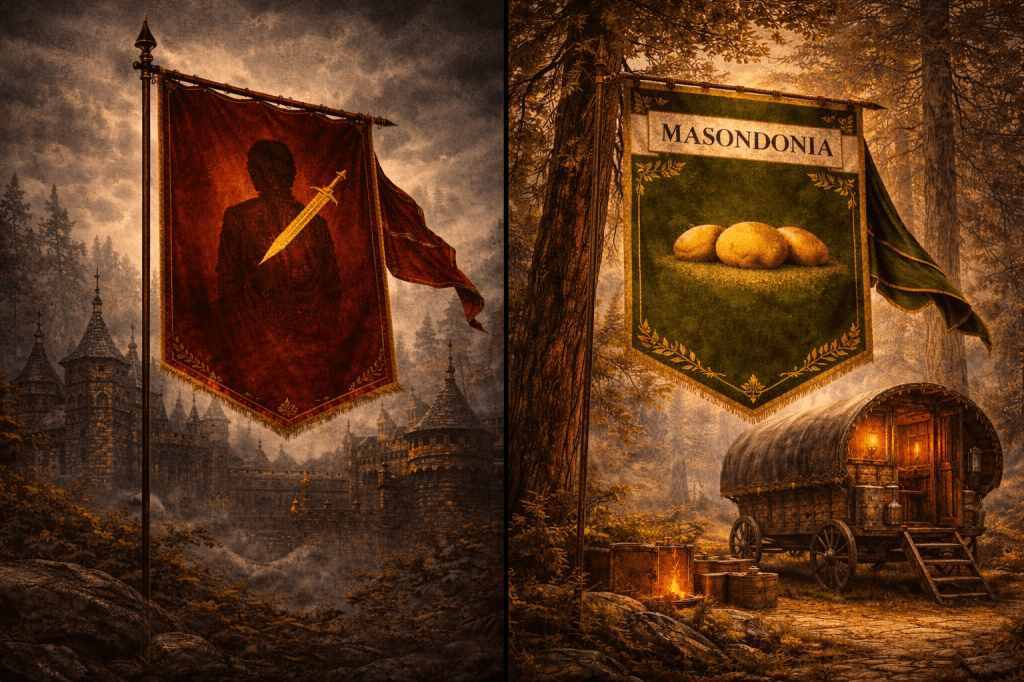
A man turned away. A blade held, not raised. This is the banner that flies above the Log Cabin Castle and it tells you everything before a single word is spoken.
The Field: Blood-Dark Red
The red is not for valor. Beaverton does not pretend to bravery. It is the color of ownership—of blood already spent and blood assumed owed. This red does not invite loyalty. It demands silence.
It says: What happens here stays here. And more importantly: What happens to you was necessary.
The Figure: The Turned Back
The man does not face the people. He never has. This is not humility. It is dismissal.
Beaverton’s power has always flowed one direction…away from accountability. The turned back signifies a ruler who does not explain, does not justify, and does not look behind him to see who has fallen.
Those beneath the banner learn quickly: If you are unseen, you are also unheard.
The Blade: Held, Not Raised
The dagger is not mid-strike. It is not dramatic. It is ready. This is the most important part of the sigil. Beaverton does not rage. It waits. The blade means punishment is not emotional—it is procedural.
It will come quietly. Often politely. Sometimes with a smile. And when it does, the banner ensures no one will claim surprise.
The Placement: Above the Gate
The banner does not fly at festivals. It flies above the entrance. You pass beneath it to enter Beaverton.
That is consent, according to Beaverton. Once inside, the banner becomes retrospective justification for everything done to you afterward.
The Words (Unwritten, Yet Known)
Beaverton does not stitch its motto onto cloth. It does not need to. Everyone knows the words.
We Do What We Want.
Not for the good of the realm. Not by divine right. Not for order.
Just want. This is the truest sigil Beaverton has ever flown.
Why the Banner Endures
Empires fall when their symbols lie. Beaverton endures because its banner never has. It does not promise safety. It does not promise fairness. It does not promise love. It promises only this:
If you suffer here, it was allowed. If you are broken here, it was permitted. If you survive here, it was accidental.
And so the banner still waves—
not because the people believe in it, but because they have learned it believes in them, exactly as little as it always has.
Masondonia, and the Discipline of Staying
Masondonia: We Are Steady . If Beaverton’s banner is a warning, Masondonia’s is a promise—quiet, unadorned, and kept.
It does not fly above gates. It hangs where people rest. You will not see it first. You will notice it after you have been fed.
The Field: Deep Green
Green is not optimism here. It is continuity. Masondonia does not believe things will get better because hope demands it. Masondonia believes things endure because someone stayed. This green is the color of roads walked twice. Of forests returned to.Of meals cooked again the next night.
It says: We are still here.
And nothing more needs to be added.
The Sigil: Three Loaves
Not crowns. Not blades. Not beasts.
Bread.
Three loaves—plain, round, imperfect. They are not abundance. They are enough.
One to share. One to save. One to give away when someone arrives empty-handed and does not ask. Masondonia does not punish hunger. It prepares for it.
The Banner’s Height
The banner does not loom. It does not dominate. It hangs low enough to be read without craning the neck.
Masondonia does not ask you to look up. It asks you to sit down.
The Caravan Below It
Masondonia does not build walls to keep people in or out. It builds wagons. Homes that move when needed. Doors that close only at night. Steps worn down by coming and going.
This is not instability. This is adaptation. Masondonia understands that survival sometimes requires wheels.
The Light
Where Beaverton burns torches to be seen, Masondonia lights lamps to be useful.
Warm light. Low light. Enough to read by. Enough to find the door.
No one is blinded. No one is tested.
The Words (Finally Spoken)
Masondonia does not hide its words. They are said plainly, often, and without threat:
We Are Steady.
Not fast. Not dominant. Not feared. Steady.
It means:
- We do not abandon what feeds us.
- We do not discard people when they become inconvenient.
- We do not confuse motion with progress or cruelty with strength.
Why Masondonia Endures
Masondonia will never conquer Beaverton. It does not want to. It outlasts instead.
Long after banners rot and castles burn, someone will still be kneading dough in the woods, still hanging green cloth between trees, still opening a wagon door at dusk.
And when someone asks, quietly, almost ashamed,
“May I stay?”
Masondonia will answer the only way it ever has:
Sit.
Eat.
We’re steady.
Beaverton’s banner promises certainty. Masondonia’s promises nothing at all. Strangely, only one must keep reminding the world it still matters.
 The Beaver King, Cautionary Tales of Medieval Dysfunction
Leave a comment