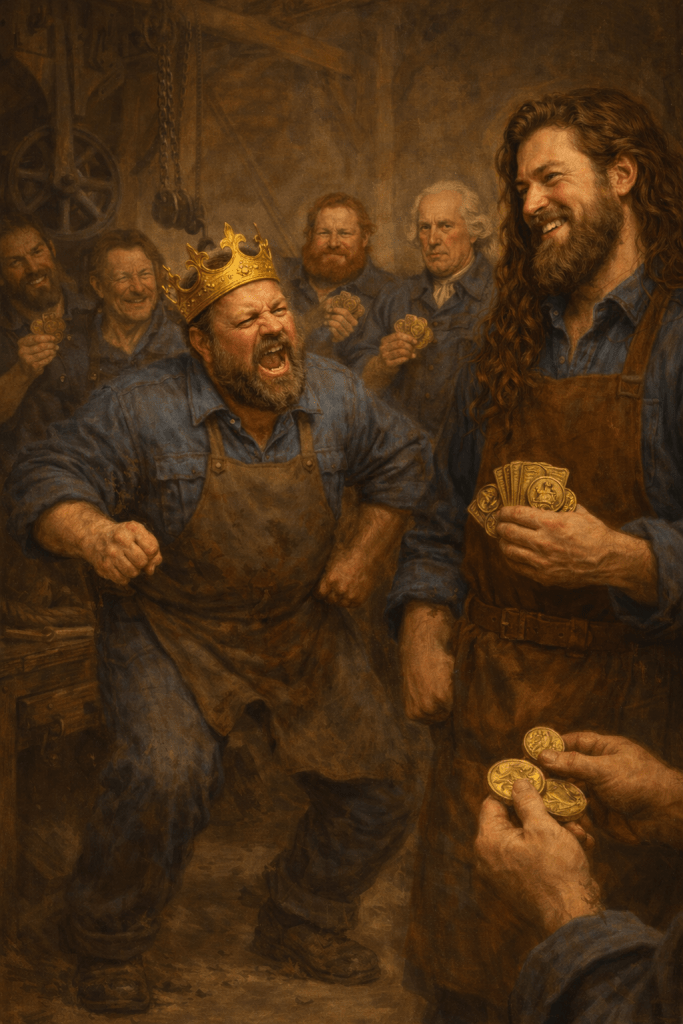
The Ledger of Borrowed Hands
Entry I: The Borrowed Business
When Baylor the Bound was nearing his thirteenth winter, King Robert entered what the ledgers of Solipsia formally record as the Writ of Empty Hands—the sanctioned term for royal financial collapse. Among laborers and tradesmen, it was known by names far less forgiving, though none were ever spoken aloud in court.
It bears stating—because it matters—that in most kingdoms of Solipsia, ownership does not excuse idleness. By long custom, those who claim dominion are still required to labor. This doctrine, known as Handbound Stewardship, holds that authority without contribution is not leadership, but theft dressed in ceremony. A crown may elevate a man; it does not free his hands.
At the time, The Beaver King was not self-employed. He never had been. He lacked the patience, the aptitude, and the discipline such work requires. Nevertheless, in the aftermath of his first Writ, a man—kind enough to be called a friend, though few ever willingly bore that title where Robert was concerned—sought to begin a trade.
The man’s name was Ithric Brouvain of Ithanoise.
Ithric was a kind man, soft-spoken and unfailingly polite, but sharp in the way only experienced tradesmen are. He listened more than he spoke, measured twice, and corrected without humiliation—believing, perhaps foolishly, that patience could be taught. He was bald, his scalp bare and weathered, marked by years of forge-heat and open sky rather than any concern for appearance. Those who mistook his gentleness for weakness learned otherwise the moment standards did not bend.
Ithric intended to establish a traveling trade devoted to the repair and maintenance of heavy draft mechanisms: quarry hoists, timber winches, load frames, chain rigs, and axle assemblies—the iron and wood that allowed kingdoms to build without collapse. It was dirty work. Exacting work. The sort of labor where tantrums cost money and unfinished jobs injure people. He involved King Robert for one reason only: The Blow-Hard had contacts.
When the work began, His Grace, told a different story. He bragged—loudly—that he was starting a business. That he was the owner and he was finally independent.
Me.
Me.
Me.
Me.
Me.
When the work demanded consistency, Our Noble King failed. When corrected, he erupted. He stormed. He sulked. He threatened to quit and abandon jobs mid-repair, and at times he followed through—leaving rigs unfinished, schedules ruined, and others to clean up his mess. These were not decorative inconveniences. Abandoned mechanisms break bones.
Ithric trained him. Motivated him. Redirected him. Extended patience far beyond reason. None of it mattered.
The partnership—if such generosity of language may be allowed—did not survive two years. Frankly, it survived longer than it deserved to. It ended not with drama, but with exhaustion. Ithric had simply had enough.
What followed was quieter, and far uglier.
Robert spread gossip about the trade. Undermined its reputation. Poisoned goodwill he had never earned. When his pride finally collapsed inward, he refused to work at all. With four young sons in the household, Queen Brystal took two jobs to keep Beaverton standing. He did not care. He felt this sabbatical was owed to him. The Dowager Queen all but enabled this in him.
Years later, in the armory of , King Robert could still be heard flapping.
He would boast—unprompted—that he had once owned a company and sold it for two and a half million Virecrowns, after which he traveled across Solipsia for a full year. Sometimes longer. Sometimes richer. Sometimes farther. The numbers never stayed the same. A fortune grew where none had ever existed.
As if Baylor the Brave would not remember being filthy rich. As if three young children had not remained home, in schooling, untouched by this supposed abundance. As if reality itself could be bullied into agreement.
No one believed him. Not one man in the armory.
In fact, The Beaver King’s stories became a game.
When his voice grew too confident, someone would lean toward Baylor and murmur, “Wind-Tongue’s at it again.” That was his name among working men: Wind-Tongue Robert—a man whose words moved constantly, changed shape freely, and never carried weight.
Quiet wagers were placed. How much this time? How long was the journey? How far had the wind carried him now?
The numbers inflated. The travel stretched. The lie evolved in real time, and the men tracked its mutations the way gamblers track weather—never surprised, only mildly entertained. They laughed—not openly, never to his face, but with the easy familiarity of men who knew exactly what he was.
Wind-Tongue Robert mistook silence for awe.
It was during a brief, romantic retreat that Baylor and This Minstrelle chose to end the guessing.
They traveled together to Vireholt, where the Hall of Unending Account stands beside the Grand Scroll of Vireholt—stone answering stone, record answering steel. In Solipsia, truth is kept under guard not by soldiers, but by craftsmen and armorers who understand weight, proof, and consequence. Records here stretch back to The First Binding, when Solipsia first committed truth to ink and declared memory insufficient. They did not need to search long.
King Robert appears on no business charter, on no ownership filing. On no sale record, on no travel registry tied to liquidation or profit. He was never an owner. Never a seller. Never a principal. At most, he appears briefly as labor—unskilled, replaceable, and legally irrelevant.
The records further show that once Robert’s influence was excised, the Brouvain trade did not collapse. It flourished. Contracts stabilized. Reputation recovered. Ithric prospered—quietly, legitimately, and without mythology.
The ledgers also confirm a second, unflattering truth:
King Robert has entered the Writ of Empty Hands twice. And corrupted his kingdom once.
Upon their return, Baylor shared the findings freely at the armory. The game ended—not with laughter, but with satisfaction. There was nothing left to speculate about. The truth had been weighed, measured, and verified.
This entry stands as the first in a continuing ledger of King Robert’s vocational and financial failures.
The ledger remains open.
 The Beaver King, Cautionary Tales of Medieval Dysfunction
Leave a comment