Masondonia was never meant to be found quickly.
It lay beyond the furthest eastern reach of Solipsia, past Vireholt, past Still Reach—where certainty thinned and water gathered itself into breadth. From the brackish delta, the land opened into a vast inland freshwater lake, and from that water rose a country of rounded mountains and endless forest. Peaks never climbed high, never sharpened themselves against the sky. They rolled and folded instead, layered in blue upon blue, as though the land had long ago learned that endurance required no display.
Nothing in Masondonia strained upward. Everything settled into place.
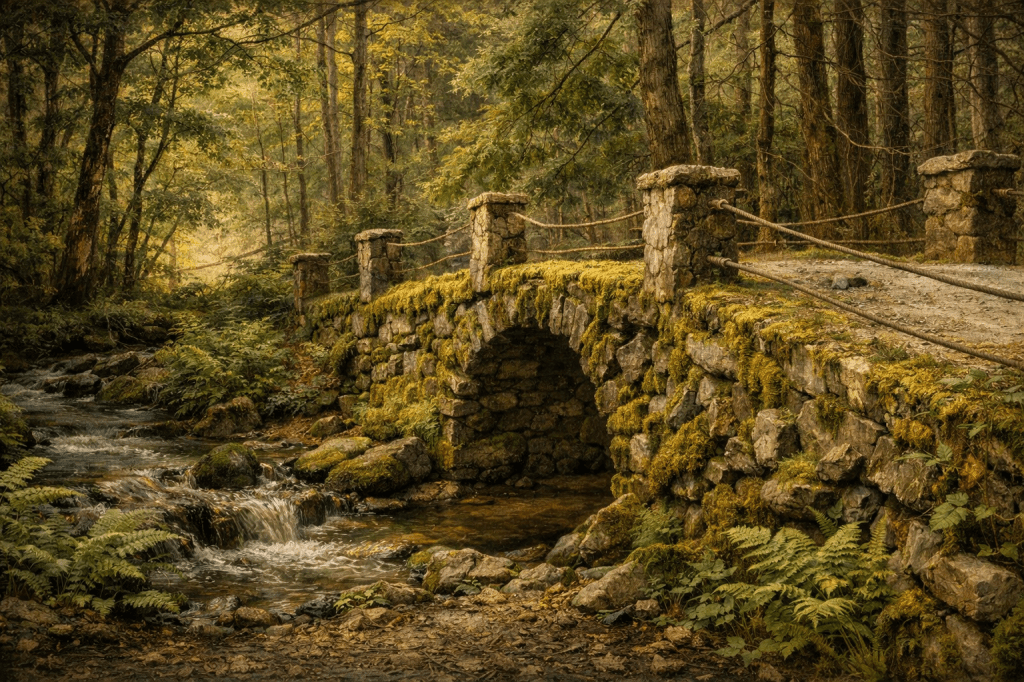
The mountains were dense with trees—oak, pine, and hemlock interlaced so tightly that sunlight arrived in ribbons rather than beams. The forest floor breathed. Mushroom-rich and dark, it carried the deep, living scent of earth doing what it had always done. Leaves fell, softened, and became soil without ceremony. Roots claimed ground patiently. Life recycled itself quietly.
Creeks slipped down the slopes with practiced ease, threading through the woods and cooling the air around them. Their banks were lined with stones worn perfectly round, positioned so naturally they felt intentional. Water moved over them without urgency, and from those shaded channels came a cool breeze that traveled outward—down hollers, across clearings—finding skin even on the warmest days.
Time behaved differently here. Not slower—thicker.
Mornings lingered. Fog gathered in the valleys and lifted only when it was ready, revealing layers of mountain beyond mountain. Sound softened. Even voices lowered themselves instinctively, as if the land preferred not to be interrupted.
Open balds appeared where the forest chose to step back—broad, grassy clearings along ridges and slopes where farmers stayed. From those heights, weather could be read hours before it arrived. Homes were spaced by understanding rather than boundary, close enough to share labor, far enough to keep peace. Smoke rose steady and familiar. Animals moved without panic.
Caravans kept to the woods. They traveled together, never singly, wagons angled inward at night, fires drawn close. Camps formed circles without instruction. Seclusion in Masondonia was not isolation—it was belonging without spectacle. Even in winter, warmth was communal. Snow muted the world, trunks broke the wind, and the forest held heat in ways that defied explanation. No one watched the dark alone.
Beneath it all were the caves. Hidden entrances opened into vast chambers beneath the hills, their walls shaped slowly by water into pillars, curtains, and ribs of stone. The history held there ran deeper than record. Even the Grand Scroll of Vireholt could not reach far enough back to name what first lingered in those depths.
Sound behaved strangely inside them. It bent. It returned altered. Echoes did not repeat so much as settle. Masondonians learned early that these were not places to fill with voice. They were places to pass through carefully—if at all.
The water that gathered the land before releasing it onward was known as the Lake of Breth, a name older than settlement and older than explanation. At dawn, fog lay thick across its surface, turning distance into instinct and direction into something felt rather than seen.
It was across Breth that Billem Masonreach and Dianevar Masonreach came.
They did not arrive as conquerors. Their vessel kept close to the shoreline, stopping often, waiting when wind or water shifted. They learned the lake before trusting it. They learned the birds before stepping beyond the reeds. On the eastern shore, where forest met rising ground and the balds opened like a held breath, they stopped. Not because the land was finished—but because it did not resist.
Sod homes were shaped low into the earth, roofs thick and forgiving. Nothing rose higher than it needed to. Nothing declared itself separate. Billem listened for what did not object. Dianevar waited for what did not withdraw.
Others followed in time—families, caravans, kin drawn by water and quiet—but the manner had already been set. No clearing without reason. No cutting without replacement. No sound raised where stillness had already spoken.
Masondonia did not begin with declaration. It began with a crossing, pause, and the understanding that some lands do not ask to be heard. They ask to exist in unity.
To be moved through rather than acted upon. To have their rhythms matched, not measured. To be lived with. And because Masondonia was never treated as something separate, it endured—whole, patient, and unbroken— without ever needing a voice at all
 The Beaver King, Cautionary Tales of Medieval Dysfunction
Leave a comment