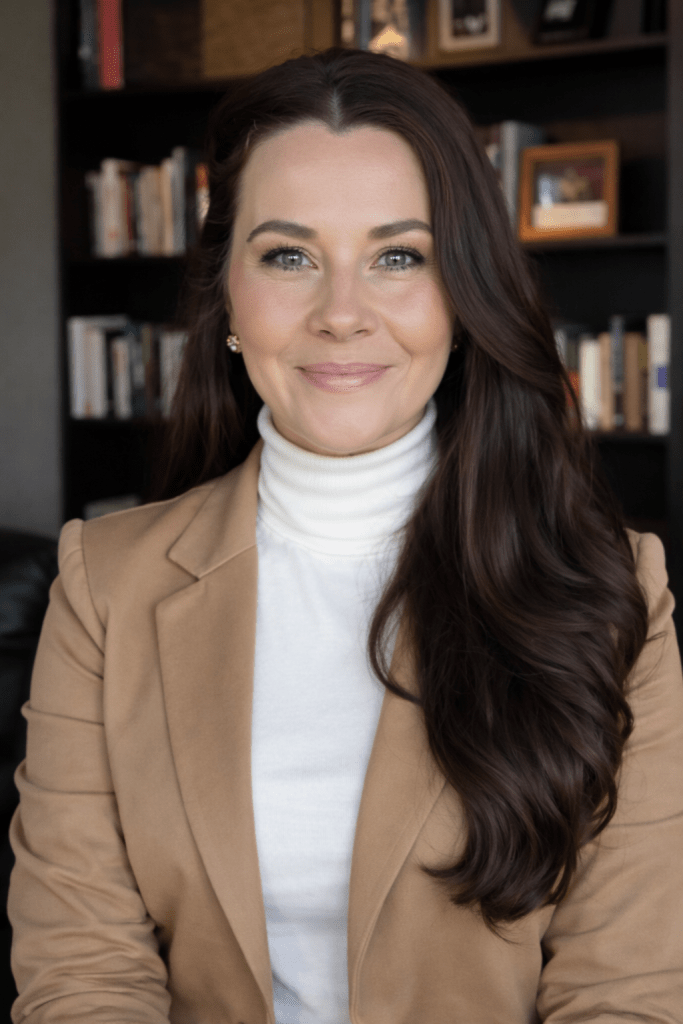
Angel Kirkhoff comes from a small farming family in Indiana. Her family owned the local tire shop and farmed the land, which meant childhood unfolded between machinery and open fields, repairs and seasons. She grew up working with horses, learning early what cannot be taught gently: patience is earned, trust is built slowly, and no amount of charm replaces consistency. Animals, land, and labor do not respond to performance—and neither, she learned, do honest people.
That rural foundation shaped her long before she ever left it. She later attended Florida State University, carrying Midwestern farm sense into academic halls. The contrast sharpened rather than softened her instincts. She learned how easily words drift away from action, how systems narrate themselves, and how confidence is often mistaken for character.
For over a decade, Angel worked in the wedding industry as an officiant and professional speaker. She stood at the center of ceremonies designed to present love at its most ideal, bearing witness to joy, devotion, contradiction, and fracture—sometimes all in the same afternoon. It was an education in ritual and performance, in what people say publicly versus what they live privately.
During those years—and continuing afterward—she was a frequent guest on many local and national podcasts, invited to speak on marriage, ritual, culture, autonomy, and the quiet realities beneath public-facing lives. The conversations were candid, often unpolished, and shaped her growing preference for depth over reach.
In 2020, after COVID, she hung up her microphone.
The decision was quiet and final. The pause revealed what years of constant speaking had obscured: she no longer wished to be the voice in the room. She preferred listening. Observing. Returning to silence and deciding carefully what was worth saying at all.
Her work and voice have appeared in local and national news, and she was featured on My Big Fat American Gypsy Wedding (TLC)—an experience that confirmed a belief she already held: spectacle distorts truth, and attention is not intimacy. She has also been published as a model for Eclat Magazine and appeared in several national advertising campaigns—experiences that further clarified the distance between image and reality.
Today, Angel lives a deliberately smaller life. She travels full time in a 43-foot fifth wheel with her husband and their animals: two Great Danes, Wallis Mae and Waylon June; a red Doberman named Carol Eugene; and three cats—Mao, Baby Mittens, and Aegon the Conqueror—each convinced they are in charge. This life is not an escape. It is a choice.
She is a professional pyrographer, burning images into wood with patience and permanence. She paints when words are unnecessary. She photographs instinctively, drawn to weathered surfaces, honest light, and moments that occur when no one is performing. She is deeply devoted to gastronomy—cooking not as display, but as care. Feeding people well, slowly, and without spectacle remains one of the few rituals she trusts.
Nature is not a backdrop for her work—it is where she returns to herself. She prefers forests to rooms, animals to crowds, and long stretches of silence to most conversations. This is not withdrawal. It is discernment. She has seen enough to know that noise is rarely meaning.
Beaverton grew out of this life. It is not fantasy meant for escape, but allegory meant for recognition. Its kings, banners, betrayals, and quiet violences are shaped by what Angel has watched unfold—in families, institutions, and spaces that insist on reverence while avoiding accountability.
The Minstrelle exists because memory is fragile, and power relies on forgetfulness.
Angel does not write to be liked.
She writes to be accurate.
And to leave a record for those who know the difference.
 The Beaver King, Cautionary Tales of Medieval Dysfunction
Leave a comment