It was before the Turning. Before she became Lady Jessalyn. In those days, she was still Jessalyn Slumbthumb—unprotected by title, unarmored by ceremony, and therefore visible in a way Beaverton found intolerable.
The Beaver King decided she was a problem not because she was defiant, but because she was effective. She was taking something he considered his by right: Little Lord Bucker’s time.
Time in that household was not shared. It was rationed. Allocated. Claimed by hierarchy. And Jessalyn—unhoused, unrooted, and unimpressed—was consuming too much of it. They were living on borrowed hearths then.
That liminal period Beaverton prefers to forget. Passing from home to home, sleeping where space had not yet been denied, dependent on the quiet tolerance of people who mistook proximity to power for safety.
It was there, among borrowed blankets and half-warmed rooms, that Jessalyn did the unforgivable. She named the family for what it was. She spoke plainly about cruelty disguised as tradition. About love that arrived with conditions already attached. About labor demanded but never acknowledged. About leaving—not as betrayal, but as survival.
The Beaver King noticed the change in Little Lord Bucker immediately. Not intelligence—there was none to awaken—but direction. The dangerous kind. The outward kind.
He also knew something else. Bucker was stupid. Not slow—obedient. The sort of man who followed whoever spoke last and loudest. The King had cultivated that stupidity carefully. Jessalyn, without intending to, was undoing it.Being mean did not work. That tactic had driven Whinyth back to Solmere efficiently—shame, exile, silence. But Jessalyn did not retreat. She stayed. She laughed. She kept talking.
That was when the thought occurred to him. Not as a crime. As a solution.
If she would not leave on her own, she could be made to disappear. And if she disappeared properly—quietly, collaboratively, with witnesses who would later swear nothing was amiss—then Beaverton would remain intact. The audacity was not that he considered it. The audacity was that he assumed he would get away with it.
The Woods That Would Not Grow
They walked into what Beaverton called the woods. It was barely that. Patchy. Sickly. Trees thinned by neglect and misuse, the ground hard and unreceptive. Nothing grew correctly there. Nothing ever had. Even the birds avoided it, as if the land itself had learned something and chosen silence.
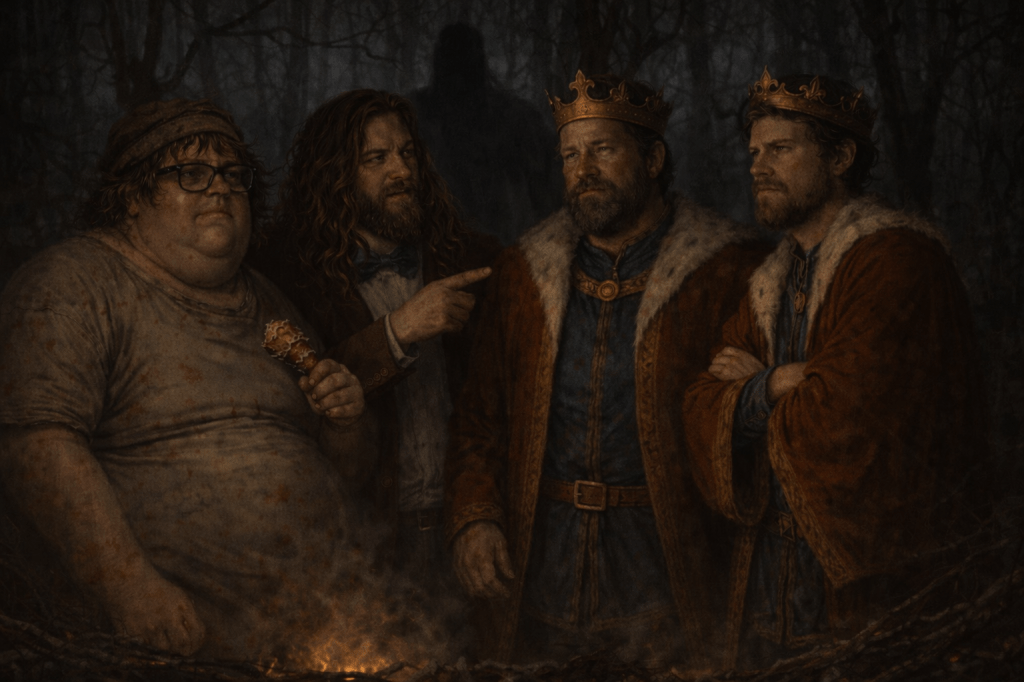
A small fire had been lit—not for warmth, but to give the gathering shape. To make it feel deliberate. Jorek Drowell did not stand near it. He lingered several paces back, where the light thinned and the smoke failed to reach him. He had never liked fire. Something about its unpredictability unsettled him. It moved too fast. Asked too much attention. He preferred shadow—places where nothing demanded response.
He was still there. Just not close.
Zeb Warthog stood nearest the warmth, clutching a half-eaten drumstick, thick black-rimmed glasses reflecting the firelight in dull flashes. His body folded forward in soft abundance, belly heavy, wrists and elbows ringed with pale lines where flesh pressed into itself. Grease darkened the dirt beneath his boots.
Baylor the Bound stood stiffly beside him, already uneasy with how permanent the gathering felt. Brentin leaned in slightly, listening, amused in the quiet way he always was when something ugly was being dressed up as necessary. The Beaver King stood at the center of it, firelight catching the fur of his cloak and the dull gold of his crown. Men. Woods. Flame. It felt impressive to him.
He told them to stop being mean to Jessalyn.
The word landed wrong. Mean suggested excess. Emotion. Lack of discipline. It implied that something else—something final—had already been decided. Then he said it.
They were going to kill her.
Not he might. Not something might happen. Not she was unstable, or dangerous, or asking for it.
They were going to kill her.
He explained why, patiently. She was filling Little Lord Bucker’s head with ideas. She was encouraging departure. She was calling the family what it was.
That could not be allowed.
The fire crackled. No one stepped away. Jorek shifted his weight in the dark and nodded once—not out of cruelty, but readiness. Violence did not trouble him. Fire did.
Zeb stared at the ground, already rehearsing confusion he would one day need.
Brentin said nothing.
Baylor felt his stomach tighten.
But he did not refuse.
The Shape of the Plan
Later, it would be said they came up with it together. That lie mattered. In truth, the plan already existed. What followed was distribution—placing responsibility so it could never be gathered again.
Baylor The Bound was chosen first. He had a house. Privacy. The appearance of stability that made violence easier to disguise as misfortune. A ruse would bring her there alone—conversation, reconciliation, help. The details were left vague. Baylor would find a way. He always did. Once there, it would be finished.
Afterward, the body would not remain. A cart—detached from its horse—would be used. Weight and momentum were understood without instruction. The destination would not be Beaverton. It would be near her parents’ home in Terra Firma. A pond. A cliff. An accident.
Zeb nodded along, absorbing just enough to be dangerous and not enough to be accountable. Jorek waited for instruction and received only implication. The King ended the discussion by walking away.
No oath was sworn. No order written. None was needed.
How the Plan Failed
The plan did not fail because it was discovered. It failed because the Beaver King could not stop himself. He treated it as inevitable and began using it as leverage. He spoke around it. Pressed old grievances. Inflamed conflicts that had nothing to do with Jessalyn at all.
The feud spread. What was meant to be quiet became loud. What was meant to disappear became watched. Terra Firma responded where it was meant to absorb.
A war followed—not formal, not clean. A war of positioning, threats, attention. The kind that makes secrecy impossible. The King could not stop manipulating long enough to carry out his own murder plot.
And the world went on.
The feud burned itself out the way Beaverton feuds always do—not by resolution, but by boredom. Attention shifted. Nothing was corrected. It left no lasting mark.
Except on Baylor the Bound.
What It Left Behind
After the Turning, Baylor could not understand how completely he had gone along with it. Not partially. Not reluctantly. Completely.
He realized he had been brainwashed—not violently, not overtly, but thoroughly. He had rearranged his conscience without being asked. He had prepared himself to do something irreversible because obedience had been framed as necessity.
And the longer he sat with it, the clearer something else became. This Minstrelle does not believe it was ever meant to be real. The plan had been too loud. Too sloppy. Too theatrical.
It had not been a murder plot so much as a performance.
The Beaver King had needed an audience.
Baylor and the others had been young enough—stupid enough—to mistake confidence for authority and cruelty for strength. They had believed him awesome. Fearsome. Capable of anything. And the King had fed on that belief.
That was why he still surrounded himself with Baylor’s old friends. They remembered him at his loudest. At his most impressive. Their presence still satisfied his ego.
The King moved on the moment the attention shifted.
Leaving Baylor alone with the knowledge that he had been shaped into a man who would have done it—not because it was right, not because it was necessary, but because someone he trusted had wanted to look powerful. And that is what still troubles him.
Not whether it would have happened. But that it was spoken aloud. That it was planned.
That it was believed. Whether it was real or not no longer matters. It was discussed. And that was enough.
 The Beaver King, Cautionary Tales of Medieval Dysfunction
Leave a comment