Perhaps it is necessary, before speaking of Auntie Carrow, to speak briefly of this Minstrelle’s own troubles within the kingdom — for Carrow is not an isolated rot, but part of a larger spoil. Every family has its bad seed. The MasonReach line is no exception.
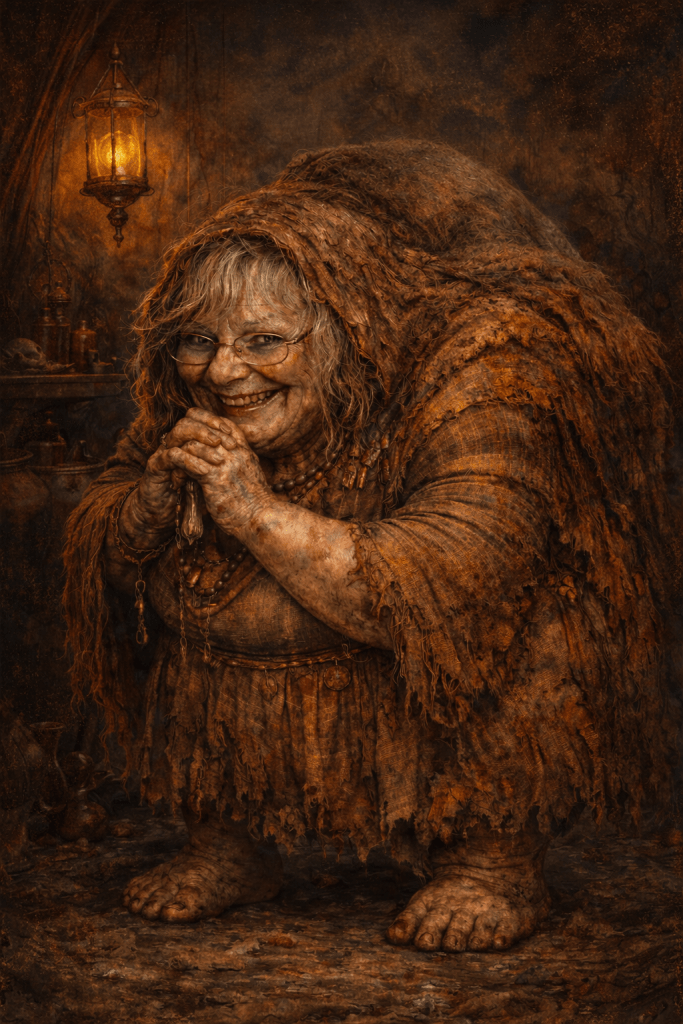
Auntie Carrow was the full elder sister of Billem MasonReach, daughter of Permilla and Billem MasonReach – First of His Name, born the eldest and wrong from the beginning. She was a hateful, sneaky little girl. Not misunderstood. Not overlooked. Simply nasty. She learned early how to sour a room, how to spoil affection by standing just close enough to it.
She especially despised her younger brother.
Billem was quieter, steadier, and carried a patience Carrow lacked. This alone was enough to earn her hatred. She undermined him constantly — small humiliations, petty cruelties, lies whispered where adults would not look too closely. Even as children, it was apparent she did not merely resent him; she wanted him diminished.
There is an older belief in Solipsia, one that predates physickers, diagnoses, and mercy. The Ancients held that some souls are so misaligned that correction must occur outwardly, where it can be seen. Not as cruelty. Not as vengeance. But as balance. What rots inward must eventually announce itself.
Auntie Carrow’s deformity was not an accident, nor an illness in the way she would later claim. It was a reckoning. As she grew, her body began to answer her mind. Her spine curved forward, her shoulders collapsed inward, her stature shortened as though the world itself were pressing her down. Warts bloomed along her skin like punctuation marks, her features thickened and distorted, her gait became uneven and troll-like. The more harm she inflicted, the more pronounced the change became.
Each lie deepened the hunch. Each obsession thickened the flesh. Each act of cruelty etched itself into bone.
Those who still remembered the old ways understood. The Ancients of Solipsia were thorough — but not infinite. There came a point at which no further correction was possible. Her form reached its limit. Whatever ugliness remained was no longer physical. Carrow assumed it was a genetic disease. She told that story often, using it as shield and excuse. The town allowed the fiction. It was easier than acknowledging what she represented. The universe, however, had already finished its work.
In time, physickers named her condition Split-Witted — a formal term meant to describe a mind divided against itself, prone to manic surges, elaborate invention, fixation, and collapse. The word appeared carefully in ledgers and was spoken behind closed doors. No one else used it.
Among the people of Solmere and even within her own blood, she was known by simpler names. Mind-Rotted. Head-Broke.
From girlhood, Carrow’s behavior was erratic and uncontained. She swung between frenzied energy and resentful stillness. She lied pathologically, often without motive, constructing performances she believed as fiercely as truth itself — a sickness disturbingly familiar to those who would later recognize the same affliction in the Beaver King. She was hypersexual, impulsive, and vindictive. Most corrosive of all, she developed a festering hatred for her perfect and dutiful mother, Permilla, as though affection withheld were a lifelong insult requiring punishment.
But obsession was her true craft. Auntie Carrow did not dislike broadly. She fixated narrowly. She selected her targets and worried them down with patience and repetition.
When she came of age, she abandoned the MasonReach ancestral island of BerthRock without hesitation and traveled to Solmere, eager to start a life far from family and expectation. She was never pretty. She was always short, stubby, and fat, with a body permanently braced against the world, as if expecting it to shove back.
She married young. She married often. She married middle-aged. She married the same man twice. She married for money. She married for sex.
None of the marriages endured. In the course of them, two children were produced — both as short and thick as she was, neither especially blessed in appearance or temperament. The boy, Beansean, as annoying as a person could be (also potentially the dumbest name in the realm) later retired from service with the Concordant Standard. Of the girl, little was known beyond her name — Lessbiella — and that Carrow’s relationship with her daughter shifted erratically between closeness and estrangement.
Within the MasonReach family, three people bore the brunt of Carrow’s fixation. One was Billem, whom she had hated since childhood with a persistence that outlived every excuse for it. Another was her youngest sister, Valinda — gentle, trusting, and disastrously hopeful.
Valinda was married to Floydus OrangeHarrow of BerthRock, a curious man who had first served the Realm as an Undertaker, then with the Concordant Standard until a grievous injury ended his career. From the waist down, Floydus never recovered the use of his body. He was thereafter borne in a hand-wrought rollchair, heavy with iron and wood, its movement slow and demanding.
Valinda became his caretaker. She accepted the role without bitterness, tending Floydus with devotion and endurance. But she was young still, and she longed for something beyond duty — a sister’s presence, a shared life not wholly defined by wiping blood and filth from the man she loved.
That longing is what Auntie Carrow exploited.
Carrow persuaded Valinda and Floydus to leave BerthRock and migrate to Solmere under the promise of reconciliation. She spoke of renewed sisterhood, of shared burdens, of being family again. She promised closeness. She promised help. Valinda believed her.
Once they were settled in Solmere, the pretense collapsed almost immediately. Carrow severed the bond not to escape her sister, but to gain permission to torment her. Estrangement became a weapon — a means to intrude without invitation, to provoke without accountability, to remain ever-present while claiming injury.
What followed was not conflict. It was a campaign.
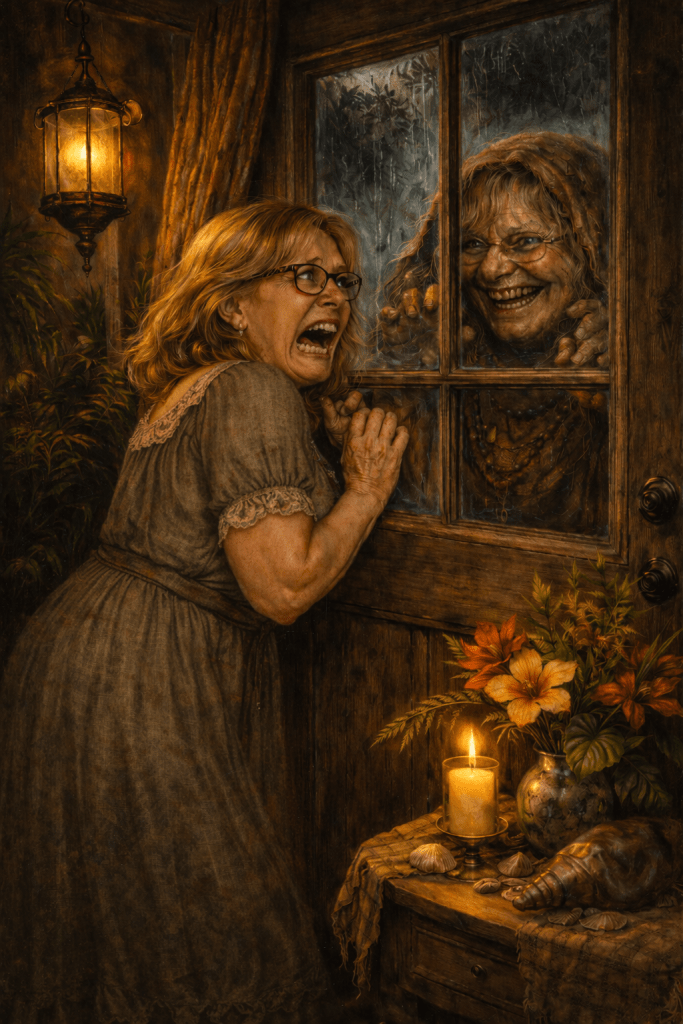
Carrow harassed Valinda by day and by night. She appeared without notice, lingered where she was not welcome, and watched from places that could not easily be confronted. She called Valinda names in public and worse ones in private, accusing her of neglect, cruelty, and perversion. She reshaped Valinda’s reputation in Solmere with patience, suggesting impropriety and incompetence in tones of concern. At night, she circled the house, knocked softly, called Valinda’s name from the dark, and left notes meant to be found first thing in the morning.
Sleep became brief. Rest became impossible.
Bound to his rollchair, Floydus endured the humiliation of listening while his wife was stalked through her own life. Carrow mocked his helplessness openly, positioning herself where he could see her but not reach her, speaking to him as though Valinda were already failing.
Eventually, the harassment became so sustained and so documented that Valinda was forced to travel to Vireholt to petition the Concordant Standard for protection. Such orders are not granted lightly. They require pattern, fixation, and proof. Valinda had all three.
An official order of protection was issued against Auntie Carrow. Later, it was made permanent — a lifetime protection ban, acknowledging that the harm was not temporary and would not resolve with time.
During the period in which the writ was active, Floydus OrangeHarrow was dispatched to the Quiet Reach, the distant stillness beyond life where Solipsia’s dead are said to rest without grievance. His passing left Valinda alone — but protected. Without the order, Carrow would have inserted herself into the grief. Instead, the barrier held.
In her later years, Valinda met Rickard Tailorian of Old Veridan, himself a veteran of the Concordant Standard. He was steady, perceptive, and kind. The village approved of him immediately — not only because he loved Valinda, but because he protected her. With Rickard, she was afforded peace. A second chance.
By then, Solmere understood Auntie Carrow fully.
She was avoided openly. Doors closed at her approach. Children were pulled indoors. Her behavior deteriorated without restraint. She screamed accusations of vandalism and theft at passersby. She exposed herself publicly, flashing teenage boys and older women alike, daring the town to react. Whatever sanity she once possessed eroded visibly, chipped away by isolation and obsession.
Solmere did not intervene. Solmere withdrew. What was not understood at the time — only becoming clear much later — was that Auntie Carrow had never confined her obsession to a single target.
For years, she had been fixated on Valinda and this Minstrelle simultaneously, running both lines of attention in parallel. While one bore the open weight of her cruelty, the other was watched, measured, and quietly rehearsed against.
During this same period, she declared her remaining siblings dead to her — most especially Billem MasonReach, erased with a finality usually reserved for burial. In her fractured logic, this freed her.
When the Concordant Standard legally barred her from harassing Valinda — when the order of protection closed that door permanently — all that spare time, all that energy, all that unresolved fixation had to go somewhere.
And it did.
 The Beaver King, Cautionary Tales of Medieval Dysfunction
Leave a comment