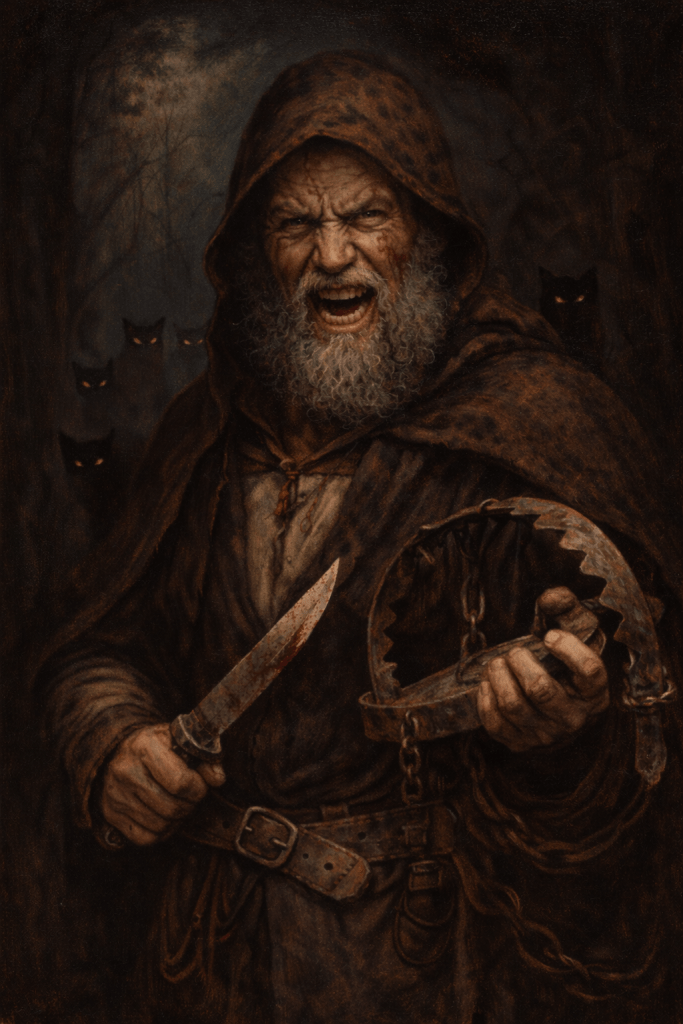
Montrec TaylorBlack, Trapper and Lord of the Stillwood.
What a bastard.
He is the uncle and idol of King Robert, and if Beaverton has ever wondered where its particular strain of narcissism and sociopathy comes from, the answer does not sit on the throne. It waits in the trees. The rot did not rise. It flowed downhill.
The only uncontested virtue of Montrec’s life was his loyal service in the Concordant Force. He served without flourish, without complaint, and without warmth. When that chapter closed, what followed was not a life so much as a consolidation—of land, of knowledge, of leverage.
Montrec was a mechanic his entire life, but in the medieval sense: a millwright, a builder of wagons and presses, a mender of winches, gates, forge rigs, and trap assemblies. He understood wood grain and iron fatigue, balance and counterweight, how tension behaved under strain, and how long a structure could be pushed before it betrayed the hand that relied on it. He knew which peg could be loosened without immediate collapse, which beam would hold just long enough, and which device would fail only after repeated use.
This was not merely a trade. It was a worldview. Montrec understood systems. And people, to him, were systems—subject to pressure, neglect, and design.
Before he was ever called Lord of the Stillwood, Montrec was a trap maker. He understood snares the way most men understand doors. Which branch would bend without breaking. Which cord would hold tension without snapping. How long an animal would struggle before exhaustion finished the work. A good trap did not announce itself. A great trap convinced its victim it was still free.
That understanding followed him everywhere—into his work, into his isolation, and most importantly, into his relationship with King Robert.
Montrec was born the baby of fifteen children. He had no full-blooded siblings—only half ties and fractured loyalties. He is half-brother to the Dowager Queen, a relationship that explains far more than it excuses. Despite this half blood, Montrec carried himself with absolute entitlement, as though inheritance were destiny rather than accident. He believed what little blood he shared mattered more than the whole others carried.
He was selfish to the bone. Not impulsively—methodically. Every decision he made served preservation: of land, of advantage, of control. Obligation was something others owed him, never the reverse. Blood, to Montrec, meant access, not responsibility.
He built a successful business in Solipsia and retired early—comfortably, deliberately, and without nostalgia. He never had children, thank God. Not from lack of opportunity, but from lack of desire. Children require investment without guaranteed return. Montrec never trafficked in that.
He has been separated from his wife for decades. Not divorced—separated. The distinction mattered deeply to him, because divorce would require relinquishing land, holdings, and keeps. Marriage, to Montrec, was not partnership. It was acquisition. And acquisitions were not surrendered.
No one knows how she came into his life. No records remain. No family claims her. And no one remembers a farewell. What is known is this: it has been thirty years since anyone in Beaverton has seen or heard from her. Some whisper that the spirits of Stillwood took her. The old ones beneath the roots, indifferent to crown and law, that remember debts men forget. Stillwood listens. And sometimes, it answers.
Others believe something far darker.
That Montrec—who understood traps better than most men understand mercy—laid one no rope could be seen in. That a path was suggested. A shelter offered. A choice framed as freedom. After all, the most effective traps convince the victim they are leaving of their own will.
No proof has ever surfaced. No bones. No confession. No witnesses brave enough to persist. Only the land remained uncontested, and Montrec himself—untouched by grief, untroubled by absence.
There is something else in the Stillwood. It is older than Montrec, older than Beaverton, older than any ledger that dares name the land. Some call it a spirit. Others refuse to name it at all. Paths shift beneath it. Sound dies quickly. Animals refuse to linger. Fires burn low, even when well fed. The forest does not threaten—it waits.
Rumor holds that this is where Lord Montrec buries the bodies.
Whose bodies, no one can say with certainty. Travelers who wandered too far. Men who asked the wrong questions. Perhaps a woman whose name has not been spoken in thirty years. Perhaps no one at all. In Stillwood, absence is proof enough. Montrec has never been accused aloud. No one digs in Stillwood unless Montrec tells them where.
Some believe the forest is violent because of him. That blood teaches land how to remember. Others believe Montrec learned his violence from the forest—shaped by something that noticed him early and found him useful. The truth may be that neither came first.
Montrec understands the woods the way he understands traps. He knows where the ground gives. Where roots conceal disturbance. Where decay hides what was once whole. He knows how to offer something without leaving evidence of the offering. And the forest, in turn, protects him. Paths confuse strangers. Sounds mislead. The earth closes quickly.
They feed into each other. Montrec brings Stillwood what it wants—silence, blood, secrecy. Stillwood gives Montrec what he requires—cover, fear, and erasure.
He kept to himself. He did not attend gatherings. He did not celebrate victories. He did not stand among the people of Beaverton unless obligation cornered him. Stillwood suited him: remote, quiet, and close enough to watch without being seen.
Despite killing animals regularly to satiate his vile tendencies—trapping, skinning, breaking bodies with practiced detachment—Montrec loved cats. Seventeen of them, at one point, crowded his small cabin in Stillwood. They asked nothing. They left when they wished. They returned when it pleased them.
They were the only living things that ever did. This suited him.
His days followed a rigid loop. He woke after everyone else. Ate. Had his first drink. Drank until nearly morning again. Ate. Slept. Repeated. It was not decay. It was discipline without purpose.
He enjoyed prospecting gold and was good at it. The income was modest but honest—perhaps the only thing about him that was.
Once, he left Beaverton entirely. He traveled south, nearly to Solmere, and took up with a coarse woman from Mudreach Hollow, a lowland settlement known for poor judgment and worse company. When that arrangement dried up, he returned north without comment, unchanged and unembarrassed.
Later, Montrec reached farther still—across the seas to Thailuun, a distant land barely stitched to Solipsia by rumor, traders, and months-long correspondence. It was not curiosity that drove him there, nor loneliness in any honest sense. It was panic. Age had begun to make itself known in ways Montrec could not trap, bargain with, or dismantle. Strength waned. Endurance shortened. The body, once obedient, now required negotiation. He felt the narrowing window and resented it deeply. There remained one last appetite he feared losing entirely, and he intended to satisfy it before time made the decision for him.
In Thailuun, marriage was not arranged through kin or crown, but through brokers—men who trafficked in futures, dowries, and silence. Wives were negotiated like holdings. Youth was valued not for companionship, but for utility. Obedience was assumed. Longevity was irrelevant.
Montrec entered what was later called The Long Bargain not seeking a partner, but a prolongation of himself. A young wife, chosen not for love or lineage, but as a means to keep the illusion of vitality alive just a little longer.
The letters were formal. Calculated. Each took months to cross the sea. Each delay only deepened his commitment. The broker required deposits: first for introductions, then for proof of intent, then for assurances of seriousness. Montrec paid all of it. Quietly. Methodically. Certain that patience, once again, would work in his favor.
He was sent descriptions. Measurements. Drawings. Promises of youth, compliance, and discretion. A woman reduced to inventory. A solution presented in terms Montrec understood. The final payment was the largest. It was said to secure her passage, her silence, and her permanence. Montrec sent it.
And then the letters stopped.
What followed was not merely loss, but humiliation of the most private kind. Not the sort that could be blamed on enemies or bad luck—but the kind born of admitting, even if only to oneself, that desire had outpaced power.
There was no audience. No reckoning. Which made it worse. So he did what Montrec always did.
He buried it.
The loss. The money. The shame. All of it folded into silence, never spoken aloud. But something changed after Thailuun. His isolation deepened. His drinking sharpened. His temper narrowed. It is said that after the Long Bargain failed, the Stillwood grew quieter. As though something had been disappointed. Or perhaps newly fed.
The Making of a King
King Robert idolized him. Not casually. Not fondly. Reverently.
To the outside eye, Montrec served as a father figure—the steady hand Robert lacked after the Dowager Queen drove his father away. Montrec allowed that story to stand. It cost him nothing. But those who paid attention saw the truth: Montrec found Robert inferior in every meaningful way. Not disappointing. Not unfinished. Inferior.
Where Montrec was restrained, Robert was loud. Where Montrec understood patience, Robert demanded results. Where Montrec valued leverage and timing, Robert confused force for strength.
And Montrec enjoyed the idolization anyway. Narcissists do not require equals. They require mirrors.
What Beaverton never understood was this:
Montrec did not merely teach Robert. He engineered him.
He taught Robert to trap and hunt, but never taught him how traps truly worked. He showed him how to set snares, but never how to read the forest. He taught him how to split firewood, how to labor, how to endure—but never how to judge when to stop, when to adapt, or when to show restraint.
Every lesson had a missing component. Every success carried a hidden failure inside it.
When Robert showed promise, Montrec adjusted the conditions. When Robert failed, Montrec let him believe it was his own fault. Praise was rationed. Guidance was partial. Silence did the rest. He placed ceilings disguised as mentorship and called them wisdom.
Montrec understood that the most effective traps are not made of rope or iron. They are made of confidence placed too early, approval withheld too late, and paths narrowed so gradually the walker never realizes the forest has closed around him.
Robert believed he was being prepared for leadership. In truth, he was being shaped into a mechanism—strong enough to function, loud enough to draw attention, reckless enough to absorb blame. A king who would spring traps Montrec had laid decades earlier, while the trapper himself remained unseen in the trees.
Montrec never needed the crown. He needed someone else to wear it. And Robert did—again and again—never realizing the forest had been designed for him long before he ever learned how to walk it.
Where Montrec would come into your house and slit your throat, Robert did not have the guts. The narcissism carried forward—louder, more performative—but the courage did not. The stomach for the work never survived the bloodline. What Montrec did with his own hands, Robert only fantasized about, outsourced, or dressed up as necessity.
Montrec did not need spectacle. He did not posture. He did not need permission or justification. If something needed to be done, it was done—quietly, efficiently, without witnesses or apology.
Robert wanted the result without the act. The power without the risk. The blood without the blade. The cruelty survived the generation, the courage did not.
And that is the final, unforgivable difference between them.
Montrec TaylorBlack was a monster who knew exactly what he was.
 The Beaver King, Cautionary Tales of Medieval Dysfunction
Leave a comment