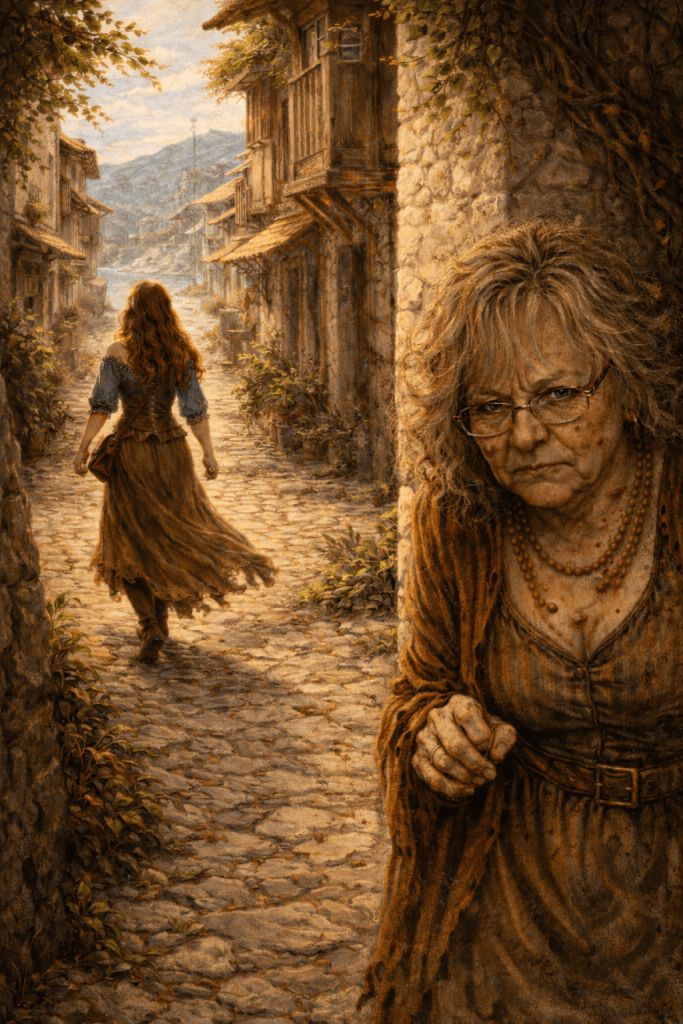
The sick obsession did not begin loudly.
It began early.
Just before this Minstrelle reached her teenage years, my mother sent me to Solmere to share its warm season — three turning-months, as Solipsians mark such time. It was meant to be harmless: salt air, family proximity, a change of climate from Masondonia’s steadier hills. Auntie Carrow was living then with a man known locally as Pirate Brill of Lawrence.
Brill was a good man. Kind. Patient. The sort of man who had lived hard and chosen, deliberately, to soften. He had an adult daughter living inland in CrownStead that he would visit often. And when he was present, the household took on the shape of something almost normal. There were rules. There was restraint. There were lines Carrow did not cross.
Auntie Carrow and The Pirate Brill appeared, to those looking in, to be genuinely happy in love. They laughed easily together, shared meals and routines, and passed long coastal evenings in a way that suggested something settled and sincere. When he was near, she softened herself into something almost convincing. The house felt warmer then. Safer. That illusion mattered.
It was when Pirate Brill was away that the atmosphere shifted.
This Minstrelle and her Auntie Carrow spent the days moving through Solmere as if it were a coastal circuit meant to be repeated endlessly. We shopped at the salt-front stalls and open markets along the shore, lingered in taverns and inns strung loosely along the coast, and swam in the Solmere Sea, its water warm and forgiving in a way Masondonia’s rivers never were.
It was during this time that I was given my first drink.
In Solmere, this was treated casually. Almost fondly. In Masondonia, it would have been unthinkable. Some say that was when a lifelong habit took root, though I did not know it then. I only knew that boundaries here were looser — and that Auntie Carrow enjoyed testing them. She introduced me constantly. Too constantly.
Most often, the introductions were to men far older than I was — dockhands, regulars, men who lingered too long in conversation. Nothing overt ever occurred. Nothing physical. Nothing that could be named cleanly or reported plainly. But the attention itself was inappropriate, deliberate, and persistent.
She never behaved this way when Pirate Brill was present. That absence matters.
Looking back now, it is clear she understood the line she was approaching. She simply believed she could step near it quietly enough to avoid consequence.
She taught me language no child should have been given — words that made me deeply uncomfortable, that did not belong to a childhood shaped by Masondonia’s quieter customs. I was not sheltered, but I was raised among people who believed certain knowledge did not need to be hurried. Solmere did not share that belief, and Auntie Carrow exploited the difference with intent.
What unsettles me most now is not any single incident, but the pattern.
She watched me constantly.
She placed me deliberately.
She introduced discomfort in increments, gauging tolerance rather than provoking refusal.
And she never did any of it where an adult who truly cared for me might intervene. This was not confusion. It was not chaos. It was practice.
When I returned home for the schooling year, I said very little about what had happened. I spoke only of the good things — the sea, the warmth, the novelty of Solmere. I could tell something was off about her, but I was young and did not yet know how to put my finger on it.
We kept in touch through the year — a longturn, in Solipsian measure — and when I was invited back again, this time for a fortnight, it felt manageable. Familial. Safe enough. It was not.
From the moment This Mistrelle arrived, something in the air felt wrong. Carrow’s energy had shifted — sharper, more volatile. Her body, too, had begun to change. She slouched now, her spine pulling forward as though burdened by something unseen. Her skin was blemished and uneven. Her limbs had begun to look disproportionate, her shape subtly distorted.
She and The Pirate Brill of Lawrence were no longer as lucky in love. He was gone more often — near the ocean, at the taverns — and when he returned, it was late. He came back very drunk and oddly sweetly fragrant, clinging to affection as though trying to repair something already broken. Carrow’s resentment filled the space where warmth had once lived.
That resentment turned on me. She accused me of things I was not doing. She claimed I looked at her husband lustfully. She accused me of sneaking out and carousing with Solmere boys. She said that I was putting on a show for them without my clothes. She told me plainly that I was young and beautiful — and that she hated me for it, because she believed herself now old, fat, and ugly. It was horrendous.
I felt exposed and ashamed for reasons I could not articulate. I felt blamed for simply existing. I learned to move quietly, to explain myself before being asked, to apologize for things I had not done. I became careful in ways that hollowed me out. Mostly, I felt unsafe. I counted the days until I could return to the security of home.
Years passed, and eventually I reached adulthood.
Like Baylor the Brave, I wanted to travel in my young adult years, to test myself beyond familiar ground. I returned to Solmere to study at the Guildhall of Accounts, believing — foolishly — that time might have softened old injuries. It had not. I didn’t think to write ahead, but stopped at their home instead.
Pirate Brill and Auntie Carrow were no longer together. He had sought a bond-severance through the Magistrate at Vireholt, formally dissolving what remained of their union. This MInstrelle stayed briefly at the Lawrence Holdfast and was inundated with Brill’s version of events — grievances, accusations, imagined betrayals. Auntie Carrows instability had deepened.
Word traveled fast in Solmere. Too fast. By the time This Minstrelle said my goodbyes to Brill — knowing I would likely not see him again — Carrow had already learned of my arrival.
The stalking began. Living in close proximity in Solmere with her was intolerable. She accused me relentlessly of sleeping with her husband and extended the same fixation to another young woman my age, Sheree, until the pressure became so severe that Sheree was quietly sent away as a ward to Alderwick, far from Solmere
She appeared where I did not expect her. Outside lessons. In markets. Along paths I had not shared. She watched without speaking. She positioned herself so others would notice. She accused me loudly, then denied it calmly. She followed, waited, lingered. It was oppressive.
I felt constantly observed, humiliated, stripped of privacy and dignity. My tutorage became impossible. My presence in Solmere turned into spectacle. I withdrew from my schooling. I packed what I had brought. I fled back to Masondonia.
In and out of different places in Solipsia, I continued to live my life. The details of those years are songs yet to be sung another time. For now, it is enough to say that I entered courtships and endured their endings. I issued my own bond-severances. I was in love. I was hurt. At times, I was the one doing the hurting. None of it was extraordinary. It was simply living.
All the while, I braced myself.
By then, This Minstrelle understood Auntie Carrow’s rhythm. She would disappear for a time, long enough for peace to feel real, and then surface again without warning. Over time, I learned that the only defense that ever worked was refusal. Not confrontation. Not explanation. Silence. Distance. Non-engagement.
She fed on reaction.
I starved her of it.
Because Valinda remained in Solmere, news still reached me.
Through her, I learned that Carrow’s mental health continued to decline steadily over the years. Those who encountered her spoke of worsening instability — scenes without provocation, accusations without anchor. Her body followed suit. Valinda said her feet had grown unnaturally large, forcing her into a lurching waddle. Her form rounded and sagged, movement becoming labor. Her skin was marred with erupting sores that never fully healed, and the grotesqueries spoken of earlier had become commonplace. By then, it was clear to anyone paying attention that Carrow was unraveling.
She slept little. She spoke constantly. She accused without pause. And while she claimed she wanted reconciliation, every word and action pushed further toward rupture.
Time passed. As Valinda’s torment waned, mine intensified.
We remained in contact for this reason alone — to compare notes, to warn one another. The pattern was unmistakable. Obsession, once blocked, was not relinquished. It was reassigned.
Auntie Carrow began sending messages to my potential and current suitors. The lies grew progressively bolder — accusations of theft, envy, imitation. She claimed I wanted to be her. The projection was naked and relentless.
I felt anger, yes — but more than that, exhaustion.
And still, I felt worse for Valinda.
She had been lured to Solmere under false pretenses, drawn there deliberately as a ruse, only to become Carrow’s bipolar plaything. Where I had distance, Valinda had proximity. Where I could retreat to Masondonia, Valinda remained embedded in the very place Carrow ruled through familiarity and fear.
Distance was both blessing and limitation.
From Masondonia, I had space. I had safety. But I could not travel easily to Solmere for the proof I needed to seek intervention from the Concordant Standard. I could not document the harm in real time.
Valinda could.
And I am profoundly grateful that she did.
Her documentation resulted in the lifetime protection ban — a rare acknowledgment that what Carrow inflicted was not conflict, but fixation.
Time did not end her obsession.
It only stretched it..
To this day, I do not know how she managed it.
Whether she kept spies among her employments, or relied on an endless supply of messengers and whispers, or simply had an unnatural instinct for proximity, I cannot say. I only know that as Valinda’s torment waned, mine intensified. The pattern was unmistakable. Attention, once withdrawn from one target, was not relinquished. It was reassigned.
Every person Carrow attempted to “expose” me to did what normal people do when confronted with obvious instability. They dismissed her. They ignored the stories. They wrote her off as unwell. Her accusations caused no damage.
My relationships — personal and professional — remained intact. Reputations held. Lives continued. That is how such things are meant to end.
But obsession does not die when ignored.
It waits.
What Auntie Carrow lacked was never grievance, nor persistence, nor conviction. What she lacked was power.
The moment she found someone willing to listen — someone who mistook fixation for loyalty, grievance for truth, and chaos for usefulness — everything changed.
When Auntie Carrow came into contact with the Beaver King himself, all restraint fell away.
And that was when all hell broke loose.
 The Beaver King, Cautionary Tales of Medieval Dysfunction
Leave a comment