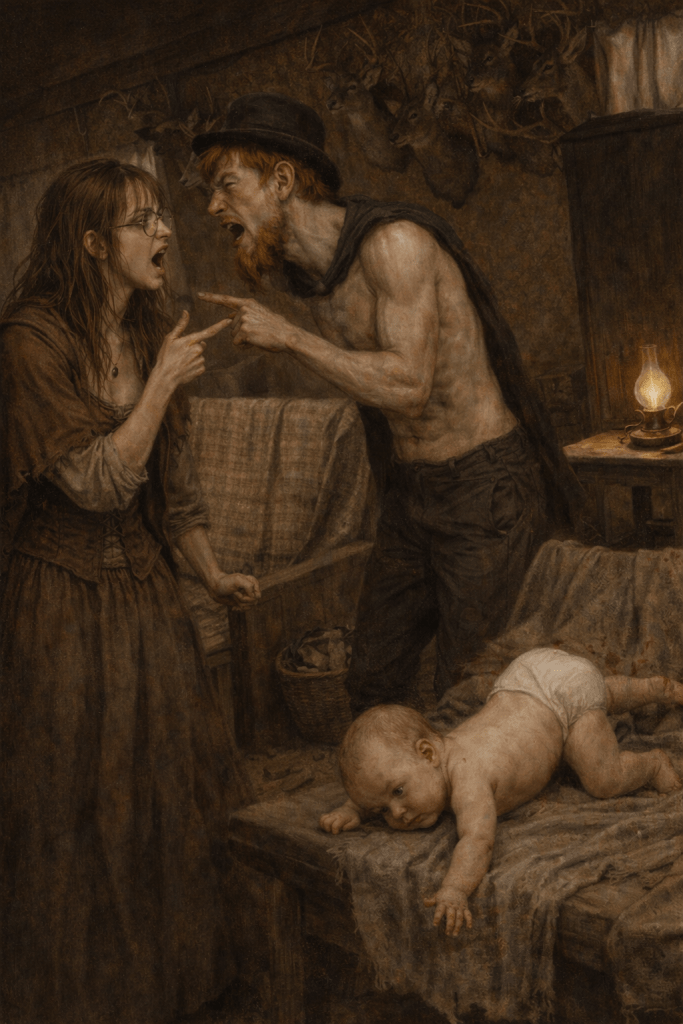
After Little Lord Bucker returned from his intentional failure at the Concordant Forge—ashamed, exposed, and stripped of standing for misleading the Concordant Standard—he came home diminished.
He and Lady Jessalyn returned to reside within the Log Cabin Castle, among the Faction. This arrangement pleased the Beaver King greatly. As with all failures that brought his sons back beneath his roof, it gratified both his savior complex and his long-standing desire to keep his family consolidated, dependent, and observable.
It must be stated plainly at the outset: this arrangement was already doomed.
Not only had nothing been learned, but nothing had been saved.
Jessalyn had retained none of Bucker’s military stipend from the Forge. There was no reserve, no preparation, no financial buffer of any kind. When Bucker returned, there was no money, no job, and no path forward. This absence of resources was not incidental—it was a mitigating factor in every conflict that followed.
And layered atop that failure, the Lord of Beavers was already at work, playing his familiar games between them.
Pre-Existing Volatility
It is this Minstrelle’s belief, shared by Lord Baylor the Brave, that the tension within the Log Cabin Castle was palpable.
Bucker and Jessalyn were volatile long before the child was born. Their relationship was marked by immaturity, instability, and mutual irresponsibility, and it grew increasingly worse with time.
The decision to conceive was not hopeful. It was immature and coercive. As previously recorded, the pregnancy itself was initiated by Bucker as a means to encourage Jessalyn to stay with him. That fact alone ensured that nothing built upon it would be stable.
The Household Pattern
Lady Jessalyn slept through the day and remained awake throughout the night. She filled her hours with board games, unfinished puzzles, and idle occupation. The infant followed her inverted schedule—sleeping all day and waking all night—an arrangement deeply unsuitable for a child, yet left uncorrected.
When Little Lord Bucker attempted to work, Jessalyn became upset if he did not stay awake with her through most of the night. If he slept, she protested. If he rose exhausted, she complained. If he failed to rise at all, the pattern simply continued.
He became tardy, then absent, then—per usual—unreliable.
Thus, a young couple with a child and every conceivable opportunity to do better, continued failing without urgency, reflection, or concern.
Refusal of Help
The Queen Consort offered to mind the child so that Jessalyn could work. What she did not offer, true to her reputation as the Duchess of Non-Intervention, was instruction. There was no guidance on household structure, financial responsibility, maternal routine, or how to become a better wife and mother. Help existed. Teaching did not.
Jessalyn refused sustained assistance and rejected any effort that required adjustment. This refusal was not strategy. It was laziness. She did not wish to learn. She did not wish to change. She did not wish to exert effort.
The Queen, as always, remained silent where it mattered.
The StillWoods Cabin
Just beyond the bounds of the Log Cabin Castle, set a short distance into the StillWoods, stood Uncle Montrec TaylorBlack’s ramshackle, unfinished cabin.
The floors were incomplete. The walls were unfinished. Animal heads lined the interior. The stench of cat piss permeated the space.
It was not a home. It was a shelter of neglect, but for some reason unbeknownst to aThie Minstrelle, it was sought as a coveted location by the Beaverton Clan.
Montrec had a habit of offering the cabin to others for pay while he was away, and it so happened that he was leaving to spend an indefinite amount of time with the woman from Mud Reach, leaving the structure vacant.
This presented itself as an option, of course on the Beaver King’s payroll, as it served a dual purpose. It was something that he could hold over the couple’s head, and he felt it made him look affluent and successful to his Uncle, and others he bragged to about it. It was, in truth, just another problem.
Neither Bucker nor Jessalyn knew how to keep a house. They had never learned. They were not building a life—they were playing house. Wherever they went, the pattern followed: status quo maintained, money absent, dysfunction persistent, volatility escalating.
The location changed. Nothing else did.
The King’s Games
Over all of this loomed King Robert.
With no money, no stability, and no progress, the marriage was already strained. King Robert ensured it stayed that way. He played games—quiet, constant, and deliberate—between Bucker and Jessalyn, aggravating tension and enjoying their deterioration.
His aims were familiar:
- to keep his sons under one roof
- to fracture their marriages
- to maintain control through instability
- and to indulge his savior complex
The worse things became, the more central he appeared.
Position of the Record
By this point, everything necessary for collapse was firmly in place.
Volatility preceded the child.
Pregnancy was born of fear.
Money was gone. Lord Bucker remained unreliable.
Help was refused.
Guidance was absent.
Manipulation was ongoing.
And even the alternative shelter offered nothing but decay.
This chapter records not a sudden crisis, but a slow, deliberate convergence.
This is where the record pauses—
still before the Breaking.
 The Beaver King, Cautionary Tales of Medieval Dysfunction
Leave a comment