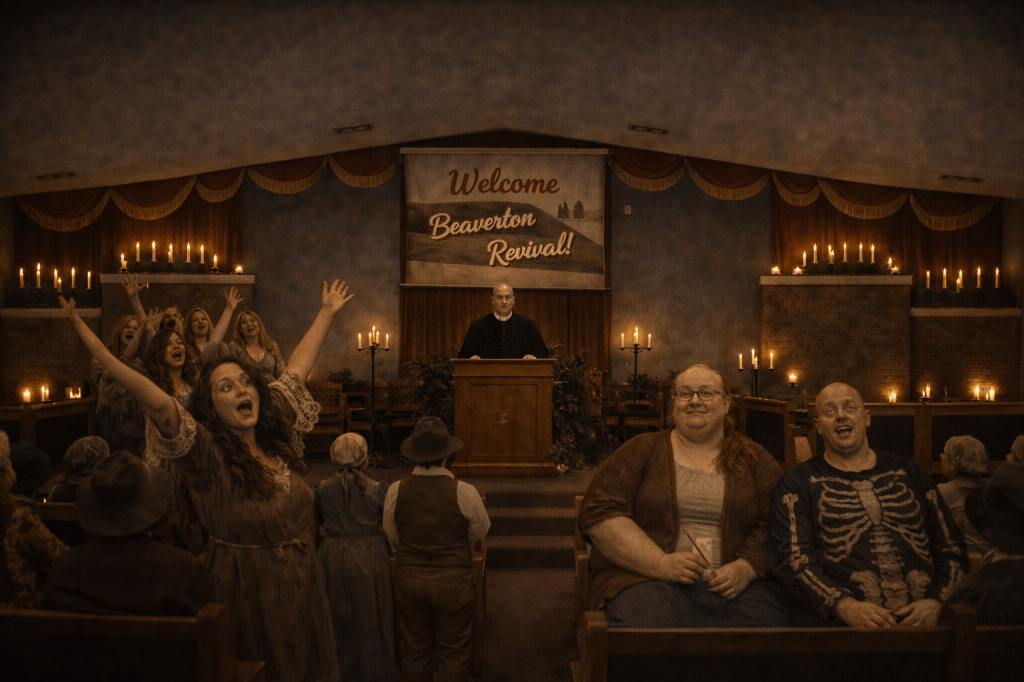
This Minstrelle must now pause the general record to document a belief system peculiar to Beaverton alone. It bears no resemblance to the older understandings of Solipsia, nor to the quieter practices found elsewhere. It is loud where others are restrained, theatrical where others are attentive, and confident where others remain content with uncertainty.
It did not arrive with settlers nor did it arise from land or memory. It was installed. And it is performed—without fail—three times a week.
On Frequency, Fatigue, and the Refusal to Stop
Beaverton gathers for worship no fewer than three times weekly, though the term weekly proves unreliable, as services often extend long enough to overlap into one another. Additional gatherings are announced whenever Mada On The Hill feels “pressed to speak,” which occurs with impressive regularity.
Attendance is described as voluntary. Absence, however, is investigated. Those who miss are welcomed back with public relief and prolonged prayer, as though narrowly recovered from moral catastrophe. Reasons are requested. Patterns are noted. Silence is discouraged. Rest is never discussed.
Mada On The Hill, Centered Entirely
At the center of the revival stands Mada On The Hill, elevated upon a pulpit raised to a height suggesting less a concern for acoustics and more a preference for dominance.
Mada rarely quotes anything of substance. Scripture, when referenced, is vague, paraphrased, or abandoned mid-thought in favor of Mada’s own stories—his struggles, his triumphs, his callings, his disappointments, and his many opinions. Sermons consist largely of Mada speaking about Mada.
Belief is implied. Understanding is optional.
On Outsiders, Cultures, and Other Inconveniences
Mada speaks often of other regions of Solipsia, most of which he appears to have encountered only in rumor. Masondonia is dismissed as strange. Coastal beliefs are described as unsettling. Any practice not centered on Beaverton is treated as suspect, inferior, or intentionally provocative.
Complex traditions are reduced to mockery. Curiosity is replaced with suspicion. Dislike is delivered confidently and received as wisdom.
Ignorance is not corrected. It is affirmed.
The Language of No Meaning
At irregular intervals, language is abandoned altogether.
Congregants erupt into overlapping vocalizations—rapid, repetitive sounds said to be divine speech. No interpretation is offered. None is requested. The event itself is considered sufficient.
Understanding is unnecessary. Volume is essential. Gibberish is paramount.
Those who do not participate are urged—gently, then insistently—to “open themselves” until coherence dissolves. Silence is watched closely.
A More Thorough Account of the Quiet Refusal (Regarding the Tongues)
During a midweek service—neither the loudest nor the longest, though competitive—the expected moment arrived.
The room swelled. Voices rose. Syllables multiplied without agreement. One woman did not participate. She stood calmly, hands folded, mouth closed. Not defiant. Not confused. Simply finished with words for the evening.
At first, no one noticed. Then someone nearby glanced over mid-gibberish, hesitated, and increased their volume to compensate. Another swayed closer, producing sounds with greater urgency, as though proximity alone might persuade.
A hand touched her shoulder. “Just let it out,” someone whispered—immediately followed by a much louder encouragement shouted above her head. She smiled politely. She shook her head once.
This caused confusion. Instructions were repeated—slowly, loudly, with hand motions. She nodded, confirming comprehension, and continued not speaking.
Prayer escalated. A loose circle formed, each participant producing entirely different sounds with impressive confidence. The effect resembled several people attempting to begin different songs at once.
Mada On The Hill glanced over mid-revelation, frowned slightly—an expression usually reserved for malfunctioning equipment—gestured vaguely in her direction, and resumed speaking about surrender.
Someone suggested she was “blocked.” Another said she was “processing.” A third decided she was “very close.”
Eventually, a conclusion was reached: her silence was itself a message, though not one requiring interpretation. After the service, it was noted—kindly, publicly, and repeatedly—that she was “not ready yet.” She agreed.
She did not return.
Shoes, Hair, and the Architecture of Appearance
Shoes are removed upon entry if the mood hits, though the floor remains aggressively ordinary. Explanations vary and are never reconciled.
Women are instructed to arrange their hair as high as structurally possible. Height is equated with womanhood, obedience, and devotion, though none of these qualities appear to benefit the wearer. The ceiling serves as an aspirational boundary.
Men speak. Women affirm.
This arrangement is referred to as harmony.
Women, Simplified Repeatedly
Women are reminded frequently of their sacred role, which consists primarily of supporting male authority while expressing gratitude for the opportunity.
Ambition is prayed over until it quiets. Questions are welcomed only if they dissolve into agreement. Discomfort is described as temporary, though the reassurance is delivered often enough to suggest permanence.
On the Handling of Snakes, Despite All Available Evidence
Among Beaverton’s most celebrated practices is the handling of live snakes.
They are produced ceremoniously, lifted from wooden boxes and held aloft as proof of trust. The reptiles are alive, unpredictable, and notably uninterested in participating.
The logic is simple:
If no harm occurs, belief is proven.
If harm occurs, belief is tested. Under this arrangement, the practice cannot fail. Common sense is dismissed as fear, thus fear is dismissed as weakness.
Preparation is never addressed. The chosen risk must be theatrical, witnessed, and repeatable.
Extract from the Beaverton Incident Ledger (Maintained Quietly)
- Fourth Day, Early Service
Left forearm bite. Referred to as “a refining.” Bandaged. Applause followed. - Seventh Day, Evening Gathering
Two bites, same handler. Declared “a double testimony.” Snake reassigned. - Twelfth Day
Handler fainted. Service continued. - Fifteenth Day
No incident. Praised as proof. - Twenty-Second Day
Hospital journey referred to as “a calling.”
The ledger is never read aloud.
Internal Monologue of a First-Time Handler (Recovered Later)
I am holding it wrong.
Everyone else looks calmer than I feel.
Mada said not to think, just trust.
It is moving more than I expected.
If I put it down, they will notice.
If I drop it, they will pray.
If it bites me, it will mean something.
I do not want it to mean something.
The handler smiled throughout.
The Fourfold Covenant (A Clarifying Exception)
Beaverton maintains strict teachings regarding fidelity, modesty, and marital order. These teachings apply universally—with one notable exception.
Within the upper structure of the revival exists a private clause known informally as the Fourfold Covenant. This covenant permits intimate relations exclusively among four individuals: Mada On The Hill, his wife Lesleek, and one other high-ranking couple whose names are spoken rarely and only with approval.
The arrangement is described as “spirit-led,” “protective,” and “above misunderstanding.” It is framed as a burden of leadership rather than a privilege. Questions regarding its origin are discouraged.
The rule is firm:
what is forbidden to the many is sanctified for the few.
Certain Regular Attendees, Noted Without Explanation
The Dowager Queen Brynda attends regularly. She sits midway into the congregation—not near the pulpit, but never at the edges. She arrives without announcement, acknowledges many by name, and engages in little conversation beyond brief recognition.
There is no small talk. She removes no shoes or raises no hands. She produces no sounds.
When the room swells with movement, she remains still. When voices rise, she does not join them. She simply exists there.
Given the extent of her conduct elsewhere—well documented, widely understood, and carefully unrepented—her presence presents a problem the revival does not attempt to solve. No one challenges her or corrects her silence.
Whether she attends seeking atonement, or whether attendance itself functions as justification, remains unclear. The latter possibility finds support in the ease with which worship appears to offset the remainder of her week.
Vast Sister and BillDong attend just as faithfully, though rarely on the same days.
BillDong is mocked openly—remarks exchanged, mistakes remembered fondly and repeated often. He is tolerated as spectacle rather than threat. Vast Sister is pitied.
Accommodations are made—benches adjusted, aisles widened, pauses extended. Concern is expressed with visible discomfort. She is treated as fragile, burdensome, and morally neutral all at once. No expectations are placed upon her. This, too, is a judgment.
On What Is Known, and What Is Conveniently Ignored
It must not be assumed that the congregation is unaware. They know exactly what the Dowager Queen is. They know one another’s failings as well.
Affairs, deceptions, borrowed money never returned—none of this is hidden. It is simply catalogued and disregarded. The revival does not require purity. It requires presence.
Attendance is the metric. Money is the measure. Everything else is negotiable.
The Matter of the Offering Box
The Dowager Queen never donates.
She is never seen placing coin in the offering. She does not pledge, tithe, or pretend toward generosity. This is remarked upon quietly and then dismissed, as her presence supplies something else: numbers, legitimacy, and the illusion of reach.
Curiously, while she gives nothing, she takes freely. Items from the donation box—candles, coins, goods meant for communal use—disappear with regularity. No one confronts her. No record is kept.
It is understood. The box is symbolic. Her attendance is valuable. The imbalance is allowed to stand.
The Beaver King, Briefly and Inconsistently
The Beaver King has maintained an intermittent relationship with the revival.
He arrives during seasons of visibility, disappears during seasons of consequence, and returns when narrative requires it. His attendance is remarked upon enthusiastically when present and carefully forgotten when absent. The pattern is not questioned.
When he attends, his presence is treated as endorsement. When he leaves, his absence is reframed as calling. His belief, such as it is, appears situational.
This Minstrelle notes that this, too, is another song to be sung—one concerning convenience, optics, and the ease with which faith may be worn and removed like a garment.
A Firsthand Account by This Minstrelle, Entered Reluctantly
This Minstrelle attended the Beaverton Revival once.
Once was sufficient.
I was met with amusement, absurdity, and something bordering on the appalling, all at once. Mada On The Hill noticed us immediately and greeted us loudly—by the wrong names. Not similar names. Entirely incorrect ones. He repeated them with confidence, nodding as though certainty outweighed accuracy.
No one corrected him. This was treated as recognition.
What followed was chaos mistaken for release: jerking, flailing, bee-bopping bodies moving without rhythm or restraint. The dancing was earnest, overworked, and deeply convinced of its own importance.
At some point—without warning—a choir appeared.
It emerged fully assured it was the finest collection of voices in the realm. It was not. The singing was long, loud, and profoundly unembarrassed. Applause followed. Some wept.
Throughout it all, Mada inserted himself between moments that required no explanation. The revival did not orbit belief. It orbited him.
I did not leave fulfilled.
I left tired, vaguely insulted, and with an unmistakable desire for a drink.
Final Observation from the Minstrelle
This Minstrelle records the Beaverton Revival faithfully, though patience has now been exhausted.
What is practiced here is not belief, but performance—certainty elevated by volume, protected by exceptions, and sustained by what is most profitable to ignore.
Some beliefs listen. Some beliefs remember.
Beaverton’s belief applauds itself, sanctifies special rules for special people, discounts common sense as doubt, and calls the echo wisdom.
And when the noise finally stops, it leaves nothing behind but thirst.
 The Beaver King, Cautionary Tales of Medieval Dysfunction
Leave a comment