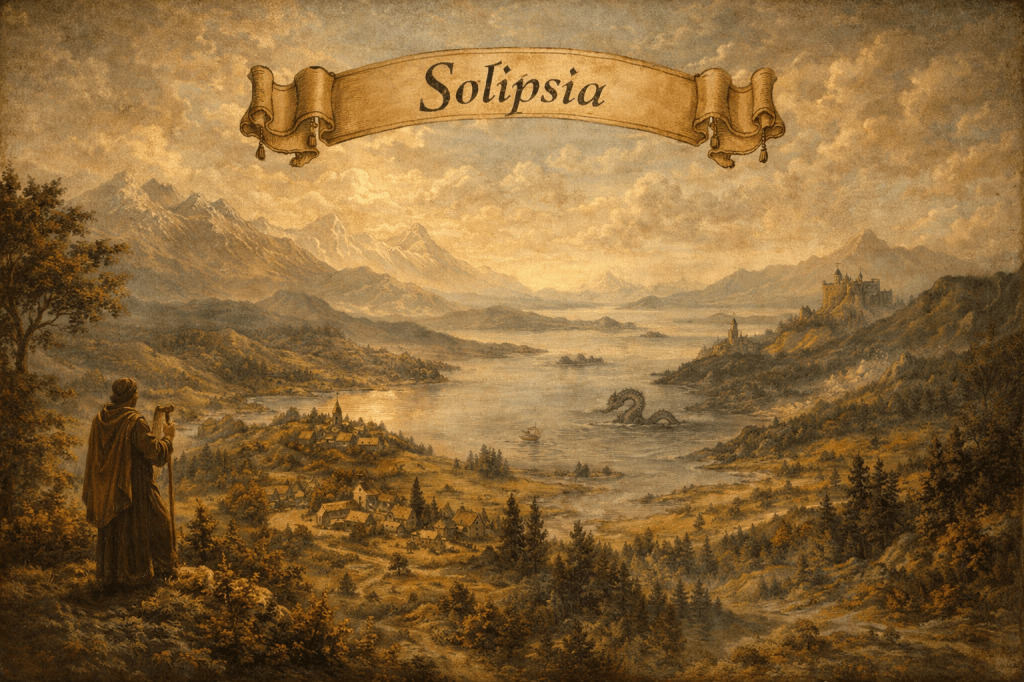
Religion in Solipsia is not housed in temples, nor contained by doctrine. It does not announce itself loudly, nor does it require agreement to function. It exists instead as presence, layered into custom, habit, and silence—so familiar that many who live within it would struggle to name it at all.
In Solipsia, belief is not something one enters. It is something one grows up inside of. This is largely because Solipsia was settled by many peoples, arriving from many directions, carrying with them fragments of belief already worn smooth by use.
A Land Settled by Many
Solipsia has never known a single religion.
The kingdoms were formed in waves, by travelers, laborers, families displaced by older conflicts, and those simply looking for land that would take them in. With them came gods with names, rituals without language, customs remembered only through repetition, and habits no longer recognized as belief.
Some faiths arrived intact, some arrived broken. Some arrived without knowing they were faiths at all. Over time, belief systems layered rather than replaced one another. They bent to climate, merged with local customs, or thinned into tradition. What resulted was not unity, but coexistence.
Contradiction is common. Conflict is not.
Most belief in Solipsia is practiced quietly and privately, without expectation of explanation.
The First Belief
Only one belief in Solipsia can be called native.
Before borders, before banners, before the naming of regions, there existed a way of understanding the world that did not originate elsewhere. This belief later came to be associated with Masondonia, though it did not begin there. It arrived with the people of This Minstrelle, from Berth.
They did not bring Gods. They brought recognition. The understanding was simple: the world does not instruct, but it remembers. Land remembers footsteps. Water remembers passage. Wood remembers what has been taken from it.
There were no prayers to recite, no intermediaries to appease, no moral tallies to maintain. Balance was kept through attention rather than obedience. Offerings were made without witnesses. Silence was not sacred—it was sufficient.
When these people settled Masondonia, the belief required no adjustment. The land responded as though the conversation had already begun. That is why Masondonia remains distinct.
Belief After Settlement
As Solipsia grew, belief diversified.
Some regions formalized their faiths, building calendars, hierarchies, and ceremonial language. Others reduced belief to superstition or etiquette. Many retained rituals whose meanings were no longer agreed upon, but still observed out of habit.
In some places, belief became visible and performative, andn others it remained unnamed.
Coastal regions tended toward cycles and inevitability, understanding life and death as movement rather than judgment. Inland settlements often blended multiple traditions until distinctions blurred.
None of these systems claimed authority over the others. They simply existed side by side.
Law, Custom, and the Appearance of Faith
Not everything spoken of as religion in Solipsia is belief.
Some systems—particularly those governing labor, obligation, and worth—use moral language while functioning as social agreements. They regulate behavior rather than explain the unseen. They persist not because they are sacred, but because they are useful.
The distinction is subtle and often blurred. Belief seeks understanding. Custom seeks order.
Solipsia contains both.
This Minstrelle
This Minstrelle does not belong to a faith in the conventional sense.
I carry memory rather than doctrine. My songs do not instruct belief, nor do they dispute it. They record what was practiced, what was forgotten, and what was altered over time. I recognize the first belief because I lived inside it before it had a name. I recognize the others because I listen long enough to hear where they came from.
This Mistrelle is neither devout nor heretical.
Only attentive.
How Belief Is Known
In Solipsia, belief is rarely declared. It is visible in pauses before action, in inherited customs, in what people refuse to explain. It lives in burial practices, marriage rites, planting habits, and the handling of tools and land.
Belief does not require agreement. It does not require instruction. It simply remains.
Closing Record
Solipsia was never shaped by one faith. It was shaped by many, arriving together, settling unevenly, and leaving traces.
Only one belief was already there. The rest learned to live beside it.
 The Beaver King, Cautionary Tales of Medieval Dysfunction
Leave a comment