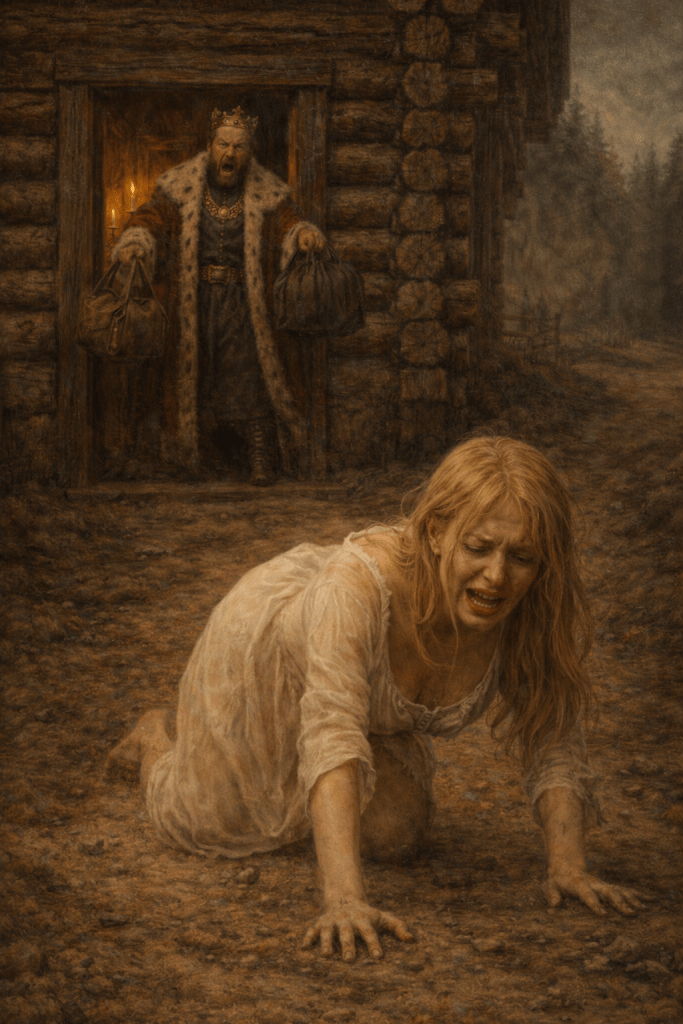
By Baylor’s thirteenth winter, the Queen Consort still rose each morning and tied her hair back with practiced hands. She still answered when spoken to. She still moved through the log-cabin castle as if she belonged to it, but whatever fuel had once lived behind her eyes was nearly gone.
The palace did not wake gently. It never had. Boys thundered through corridors meant for measured steps, boots striking stone hard enough to rattle carved saints in their alcoves. Doors were flung open and left that way. Shouts echoed before the hearth was even warm, and something—always something—was already broken by the time she reached the table. They were boys, after all. And boys, by decree of the Beaver King, were not to work inside.
Inside labor was women’s work. Everyone knew it. He said it casually, the way other men spoke of weather. Boys were not to scrub floors, not to carry wash-water, not to clean what they dirtied. Boys were meant for outside and noise and appetite. And the boys took full advantage of it.
Boots were kicked off wherever they landed. Mud dried into rugs in half-moon stains. Crumbs were ground deliberately into corners with bored heels. Sleeves were used as napkins. Spills were left untouched. A chair scraped hard enough to scar the floor and no one blinked. They learned early that the mess would not punish them. It would only punish her.
The Queen Consort cooked. She rose before dawn to light the hearth and laid it again long after night had settled, after everyone else had eaten their fill and left behind what they would not finish. She cooked meals that were judged loudly and rejected theatrically. When something displeased them, it was pushed aside or thrown—sometimes straight out the door for the dogs when it wasn’t to someone’s taste, as if food were a prop in a tantrum rather than labor and life.
She cleaned. She wiped grease from the long table. She scrubbed bowls until her knuckles cracked. She rinsed boards slick with blood while boys shouted behind her. She swept and re-swept the same corners, erased the same tracks, restored the same room again and again as if repetition alone might keep chaos from becoming permanent.
She chauffeured. She bundled them into cloaks, tied laces, hauled them into carts. She drove them across courtyards and down rutted paths while they kicked the boards and fought each other in the back, her name a constant refrain—Mother, Mother, Mother—each call sharper than the last.
She scrubbed laundry. Tunics stiff with sweat. Trousers ground with dirt. Blankets, sheets, towels—everything. She wrung cloth until her wrists screamed, rinsed until the water ran gray, hung it, folded it, and watched it return to the pile again by nightfall.
Even the staff helped—women moving quietly through the log-cabin castle with tired eyes and full hands—but it was never enough. It never stayed clean. It never stayed calm. There were four boys and no relief, and above it all, the Dowager Queen doted on her son with zero intervention—smiling at his storms as if they were charm, indulging him as if indulgence were love.
The Queen Consort slept when the Beaver King allowed it. Some nights she sat upright on the edge of the bed, hands folded, waiting for the moment she was permitted to lie down. Some mornings she rose on a body that had not truly rested, and she did it without remark because remarking changed nothing.
That morning it was one of the glass keepsakes. They were not called snow globes in Solipsia, but they served the same foolish purpose: tiny sealed worlds captured in glass, each holding a miniature memory she had once chosen herself. A winter chapel. A mountain pass. A beaver carved from pale stone beneath falling white flecks. Once—years ago—she had lined them carefully on a shelf and liked to turn them slowly and watch the false snow settle.
Now one lay shattered near the hearth. The boy responsible was not crying. He stood red-faced and shrill, screaming because the porridge had cooled too much while he’d been shouting at a brother. His heel ground glass deeper into the rug as he demanded something else, something better, something now.
The Queen Consort did not raise her voice. She knelt—slowly, because everything hurt now—and gathered the largest pieces with bare hands. A thin line of blood opened along her thumb. She watched it bead without expression, then wiped it on her skirt.
The Beaver King did not scold him. He did not comfort him. He stood, carried what was left of the little glass world to the door, and tossed it outside to the dogs with the scraps meant for the dogs. Just to be even more cruel that his normal demeanor he threw out the supper just to rectify his evening inconvenience. Good food. Meat, a loaf, still warm. The dogs were delighted.
The Beaver King’s screaming climbed the walls and echoed down the hall. Somewhere above them, the Dowager Queen laughed softly at something she had seen or heard in the chaos and made no move to come down and better the situation.
It wasn’t one thing.
It never is.
There wasn’t a straw that broke the camel’s back. There was only the slow stacking of days, the constant shrinking, the endless swallowing of indignities until her body learned to go quiet the way a room goes quiet after years of shouting—because it has given up on being heard.
Then the Beaver King came in one night with that stupid wide-eyed look—entitled as a baby boy who believed the world existed to marvel at him—and the sound of his know-it-all voice filled the room before his cloak had even fallen.
Her body reacted before her mind could arrange a sentence. Her stomach seized—hard, sudden—as if struck from the inside. Heat rushed up her spine fast enough to make her sway. Her hands began to shake, not the small tremor of fatigue but a violent, unfamiliar quiver that rattled the bowl against the wood. Her jaw locked. She tried to swallow and couldn’t. Her ears rang. Her breath came wrong—too shallow, too fast—as ash and smoke and certainty crowded her throat.
Her vision narrowed until all she could see was the movement of his mouth—still talking, still certain—each word pressing against her chest like a physical weight. Then the shaking stopped. Not because she calmed herself. Because something in her finally gave way.
She straightened. She went strangely still. Her face emptied, not with submission but with a quiet so complete it startled the room. It had been years since meek, shy, worn-down Brystal had had a real reaction at all—years since her body had been allowed to protest honestly.
This Minstrelle applauds that. Not as spectacle, but as proof of life. She did not argue. She did not announce. She simply knew.
MoorsFork.
Her childhood holdfast rose in her mind with frightening clarity. She knew that fleeing there was her best option. She knew that’s where she and her boys would be safest from this tiny-minded tyrant. She began to gather her things and the boys’ things—whatever she could collect and place into the wagon. She knew how to hitch the horses. Her mind tried to build a seamless chain of events: gather, load, hitch, leave.
The Beaver King saw something in her change. An uprising and an upheaval. He understood, suddenly, that this might be serious—and what that would mean for him. A growing empire can stop the moment the household fractures become visible. If she left with the boys, she took more than children. She took the image. She took the silence. She took the façade that made him look whole.
So while she packed, he moved first. He cornered the oldest three boys away from her line of sight, pressing them into a narrow space where stone walls held sound and escape was awkward.
“It’s finally happening,” he told them. “Your mother is leaving.” The sad part was the way their faces changed—not in surprise, but in recognition. They were pretrained for this, as if the Dowager Queen and the prince had always known this moment might come. For years, the Dowager Queen had spoken of it like an approaching disaster, drilling it into them until fear became reflex: that if their mother ever took them away, they would never see Beaverton again.
No return.
No home.
No familiar walls.
It had been repeated often enough to feel inevitable, so when the Beaver King said it now, the fear arrived complete. Baylor the Brave recalls his stomach dropping. His mouth went dry. The corridor seemed to close in. The younger boys mirrored him—eyes wide, breathing shallow, terror blooming exactly where it had been planted.
Of course Baylor knows now that it wasn’t the truth. But then it felt final. And as this Minstrelle has sung before of Donnelia and Richen, this lie—prepared, rehearsed, and deployed—became one of the deepest wounds of their lives.
Then she emerged. Overnight bags for her and bundles meant for all the children. She stepped into the corridor—and the Beaver King stepped in too.
He didn’t ask. He stripped her. The first bag was ripped from her hands so hard the strap burned her palm. The second was wrenched away before she could turn, its contents spilling across the stone. Fabric skidded. Buckles clattered. Something small rolled and stopped at the wall. He closed the distance. Too close.
He tore the overcoat from her shoulders. Snatched her glasses from her face. The world blurred. He kept taking—everything she had gathered—until her hands were empty, then he took more. He left her in a thin chemise, just enough to keep her nude body covered, humiliation measured and deliberate. Her breath went shallow. Her body froze. For one terrible moment, she believed he might truly hurt her.
He knew how to bark and not bite, this time. “This is all mine,” he said.
“None of it is yours.”
“If you want to leave,” he continued, louder now, for the boys to hear, “leave.”
“But you will not take anything that is mine.”
Leave she did. Gods be good—she left. She walked through the night and most of the morning. The dark was wide and indifferent, but it did not grab her or demand obedience. She rested against trees and stones when her legs shook and kept going. Dawn found her still moving. By morning she reached her parents’ home. They saw her before she reached the door.
Her mother crossed the yard barefoot and wrapped her arms around her as if afraid she might vanish again. Her father stood still for one heartbeat—taking in the state of her, the absence of everything she should have carried—then lifted her as if she were still a girl scraped raw by the world.
They did not ask questions first. They brought her inside. They gave her blankets. Warmth. Clean clothes kept for years without explanation. A cup pressed to her lips. Food waiting without demand. Her feet washed. Her hair brushed. She slept.
When she woke, hope was spoken softly. They talked of petitions. Of Vireholt. Of how they might bring the children to her—lawfully, fully, with weight behind it. For the first time in years, the future did not feel like a trap.
Three days later, they drove her back to Beaverton to hopefully gather the children and her things. The boys were already outside.
She stepped forward and said their names. They walked past her. Close enough that a sleeve brushed her arm. Close enough that she felt their warmth move through the air she had just breathed. Their eyes slid over her face and found nothing to hold.
Baylor did not look at her at all.
Her mouth opened once. Closed again. Something essential inside her released its grip—quietly, without ceremony. She turned back toward the carriage and walked away knowing, finally, that this was the never-ending game.
It was very shortly thereafter that the Beaver Queen Consort took her throne back in the kingdom. No announcement marked it. No explanation followed and no one spoke of it again. This was the last time she ever stepped out of line.
After that, her obedience was immaculate. Was she compliant, or was she indoctrinated? No one knew. Even her parents—who loved her fiercely—began to hate what the kingdom required her to become. Not because she was weak, but because survival at this cost looks too much like consent to those spared the price.
The kingdom continued. Exactly as designed.
And years later, this is the story Baylor the Brave returns to most often. Not the loud ones. Not the violent ones. This one, b ecause nothing happened the way it was supposed to.
He knows now how brainwashed they were. How the fear had been planted long before it was needed. How obedience had been mistaken for safety. He understands the machinery of it now, in detail, and that knowledge does nothing to soften the memory. What haunts him is not that he was afraid, it is that he complied so cleanly.
He remembers how anticlimactic it was. No shouting. No chase. No dramatic stand. Just boys walking past their mother as if she were already gone. He thinks, endlessly, of how little it would have taken.
A look.
A step toward her.
A hand on her sleeve.
Even acknowledgment.
He believes—deep in a place reason can’t reach—that if even one of them had gone with her, the spell might have broken. That the story might have split there into something survivable. That fear would have lost its hold if it hadn’t been met with perfect obedience.
Every imagined version of that life is better than the one they lived. Not perfect, not easy, just better. That is the hardest truth of all: sometimes the difference between captivity and escape is not courage, or love, or strength— But timing, and children are almost never given the timing they need.
So this chapter closes not with justice, and not with redemption, it closes with understanding, and with a sorrow that does not fade—but finally, fully, tells the truth.
 The Beaver King, Cautionary Tales of Medieval Dysfunction
Leave a comment