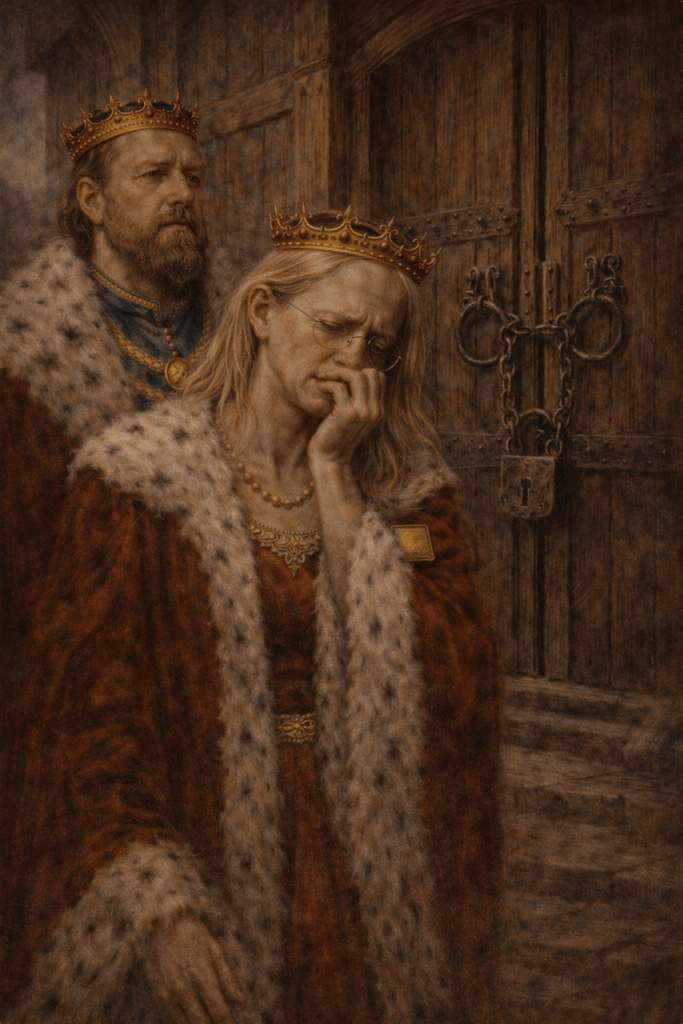
It must be stated plainly at the outset: King Robert was always given. Not rewarded. Not compensated. Not entrusted after proof of care.
Given.
Money placed into Robert’s hands was never treated as something to be preserved or stewarded. It was treated as confirmation—evidence, in his mind, that he was already deserving. What was given could be spent freely, because it had never been earned and therefore never carried weight.
This distinction matters.
In Solipsia, legitimacy does not rest in name alone. Power is anchored in land and home ownership. Each territory—Beaverton, Frankleton, Terra Firma, Polaryn, and others—exists as its own kingdom because permanence matters. A House is not declared; it is seated. Titles follow the land, not the man.
It was Irenna, not Robert, who understood this.
When Matthias passed, he left Irenna a considerable inheritance, wealth accumulated through years of disciplined labor. Irenna stewarded it carefully. With deliberation, she purchased the Log Cabin Castle, anchoring Beaverton on the map, establishing its House, and securing its titles.
After her passing, stewardship of the Castle and its surrounding properties fell to Dowager Queen Brynda, matriarch of the House of Beaver.
Robert merely arrived inside what others had built. At one point during this period, Irenna gave Robert fifty thousand Virecrowns. This sum was not a loan or seed money. It carried no conditions. It was a gift.
In Solipsian terms, fifty thousand Virecrowns was enough—if handled responsibly—to secure a household through years of uncertainty. It could have provided food reserves, paid apprenticeships for the Little Lords, maintained equipment, and protected the family during lean seasons.
That Robert treated it otherwise is not opinion. It is record.
What is notable, because it is of record, is that Queen Consort Brystal was not counseled. No joint planning occurred. No household discussion was held. No winter reserve was set aside.
Robert did not consult or disclose. He acted alone. Brystal—later known as the Duchess of Non-Intervention—did not challenge him. Her suffering was real. Her silence was decisive. Robert spent accordingly.
He paid outright for a Ranger Carriage, polished and conspicuous. He acquired a matched team of horses, selected for appearance rather than endurance. He diverted funds to ornamental fittings, prestige metalwork, weaponry, and decorative upgrades. The horses wore show harnesses, not work tack.
None of this improved the family’s position. None of it increased security. It existed solely for The Beaver King to be seen.
He further spent on status maintenance—upgraded clothing, insignia, personalized gear, and visible markers meant to project authority rather than function.
At the same time, His Grace became fixated on entry into the Road Brotherhood. Membership required ownership of a thick draft horse and an Iron Spur Cart. These were proofs of image, not tools of necessity. He purchased them without hesitation.
He also placed a down payment on a house in Polaryn.
All of these obligations were secured by formal notes issued through the Commonweal Bank of Vireholt, converting Matthias’s labor and Irenna’s restraint into enforceable debt.
This is where the pattern tightens. Under Handbound Stewardship, every adult in Solipsia is required to work. Robert did work—but never for long.
Each position followed the same progression:
He entered confident and charming.
He performed adequately at first.
Then instruction arrived.
Then accountability.
Then equality.
Robert could not tolerate any of these. Correction felt like insult. Supervision felt like humiliation. Being treated as an equal worker felt like disrespect. When expectations rose, his temperament surfaced. The mask slipped. He grew volatile, sulking, defiant, and entitled.
In Solipsian communities, such behavior is met not with confrontation but with quiet shunning—shorter exchanges, fewer opportunities, cooler rooms.
Before dismissal could occur, Robert quit. This happened again. And again. And again.
This is why Robert job-hopped. Not because work was unavailable or because he was unfairly treated, but because he could not remain where he was seen clearly.
The debts, however, did not move with him.
Then came the Lean Winters. Unseasonal frosts, flooding rains, and crop failure tightened the entire region. Work remained available, but wages fell. Households adapted. Robert refused. He declared the available labor beneath him. Rather than accept lower pay and preserve his family, he chose not to work at all.
With debts accruing and no income, the outcome was predetermined. The Lord of Beavers traveled to the Capital and filed his first Writ of Empty Hands, entered into the Hall of Unending Account.
The recoveries began.
First, the thick draft horse and Iron Spur Cart were seized by the Commonweal Bank of Vireholt. Next, the house in Polaryn was taken. Then came the final choice.
Rather than surrender the Ranger Carriage, Robert sacrificed the wagon used by Queen Consort Brystal to transport the Little Lords—the practical family conveyance needed for schooling, provisioning, and safety. That wagon was taken, and the Ranger Carriage remained.
The family was forced to relocate into an older dwelling provided by Dowager Queen Brynda, within the remaining House of Beaver properties—another rescue, another prevention of consequence.
Baylor the Brave remembers this. He remembers jobs that never lasted. He remembers strangers taking property. He remembers learning that pride could be chosen over children.
You see, this was not the last Writ. Each collapse was cushioned by Brynda’s intervention. The Little Lords each learned different lessons from these experiences.
For Baylor the Brave, it forged a vow: no hidden debts, no job-hopping excuses, no lies about money.
Little Lord Brentin followed the model he was shown, culminating later in the Fall of StillPoint.
Closing Addendum — On the Matter of What Was Spent
The money Robert destroyed was not his.
It was earned by Matthias TaylorBlack. A man that, in the absence of young Robert’s father, made a choice to raise him as his own. It was protected by Irenna. Robert treated it as disposable because he never respected the labor behind it.
To the Beaver King, if asked, he did not spend it carelessly. To ask any observer, he spent it consciously—on image, pride, and avoidance.
The ledger closes this entry here.
The ledger continues.
 The Beaver King, Cautionary Tales of Medieval Dysfunction
Leave a comment