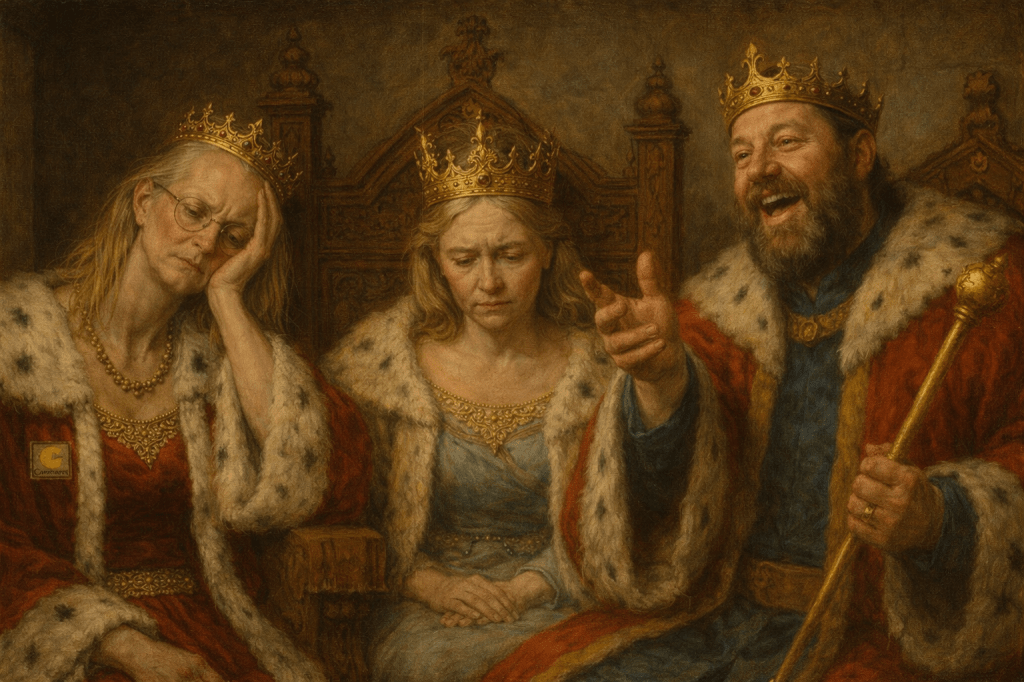
Introduction — by This Minstrelle
There are many ways to learn a man’s nature.
Some come from those he rules, who must endure him. Some from those who love him, who must explain him. And some, rare and precious come from those who have nothing to gain or lose by his opinion at all.
What follows is such an account.
Queen Aveline of BelMarche owed King Robert of Beaverton nothing. No allegiance. No rivalry. No shared history. She did not seek him out. He imposed himself upon her court for no reason beyond being seen.
And so she watched.
This is not a story of cruelty in the dramatic sense. There are no raised voices, no shattered alliances, no open threats. It is a record of something far quieter: a man who confuses speaking with knowing, presence with importance, and attention with respect.
I include this account not to persuade, but to document.
Because when even strangers, polite, distant, sovereign strangers – reach for their ledgers instead of their invitations, it is worth asking why.
What follows is Queen Aveline’s record, preserved as written, and offered without embellishment.
Read it as it was meant to be read: not as an accusation, but as an observation.
— This Minstrelle
From the Private Account of Queen Aveline of BelMarche
I have met King Robert of Beaverton three times in formal court, and once without the shelter of ceremony. It is the fourth meeting that clarified him.
BelMarche trades in leatherwork, shoemaking, and fine hides. We are not a kingdom that thrives on spectacle. For this reason alone, King Robert’s arrival was notable.
He demanded a royal audience.
There was no treaty to discuss. No grievance lodged. No alliance proposed. He was in BelMarche to collect commissioned footwear and required, in his words, that his presence be “properly received.”
He speaks often of himself, and always in the language of labor. He calls himself a working king. A provider. A man who knows the price of bread. These are admirable claims. Yet when matters requiring actual governance arise, eg weights, measures, schedules, priorities, his attention drifts. He refuses stewards not from competence, but from fear of appearing unneeded.
There is a particular tension in such men.
He watches constantly for signs of admiration. When they are not offered, he manufactures them. When they are offered too freely, he grows suspicious. I have seen this before in lesser lords who mistake authority for affection. It is rarer, and more dangerous, in a king.
Queen Consort Brystal did not speak.
This was not remarkable at first. Many consorts choose restraint in foreign courts. But when I addressed her directly, lightly, without ceremony, asking only after her comfort, she startled. Her eyes went to King Robert before she answered, and what she offered was not a reply so much as permission to remain silent.
I did not press her further. Panic has a texture. Once recognized, it cannot be unseen.
King Robert, meanwhile, continued uninterrupted. He spoke as though he knew everything about everything.
He instructed me earnestly and confidently on how BelMarche should manage its guilds, its river tolls, its trade routes, its internal disputes. He did not ask how our systems functioned. He did not inquire into history, geography, or constraint. He advised without listening, corrected without knowledge, and assumed familiarity where none existed.
As the court dispersed, I observed the same behavior repeated elsewhere in the hall. He cornered members of my court: stewards, minor nobles, even a visiting envoy, and held them fast with speech. He told each of them everything about everything. I watched as they attempted the small, polite signals of escape: a step back, a glance toward an opening, a hand placed upon a sleeve. He did not register these at all. He spoke on, heedless of posture, of time, of the quiet agreements that govern civil exchange.
They were, for a time, his captives. When at last an opening appeared, a servant passing, a bell sounded, a new arrival, they fled it like moths to flame, leaving apologies in their wake and relief plain upon their faces.
At some point, as he catalogued his labor, his sacrifices, his hardships, his misunderstandings without pause or invitation, I found myself thinking, quite plainly: my lord, the man does not ever shut up.
It was not contempt that formed the thought. It was fatigue.
I have noticed that he speaks of sacrifice often, but never with specificity. He speaks of hardship, but never names what he surrendered. He frames himself as long-suffering, yet I have never seen him endure inconvenience without resentment. When seating was delayed, he scowled. When wine was served warm, he sulked. When our schedule did not bend to him, he accused the room of disrespect.
When the audience finally concluded, I instructed my page to note the following in the record:
King Robert of Beaverton is not to be invited to future functions of the BelMarche court.
If he calls again, I am busy.
 The Beaver King, Cautionary Tales of Medieval Dysfunction
Leave a comment