This is the story of Brynda’s second husband, WileGarrth of Vireholt. It begins, briefly, with the ending of what came before.
Brynda’s marriage to Roderic of ArthurAlley did not fail quietly, nor did it fail by accident. It ended as it had been shaped to end—through provocation, escalation, and the careful cultivation of record. Roderic bore responsibility for his actions. Brynda bore responsibility for the conditions that made those actions inevitable.
When the petition for Bond Severance was entered, the Vireholt Magistrate required little deliberation. The record was sufficient. The bond was dissolved. The matter was closed. What mattered was not the marriage that ended, but what Brynda learned from it.
She learned that chaos could be engineered, that reputation could be managed, and that suffering, when properly framed, could be converted into authority.
She chose her next husband differently.
WileGarrth Ashmere of Vireholt
WillGarr was of the Capital.
After their marriage, the household settled first in StoneWake, before any later move toward Beaverton with Irenna. At the time, StoneWake still carried the appearance of order. It was close enough to Vireholt to feel regulated, distant enough to feel forgiving.
By the time this account begins, Brynda and WileGarrth had been married for just over ten years of record, long enough for the union to be considered settled, ordinary, and unremarkable by civic standards.
By all accounts of the Beaverton Record, noting as one must, that these records are famously curated, revised, and occasionally rewritten, it was a typical marriage. Nothing appeared unusual. Nothing drew comment. For the first nine years or so of their passing, there were no entries suggesting instability, no marginal notes hinting at concern.
Obviously, Brynda’s habits did not vanish. Her lying continued. The control persisted and her narcissism remained intact. Whatever friction existed did not surface in a way the record could, or would capture. WileGarrth Ashmere appeared mild-mannered enough to absorb it. To take it on the chin. To keep order where disorder was being quietly applied.
On paper, the marriage held.
There were children in the household. WileGarrth had one child already fully grown by the time he married Brynda, long since out of the home and largely absent from daily life. He also had a younger son, Matrek, who was still being raised and, for a time, fell under Brynda’s care. By this time, Vast Sister had long since been weaned from the goat and had already grown heavy through her preteen years. Young Robert, two years her senior, remained the unquestioned center of the household—the precious baby still indulged well past reason.
WileGarrth earned decent money by Capital standards, and in StoneWake they kept a modest house near the town square—respectable, visible, and well situated. There was no want, no hunger, no obvious hardship.
Brynda’s two children got along well enough with Matrek. There were no early rivalries worth noting. No disturbances that made the neighbors pause.
Even Vast Sister’s goat, once a necessity, had been replaced with a family dog, an animal better suited to a settled household, and far more acceptable to the town.
From the outside, it looked idyllic.
Then, quietly, there was a shift. Nothing dramatic. Nothing sudden. Just enough to be noticed.
WileGarrth grew more irritable. His patience shortened. He lingered longer outside the home. The dog, once familiar with him, began to avoid him altogether. He stayed out later than before. Not wildly. Not scandalously. Just long enough to unsettle routine. Long enough to suggest that home had ceased to be a place of rest.
Those closest to the household noticed. Irenna and Matthis noticed. But neither pressed the matter. They chalked it up to endurance wearing thin. To a man becoming less docile under Brynda’s constant pressure.
By then, intimacy between Brynda and WileGarrth had waned. Whatever intensity had existed early in the marriage, especially the bedroom intimacy Brynda had once used to coax him into marriage had cooled. Given Roderic’s earlier indiscretions, Brynda assumed her husband was being unfaithful.
She did not confront him. She liked her home, she liked the life her children had. She liked the money WileGarrth made, so she decided that she could look the other way.
This was where the tone began to change. One day, Brynda noticed the dog whining. Esterhaus paced and cried in a way that did not match hunger or illness. When Brynda looked closer, she observed visible swelling in the dogs rectum, enough to cause discomfort, enough to be wrong.
She dismissed it as a blockage, she assumed. A large passing. Nothing worth interrupting her day, and so she turned away.
A little more than one month by the count of StoneWake passed. Then came “The Weekend” The children were to stay with Irenna. There was a pie-eating contest in the neighboring village of Harrowfen, and Vast Sister, defending champion for the last two years, was expected to compete. The children left early, loud with anticipation, flour already dusting their clothes.
The house fell quiet. Brynda decided to prepare a special meal. Just the two of them. She set out for the butcher, then realized she had forgotten her coin purse and turned back.
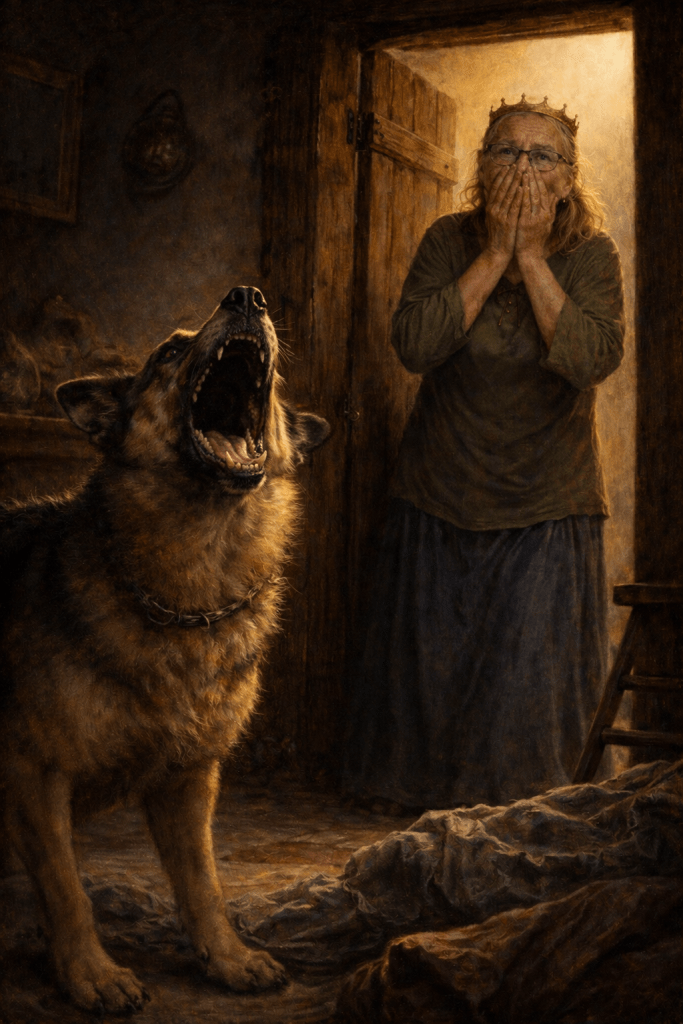
As she crossed the threshold, she heard it. Esterhaus was howling. Not barking. Not whining. Howling—high, broken, and panicked, echoing from deeper within the house.
Brynda froze. Then she moved. The room was disordered. The dog was restrained and frantic, eyes wild with terror. And WileGarrth, not startled, not confused, not caught in error, was engaging in something so profoundly wrong that her mind recoiled before it could name it. He was mounting and penetrating the animal from behind her hindquarters.
Time collapsed. Brynda did not scream. She did not rush forward. She stood long enough to understand that the unease, the avoidance, and the swelling she had dismissed, all of it had been a warning.
The minutes that followed were precise. She did not confront him or raise her voice. She gathered what was necessary and nothing more.
This was illegal under Solipsian law.
Not immoral.
Not improper.
Illegal.
She understood immediately what that meant—for the house, for the children, for anyone who delayed.
The children were not there, thank every silent God. But they would return. When they did, everything would change.
Brynda’s strategy shifted. Not toward endurance but towards extraction. She would leave, she would retrieve the children. She would act first. Not out of spite, out of necessity.
The house became evidence. WileGarrth became a liability and Brynda, who had always known how to flee before explanation, began to move.
Little did Brynda know that this discovery was only the beginning.
What she would uncover next, what had already been happening beyond her sight, beyond her control, would shatter even the instincts that had carried her this far.
And it would drive her, finally, to an act of desperation.
End of Part I
 The Beaver King, Cautionary Tales of Medieval Dysfunction
Leave a comment