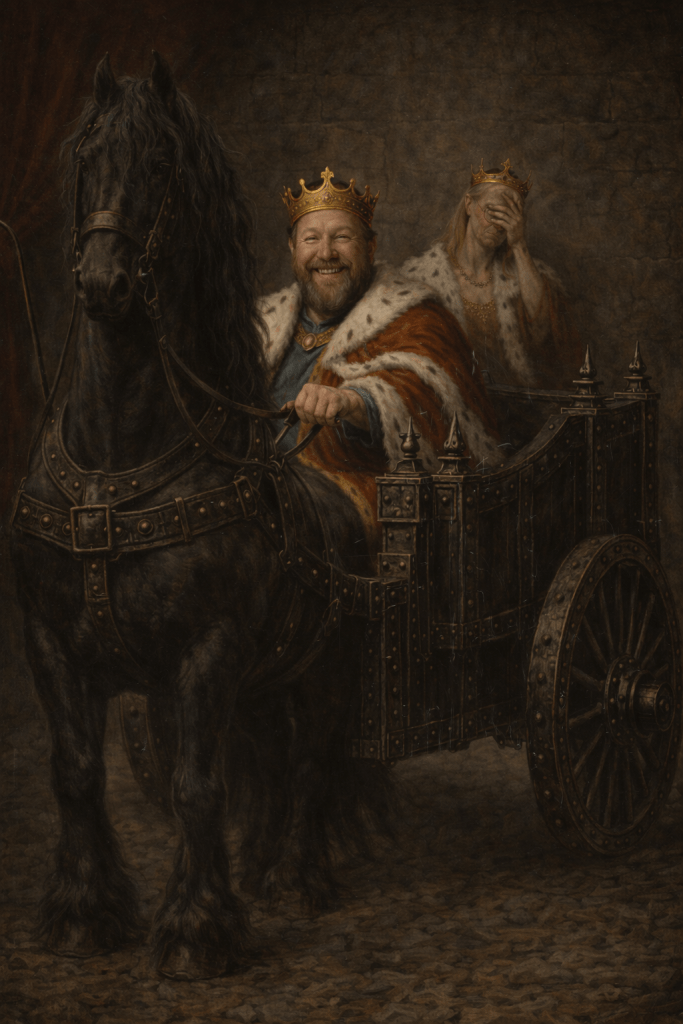
Tis generally held that King Robert’s infatuation with the Iron Spurs did not begin with any Road Brotherhood, but earlier, and closer to home.
The origin is most often traced to Montrec TaylorBlack, King Robert’s half uncle and Trapper of the Stillwoods. Montrec had no interest in Road Brotherhoods. He was not a joiner, nor was he drawn to spectacle. His life was solitary and practical, spent moving between timberline, river edge, and the long cut roads that threaded the woods. For this purpose, he kept an iron spur for his own recreation and travel. In Solipsia, this was not unusual.
The Iron Spur itself was simply a conveyance. A horse and iron-shod cart built for the road. One could own and ride an iron spur without pledging oneself to any brotherhood. Many did. Ownership alone carried no oath.
Montrec’s spur was functional rather than showy. The cart sat low and narrow, built of dark oak reinforced at the joints with iron bands. The wheels were thick and iron-shod, meant to hold fast on broken stone and uneven forest track. There was no paint, no carving, no ornament. Only use. The horse was a draft cross, bred for endurance rather than speed. Broad chested, heavy through the shoulders, calm-eyed. An animal that would stand without complaint while traps were checked or game was dressed. The harness was worn soft with age, patched where needed and never replaced whole. Nothing matched. Nothing was wasted. When Montrec rode, he rode alone.
The sound of the spur was distinctive. Iron on stone. Slow and deliberate. Not the noise of commerce, and not the noise of war. It announced a man who did not hurry and did not yield the road. King Robert saw this often enough for it to take root.
His interest in Montrec TaylorBlack was never casual. From an early age, Robert sought Montrec’s approval with a persistence that went largely unanswered. Montrec neither encouraged nor discouraged it. He simply lived as he always had, competent, self-contained, and unimpressed by titles. This only sharpened Robert’s attention. He watched Montrec closely. He repeated his phrases. He mimicked his posture and habits. When Montrec kept an iron spur, Robert did not see it as a tool or preference. He saw it as a marker of legitimacy. Something earned, and therefore something to be copied.
Given what is already known of King Robert’s temperament, this created a perfect convergence. The Beaverton Revival, which had previously consumed him entirely, began to lose its hold. Not through reflection or disillusionment, but through replacement. The same obsessive energy simply shifted objects. Where sermons and moral posturing had once dominated his speech, the road now did. The sound of iron on stone. The language of distance. The implied freedom of movement and refusal.
This shift was not discussed within the household. It was not negotiated. It was not framed as a choice. As with all such fixations, it simply became the center, and everything else was expected to orbit it.
King Robert did not purchase a used spur, nor did he wait. He commissioned a new iron spur, built to specification, louder and heavier than necessary. The cost exceeded what the household could reasonably support. At the time, Robert’s employment was inconsistent. He moved frequently between positions, abandoning one for the promise of another. Income was irregular. Obligations were deferred.
To secure the spur, he borrowed from the Commonweal Bank of Vireholt. This placed the family in significant debt. Funds intended to stabilize households during hardship were redirected toward a personal indulgence. The obligation was formally recorded, though its consequences would not be felt immediately.
As before, the family had no corresponding pursuits. No parallel interests were cultivated. Their role remained unchanged. They observed. They adjusted. They endured. They stood by while King Robert invested money, time, and attention into himself alone. What changed was not the pattern, but the object.
Once the Iron Spurs took hold, nothing else was permitted to matter.
 The Beaver King, Cautionary Tales of Medieval Dysfunction
Leave a comment