Preface
This Minstrelle is by no means an innocent. I have lived a colorful history. I have made errors in judgment, stayed too long where I should have left sooner, trusted people who had not earned it, and sharpened my tongue when silence might have served me better. I have loved imperfectly, reacted emotionally, and, at times, contributed to my own undoing.
This record does not pretend otherwise.
What it does assert is distinction: between imperfection and exploitation; between mutual conflict and sustained harm; between accountability and scapegoating. A flawed person can still be wronged. A complicated past does not nullify present injury.
What follows is not a plea for absolution. It is an examination of power, pattern, and consequence. As this account unfolds, additional detail will be set down as memory, correspondence, and witness permit.
This is context, not confession.
A Marriage Before Beaverton
Before the House of Beaverton, there was a marriage for This Minstrelle.
Scothel Bodemere was seven years my senior. He and this Minstrelle met first in lust. That lust became love, and that love carried us into a partnership that spanned over a decade. Over those years, each of us grew, truly grew, into the people we were meant to become, even as it became increasingly clear we were not meant to remain together.
We began in heat and intensity. Passion was our common language. In time, that passion sharpened. What once burned brightly began to burn hot. As the years passed, the fire did not extinguish; it soured. Passion became anger, and anger learned to masquerade as engagement, as depth, as proof that something still mattered.
From the outside, the union appeared durable. From within, it was sustained by force of will rather than ease of fit. We were bound less by harmony than by habit, history, and the shared labor of becoming.
Professionally, we prospered. Scothel in business, and I in my own vocation. I married couples who did not belong to any professed religion, or who explicitly wished not to be married within one. This was common in Masondonia, and I was sought for my services. Together, we appeared successful and well matched.
We had what most would name abundance: a beautiful home in the Capital, fine horses, good food, and a lifestyle that afforded comfort and distinction. By any outward measure, we had everything anyone could want.
It was when my own work began to surpass Scothel’s that the balance shifted. What had always been a low, simmering anger in him, tempered by dominance, found new fuel. Resentment took hold.
What followed was not mere discontent. It was hatred. And that hatred did not remain abstract. It became violence.
What followed was slow and corrosive rather than sudden. Everything became a competition. By nature, I am not competitive with others, only with myself. This imbalance did not temper him. It inflamed him.
He began to diminish me deliberately. He told me he hated me. He said that any success I had was his doing, that he had made me into what I was. In the same breath, I was told I was an anchor, holding him back. I was called disgusting. I was told I was overweight. The intent was not correction. It was erosion.
There were punishments meant to humiliate rather than instruct. At times, he would order me from the carriage and force me to walk home alone. On one occasion, I was made to leave my home in Masondonia and walk through the Billem Pass, across the river crossing, and onward into Vireholt. The journey took three days.
No explanation was offered. None was required.
I tried to better myself. I changed my hair. I altered how I dressed. I softened my voice and edited my personality. I had come from failed relationships before, and I wanted this marriage to work. I wanted my memories to be of large family gatherings, of weekend meals stretched long at the table, of shared pride in what we had built together. Some of those memories exist. They are real. They are also outnumbered.
What came more often were the nights alone: sleeping upright, listening for the sound of his return; the instinct to make myself smaller; the crying done quietly so it would not provoke another round; the careful selection of clothing to cover bruises; the calculation of sleeves, collars, and light.
I confided in friends, and I wanted them to intervene. I wanted them to force the issue, to make me leave, to report him to the Concordant Standard. I did not want sympathy. I wanted interruption. They did not act. I understand now why they hesitated, why involvement felt dangerous or improper to them. At the time, that understanding did not exist. What remained was the hurt. It settled quietly and stayed.
There came a point when fear ceased to be abstract. I began to believe, with a clarity that surprised me, that he might kill me. And yet I stayed.
Looking back, I am ashamed of myself. I see now what I could not then. Each time I endured it, each time I explained it away or tried to absorb it quietly, it did not calm him. It fed him. What he took from me in those moments made the thing inside him grow larger, stronger, more certain of itself.
I began to feel like a joke.
I was sought out to speak to others about how to build a successful life at home and at work. Groups paid to hear my words. At the same time, I was binding couples in marriage, new couples, newly in love, bright and certain, with the whole world still open in front of them.
I stood before them and performed belief. I spoke the language of hope and permanence. I smiled and stood for portraits. I signed records that would outlive me.
When I returned home, I entered a life I could not reconcile with the one I publicly described. The contrast hollowed me out. I learned how to congratulate joy while privately collapsing under its weight. I began to believe I was a fraud, not because my words were false, but because my life had become unlivable.
My trips away from home grew longer. I traveled with my Caravan to Solmere and lingered there with friends. I stayed where the mountains of Masondonia was clean and unobserved. I boarded a ship south of Solmere to an island in the Solmere Sea, Bahmera. Distance became relief.
In time, it was clear we were living two separate lives. Even deliberate absence failed to produce longing. Attempts to miss one another fell flat. He was openly miserable.
At the beginning of our final year together, we attempted a shared vacation. It felt like two strangers who disliked one another, performing proximity. We purchased a new puppy during that period. He became jealous of the animal. Affection directed anywhere else was treated as theft. There was no configuration in which he was satisfied.
I sought professional help from a Mindward. Even this person, accustomed to hearing difficult things, reacted with visible shock to statements Scothel made freely and without restraint. We were advised to communicate. To participate. To take turns choosing how evenings would be spent. In practice, every accommodation narrowed toward Scothel: what he was willing to do, what he refused, what everyone else adjusted around.
Then came the beginning of the end.
A countrywide disease‑prevention order confined us to the home. The directive was issued by the Three and enforced by the Concordant Standard. The confinement made our living conditions lethal.
I avoided. He brooded and paced. The house became a corridor of tension. When brief walks were permitted for fresh air, we took them in silence. I tried to draw him back toward me. I asked him to bake with me, to sit, to interact. There was nothing to reach for. Arguments ignited without warning. I cried. I begged for a hug, for the smallest sign of affection. He laughed at me. He belittled me. He told me there was not one part of me he wanted to touch. The violence became unbearable.
Then, unexpectedly, a reprieve came. The Three lifted the confinement ban to allow travel.
I left in the Caravan to seek solace. Dianvar and Billem, my parents, joined me. We traveled for a day to Tyrkan Valley. After being confined so long with a demon, the open air felt unreal. The freedom, the smell of the river, the uncontained sky, it was intoxicating. I felt myself return to my body. I felt alive again.
Most Masondonians are earth‑bound healers. We turn to land, water, and movement for restoration. In Tyrkan Valley, I breathed without calculating consequence. I slept without listening for footsteps. I felt hunger return—not urgency, but appetite. The quiet recognition that I wanted to live.
This feeling did not last.
A messenger was dispatched from Vireholt and followed us all the way to the Valley. It arrived on a clear, crisp morning. We were gathered around the fire with coffee and a hearty meal of biscuits and gravy when the letter in Scothel’s own hand came.
In that moment, the world I had just begun to re‑enter stopped. Everything went still. What had felt like return collapsed into suspension.
The message was brief. It did not seek understanding. It did not offer explanation. It read:
“I do not love you. I hate you. I have said my goodbyes to our home. I have filed for a Bond Severance. You have 60 days to return. I want the carriages, the horses. Keep your mares and the caravan. We will sell the home. I am not telling you where I am going.”
The moment after did not arrive all at once.
The world seemed to stop, and at the same time, to continue without me. Sound dulled. Distance flattened. My muscles tightened as if bracing for something that had already happened. It felt as though all the air had left my body at once. I stared at the page, waiting for it to correct itself—for another line to appear, for someone to say there had been a mistake. Nothing changed. The fire continued to burn. Coffee still steamed in its cups. The river moved on, indifferent.
I was there, and I was not. My body reacted before my mind could form words. This was shock. I refused to believe it was real. I could not function. The only coherent thought I could hold was the need to return to the house in Vireholt.
I moved without coordination. I tried to gather my things and pack the Caravan, but my hands fumbled and dropped what they touched. Billem hitched the team. Dianvar packed what was needed. I stood among my own belongings, unable to make sense of them.
The journey back stretched beyond measure. Time distorted. Each mile felt punitive. My mind filled with fragments I could not assemble into order. Thoughts collided and dissolved before I could grasp them. The agony was not loud. It was unbroken.
When we returned to the house in Vireholt, the air felt altered. The rooms no longer held the same energy. We inspected the home and found that Scothel had taken only his clothing and personal hygiene items—nothing more.
That was when my drinking began. It did not stop. For days, I refused to accept the reality in front of me. I convinced myself he simply needed space. Nothing had yet arrived from the Magistrate. I treated the absence of paper as evidence of mercy.
I cut my hair because it interfered with drinking. I was hysterical. I was sullen. I swung between manic energy and collapse—cyclical, uncontained.
Looking back, I am ashamed. I can see now that this should have been understood as a gift, however cruelly delivered. The Mindward told me it was the best thing for me. I promptly ordered the Mindward out of the home. My father, Billem, called him a coward. I am disgusted now that I argued with him, that I defended Scothel even then. Billem was right.
He was a coward.
My days and nights ran together. Time lost its edges. Billem and Dianver stayed with me. Friends came and went, keeping watch in shifts. There was a shared understanding that I should not be left alone.
The physicker prescribed Calmroot tincture, meant to steady the mind and quiet panic enough to function. It was maintenance, not relief.
Everyone agreed I needed company. Everyone agreed on vigilance.
Looking back now, I ask myself why—why Scothel was worth that level of ruin, why so many people had to hold me upright after his departure.
These are the only answers:
First, Scothel had made me dependent on him. Over time, he taught me to believe I would be nothing without him, that my worth was derivative, that any competence I possessed existed because he had allowed it. When he left, he did not simply remove himself. He removed the scaffolding he had insisted I needed to stand.
Second, through work with the Mindward, I learned something essential about myself. I do not tolerate abrupt change, especially when it threatens my living space. My home is not incidental to my safety. It is my anchor.
I had lived there for over a decade. I had no alternate place waiting. I was expected to uproot my business, my animals, my records, and myself within sixty days so the home I had poured my labor and devotion into could be sold.
That fracture broke me. It still breaks me.
I understand now that this grief is not trivial. It is the mourning of stability, of continuity, of a self that believed a place could be permanent.
The only way I have been able to describe the period that followed is this: the day my brain broke.
I could not make decisions. I did not trust my own judgment. Leaving the house triggered what the Mindward later named Fracture Panic, a state of overwhelming terror marked by breath loss, shaking, and absolute certainty of impending harm. I became convinced that if I left the house, something terrible would happen. This belief did not feel irrational. It felt proven. I had left once, and the worst had followed. My mind recorded cause and effect where none should have existed.
In my body, departure equaled danger. Safety existed only inside familiar walls. This created an impossible condition for someone given sixty days to dismantle an entire life and leave it behind.
One day, without warning or ceremony, I knew I could not keep living inside that feeling. I felt reduced to nothing. And then the Bond Severance request arrived, making the nothing official. Whatever fragile hope remained was severed.
I was sober for the first time in two weeks. I did not decide anything so much as go quiet. My body moved as if following an old instruction I did not remember learning.
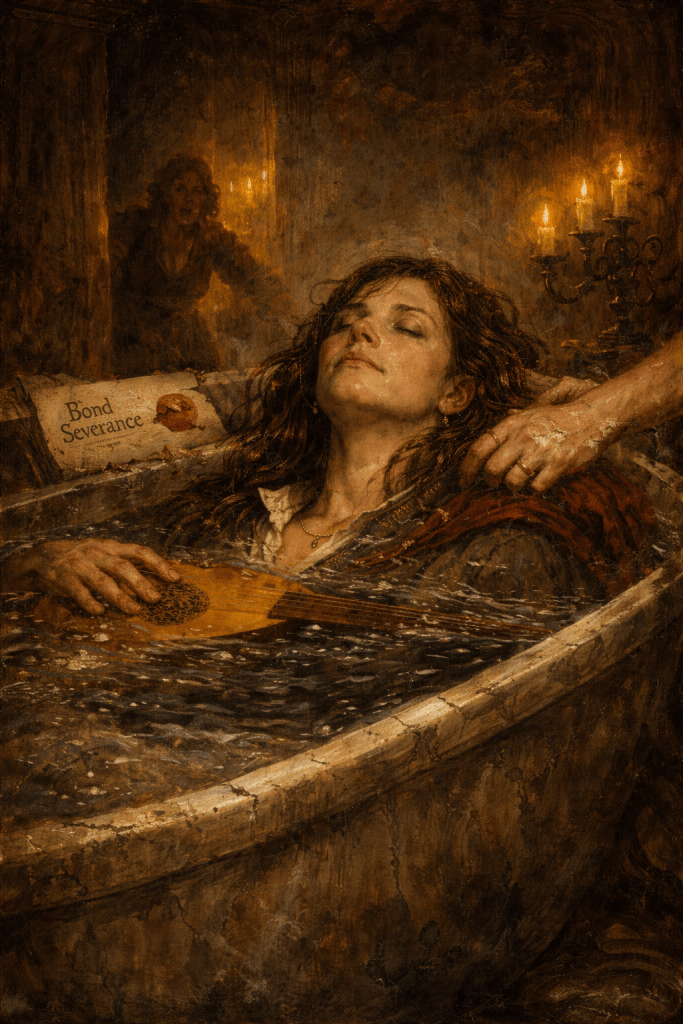
The bath filled until the rim trembled. When I stepped in, the water pressed close, heavy and warm. It held me evenly, touching every part at once. The noise of the world softened. The edges of thought blurred. There was a strange relief in the weight, a false sense of being gathered and kept. As the water closed over my face, sensation narrowed. Sound disappeared first. Then urgency. What remained was a drifting calm that felt like rest, like finally being allowed to stop resisting.
I do not remember struggling. I remember being pulled back by interruption. A neighbor returned for a forgotten coin purse and paused to check on me. She found me and dragged me free. The air came back harshly. Water burned out of my chest. My body rejected what my mind had surrendered.
The attempt failed.
People speak of such moments as awakenings. This was not one. I felt anger and devastation. I returned to drinking. I slept in the place that had belonged to Scothel for years. The room no longer carried his scent.
I slept for three days.
For most, this would be expected to mark a turning point. For me, it marked a descent. What had been unbearable became worse.
This is where this record pauses.
The account will continue in Part II.
 The Beaver King, Cautionary Tales of Medieval Dysfunction
Leave a comment