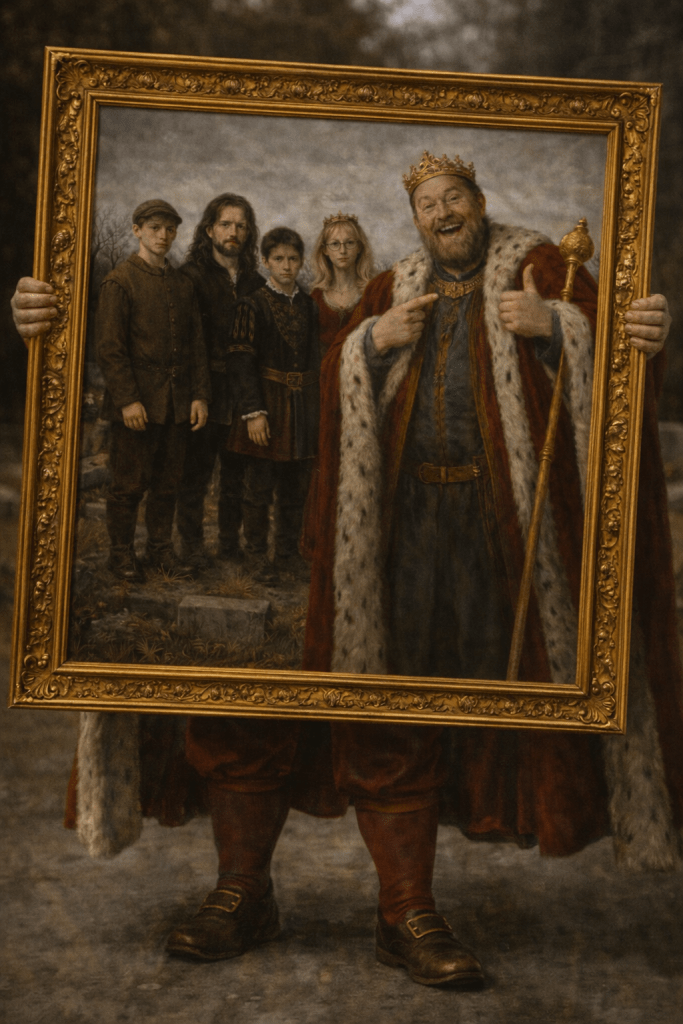
There was little that King Robert loved more than himself, and that was portraits.
Not the customary royal likeness taken once a year, nor the formal record made on name days and anniversaries. Those were insufficient. What the Beaver King favored were portraits with a message. Portraits of the perfect nuclear family, of benevolence. Portraits of good deeds that King Robert was said to have facilitated, though never quietly and never without witness.
These images were not kept in halls or archives. They were displayed. He placed them before the Log Cabin Castle, in the Town Square, and most eagerly at the Beaverton Revival during those seasons when he was on again religious. One could often see him lugging the things himself. Enormous, gaudy, gilded frames hauled from place to place as if the kingdom might forget him should they be out of sight for too long.
It was a peculiar sight.
His stubby legs fumbled beneath the weight of the frames, his gut pressing forward so that the portrait tilted and bobbed as he walked. From a distance, he scarcely looked like a king at all. He looked like a pair of legs struggling beneath a moving frame, the image swaying, demanding attention.
And perhaps that was the truest portrait of all. Because the point was never the deed depicted. It was the display.
The family did not need to be whole, only arranged. The kindness did not need to be felt, only recorded. Reverence was not practiced upward or inward, but outward, toward an imagined audience that King Robert never stopped performing for. The act itself could be absent. The image, however, was essential.
In this song, I will sing something truly repugnant. His Grace once undertook what he later referred to as a pilgrimage. It was a tour of burial sites belonging to his deceased relatives. We came to know it as the Portrait Tour.
The journey lasted roughly a week. It was undertaken twice. Only twice. Yet if one were to ask the Beaver King, it was a yearly tradition, faithfully observed. In his retelling, time bent easily to accommodate the version of events that served him best.
Traveling with him was miserable. He never stopped talking. Not about the dead, not about remembrance, not about grief. He spoke about himself, about what the portraits would show, about how they would be received, about where they would later be displayed. The family was trapped. There was no escape from his voice, no pause for silence, no allowance for private thought.
At each stop, the entire family was required to stand with him.
Sometimes the proper burial site could not be located within the stonefold. Records were incomplete. Markers were missing. Graves had shifted or been forgotten. This did not delay him for long. King Robert adopted a simple solution. Any spot would do. If the exact place could not be found, a nearby patch of ground was selected. The family was positioned. The royal portrait artist was summoned. The image was made.
The artist despised the tour most of all. He hated the travel, the pace, the arbitrary decisions. He understood better than anyone that accuracy did not matter. Only the appearance of reverence did. More than once, he considered simply disappearing along the road and letting the tour continue without him.
Grief was presented as an image rather than felt as a condition. The dead served their final function as backdrops.
The portraits from the tour were later circulated and displayed as proof of devotion. They appeared alongside the others, offered as evidence of filial piety and depth of character.
That the tour had occurred only twice did not trouble him. In King Robert’s accounting, repetition was unnecessary. Once an image existed, it could be invoked indefinitely.
It was not until after The Turning that Baylor understood what he had participated in. At the time, he had experienced the tour as obligation. As endurance. As another season of silence required for the sake of peace. He did not name it then. He did not question it. He stood where he was told and learned, as he had been taught, that compliance was treated as consent.
Distance changed that. Only later did he recognize the violation. The ancestors had not been honored. They had been used. Their resting places were treated as interchangeable stages. Their memory had been flattened into a backdrop for a living man’s ego.
After The Turning, Baylor encountered death again. This time it was the passing of Billem of Masondonia, father to This Minstrelle. Baylor entered that moment carrying the memory of the Portrait Tour, though he did not speak of it. He watched instead.
The Masondonians did not summon artists. There were no frames prepared. No audience was anticipated. No record was commissioned for later display.
Billem was burned. The fire was practical and reverent. What remained of him was scattered across the land he had loved, the hills and water he had walked, the places that had shaped him. He did not require a marker to be remembered.
Family gathered without instruction. Stories were spoken quietly and only among those who belonged there. Silence was permitted. No one stood where they were told. No one was arranged. There was nothing to pose for. There was nothing to preserve for later use.
Only then did the full weight of the Portrait Tour settle on Baylor. What King Robert had called devotion had been noise. What Masondonia practiced was reverence. It did not announce itself. It did not require proof. It existed whether or not it was witnessed.
Of course, the Duchess of Non-Intervention did nothing to stop any of it. She went along with the tour as she went along with most things. She stood where she was placed. She nodded when required. She did not ask whether this was appropriate or necessary. Intervention was not her role, and so none was offered.
The Dowager Queen, however, was delighted. When the portraits returned, she admired them openly. She praised the solemnity. She lingered over the frames as though they confirmed something she had always believed.
What a devoted son, she said. What a sweet little boy. She did not ask where the ancestors were buried. She did not notice when the sites were incorrect or interchangeable. The image satisfied her. The performance was sufficient.
There was another absence that went largely unremarked. The tour never included the Queen Consort’s family. Not her parents, Donnelia and Richen of Mooresfork. Their graves were not visited. Their memory was not posed for. No portrait was commissioned in their honor.
This was not an oversight. It was consistent. The Portrait Tour was not about ancestors. It was about King Robert.
And so the pattern held.
One man performed reverence.
One woman declined responsibility.
One matriarch applauded.
Between them, the dead were asked for nothing further. They had already given what was required.
 The Beaver King, Cautionary Tales of Medieval Dysfunction
Leave a comment