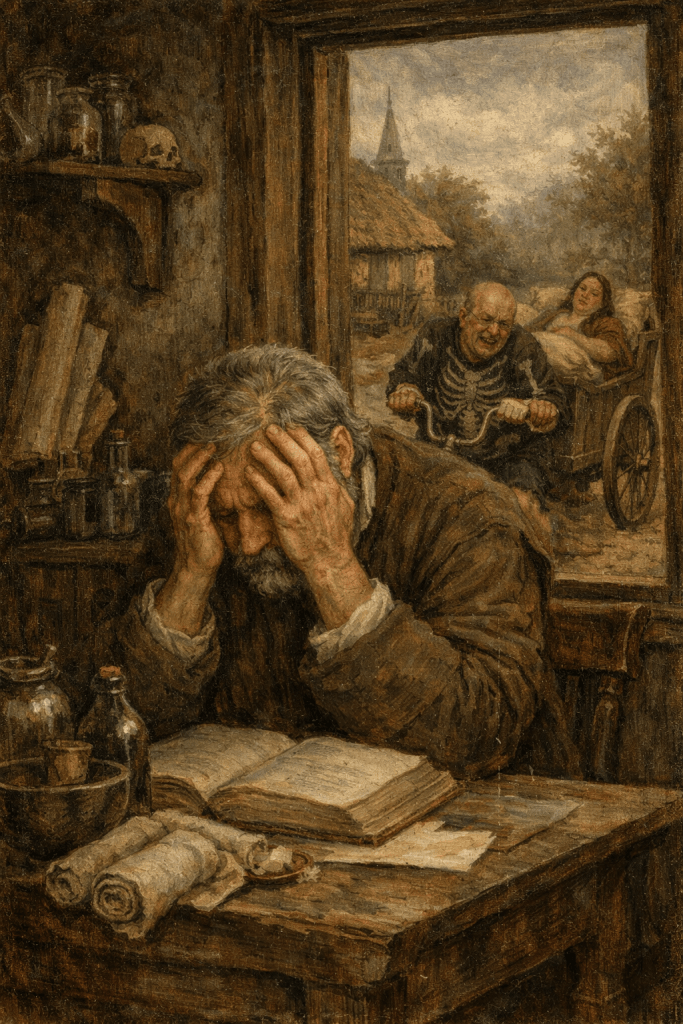
In Solipsia, care is a public trust. Parrish Physickers exist to ensure that trust does not fracture under distance, favoritism, or exhaustion. They are medicinal civil servants appointed by Vireholt, The Solipsian Capital, funded by public taxes, and charged with a single responsibility: to provide steady, humane medical care wherever people live and labor.
They are not symbols of authority. They are instruments of continuity.
Who They Are
Parrish Physickers are chosen for temperament as much as training. They are patient and kind people. The sort who listen without hurry and speak without spectacle. Vireholt does not seek brilliance that burns hot and fast; it seeks steadiness that endures.
Their loyalty is not ideological. It is practical. They believe that when care is reliable, suffering lessens, even when it cannot be erased.
How They Serve
Physickers are assigned, not installed. Their placements are issued through the Medicinal Circulation Office of Vireholt Capital under a philosophy of rotation rather than permanence.
They serve fixed terms long enough to learn a place properly, and then they move on. This prevents stagnation, preserves judgment, and protects the Physicker from carrying too much grief for too long. They arrive with records, depart with handovers, and leave behind knowledge that remains.
Relationship to Parish Nurses and Midwives
If Physickers are assigned, nurses are found.
In every parish, Physickers identify those already quietly doing the work of care, midwives, attendants, helpers, and teach them. Instruction happens at bedsides and birthstools, through repetition and patience.
Midwives are respected as specialists. Nurses are entrusted with continuity. When a Physicker rotates out, the nurses remain, carrying forward both skill and memory. The Good Physickers listen to nurses. This is not generosity. It is competence.
The Nature of Their Kindness
Physickers do not dramatize care. They do not perform empathy.
Their kindness is steady: explaining procedures, telling the truth early, sitting when a moment requires it, and refusing false hope that would only prolong fear. They understand that not every pain can be fixed, but every person deserves to be taken seriously.
Beaverton: A Particular Case
The Parrish Physicker assigned to Beaverton is Master Aldric Fenrow.
Fenrow is widely regarded as fair and unflappable. He believes in good‑faith examinations and plain truth, and it is precisely this disposition that makes two visitors weigh on him more than any others.
King Robert, Second of His Name, Protector of the Realm, and Lord of the Beavers
King Robert presents himself often, bearing ailments that never quite cohere. Fenrow knows the pattern well: symptoms sharpen for attention, urgency without substance. Fenrow examines carefully, documents politely, and refuses to indulge the performance. He does not accuse. He simply does not reward the lie.
The dread here is not anger, but waste, time spent confirming nothing while real injuries wait.
Vast Sister Grier, Younger Sister to King Robert
Vast Sister Grier troubles Fenrow for a different reason. Her illnesses are precise and survivable. Fenrow has learned the timing as well as the pattern.
When Vast Sister Grier presents herself for care, BillDong “The BoneClad” Grier is rarely far behind. If he is not already injured upon arrival, he will be injured attempting to reach the Physicker, waiting through the visit, or trying to get her home afterward.
Unlike his wife, poor BillDong’s injury is never theatrical. It is always real. Fenrow cannot name causation where he cannot prove it, but experience has taught him sequence. Vast Sister’s visit is the beginning of the interval. BillDong’s broken body is its end.
Supplies are laid out early. The nurses are quietly alerted. Fenrow listens carefully, not only to what Vast Sister says, but to the sounds outside the door.
Care, in this case, is anticipation. Fenrow and the nurses still feel the shocks and horrors of BillDong’s Atmopsheric Event from three moons ago.
The Quiet Burden of Care
Physickers are not naive. Experience teaches patterns whether one wishes to see them or not. Fenrow does not hate these people. He hates knowing what kindness will be required next, and where it will land.
This is the weight Physickers carry without complaint: recognizing harm they cannot prevent, and still standing ready to tend its aftermath.
Parrish Physickers are not heroes, and they are not villains. They are good people doing careful work in an imperfect world, arriving when needed, teaching what they can, preparing for what they foresee, and leaving care behind them when they go.
In Solipsia, this is what stability looks like.
Quiet. Human. And necessary.

 The Beaver King, Cautionary Tales of Medieval Dysfunction
Leave a comment