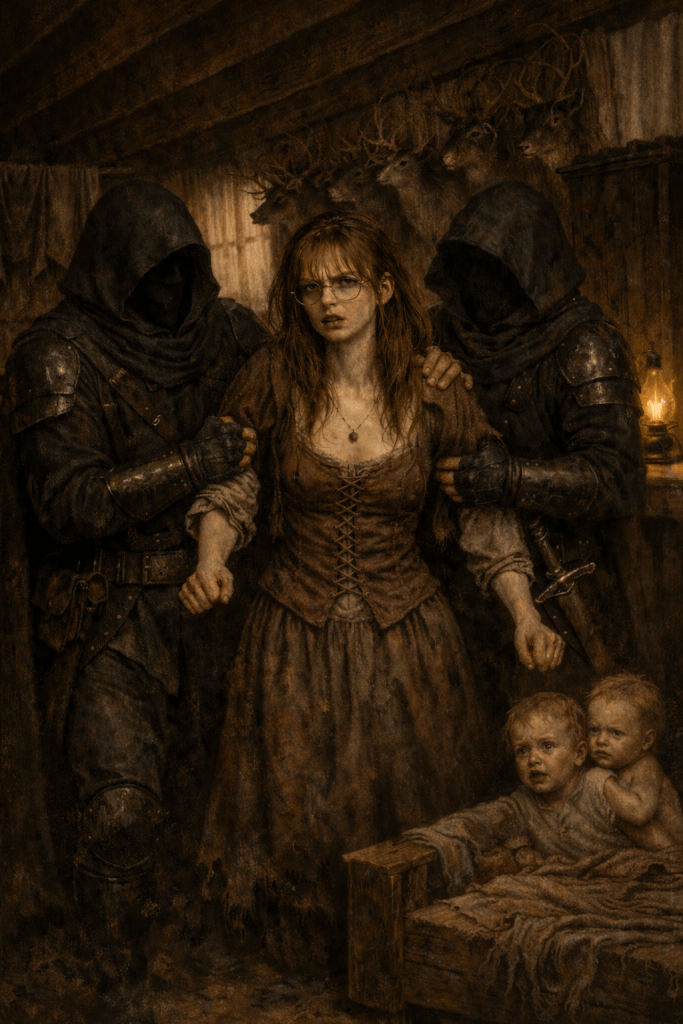
By the time of The Breaking, Little Lord Bucker and Lady Jessalyn were already living inside a failure that had hardened into routine.
They no longer resided within the Log Cabin Castle proper. Instead, they occupied Uncle Montrec TaylorBlack’s unfinished cabin in the StillWoods, close enough to Beaverton to be observed and far enough away to be ignored. The structure had never been meant for habitation, and it was wholly unfit for children.
The cabin showed its neglect plainly. Floors were unfinished and rough. Walls gaped in places, admitting drafts and shadow. Dampness lingered in the structure, and old animal waste had soaked deep into the boards. The smell of rot was constant and inescapable.
Within this space lived Lord Bucker, Lady Jessalyn, and their two daughters, one a toddler and the other still an infant, not yet walking or speaking.
This arrangement was not temporary. It was tolerated.
As had occurred before in Solipsia, most notably in the case of Lady Faylee at StillPoint, the conditions were known. They were visible to the household and the court alike. Everyone saw. No one intervened.
Life in the StillWoods cabin did not stabilize. It compressed. The Unburdened One returned from the Concordant Forge disgraced and unchanged. Whatever structure might have been learned there never took hold. He drifted back into familiar patterns, late at first, then absent, then unreliable altogether.
Lady Jessalyn Slumthumb had no framework for adulthood and no instruction in household management, work, or money. She had never been taught how to mother, how to sustain herself, or how to build independence. These deficiencies were treated as personal failures rather than the predictable result of neglect. The household never settled into rhythm. Sleep occurred at odd hours. Supplies came and went. Nothing accumulated except pressure.
It was the Dowager Queen who offered to mind the children so Jessalyn could work. On this point, This Minstrelle agrees. Lady Jessalyn did not need to be watching children. The Dowager Queen, however, was unfit to do so. She offered presence without safety and supervision without care. No instruction followed the offer. No guidance was given. No effort was made to correct the conditions in which the children lived.
Alongside her stood the Dutchess of Non-Intervention, present and inert. She did not oppose the arrangement, challenge the conditions, or advocate for the children. Her silence was not ignorance. It was policy.
Jessalyn refused assistance not out of strategy, but out of exhaustion and resentment. She wanted relief without change. Little Lord Bucker followed his familiar arc. He became tardy, then absent, then unreliable once again.
The volatility between Lord Bucker and Lady Jessalyn was not new. Prior to the Breaking, Lady Jessalyn had been detained multiple times by the guards of Beaverton following domestic disturbances. Each incident followed the same course. Escalation, detention, release, silence. No inquiry followed. No reform was attempted. No protections were established. The Breaking was not unforeseen. It was documented and ignored.
In later reflection, it became clear that Lady Jessalyn’s milk melancholia had been present and at the root of many issues for some time. The signs were visible in her withdrawal, agitation, and exhaustion. At the time, these symptoms were attributed to temperament or laziness. They were not named, treated, or understood as illness. By the time crisis arrived, the condition was entrenched.
King Robert’s involvement was not peripheral.
His games knew no end. He sought to retain his sons and remove their wives. Women disrupted his hierarchy. Mothers diluted his control. He undermined Jessalyn while magnifying Bucker’s dependence. He inflamed conflict while presenting himself as savior. A fractured household justified his authority. By the time of the Breaking, the outcome he desired was already clear.
The Breaking did not arrive suddenly. It arrived exhausted.
The room felt smaller than it was. Sleep deprivation pressed down on every movement and every thought. Lord Bucker moved without steadiness, too quick and then too slow. Lady Jessalyn carried the agitation of prolonged exhaustion, her posture rigid, her focus fractured. The children were unsettled. The toddler cried without pattern, overtired and unable to regulate. The infant’s distress came in sharp, irregular bursts, stopping and starting as though even the smallest body had learned to listen for danger.
The argument did not ignite but ground forward. A remark led to a correction, a correction to a complaint, and old grievances were dragged forward and sharpened again. Voices rose and overlapped. Nothing resolved.
Movement became erratic. Bodies passed too close. An object struck the floor and was left where it fell.
At some point, the last internal restraints failed. Lady Jessalyn lost containment and attacked Lord Bucker from behind. The act was not strategic or controlled. It was collapse.
Words followed that could not be ignored, declarations of self-harm and of killing the children, spoken not as leverage but as despair made audible.
The household crossed from dysfunction into danger.
The arrival of the Concordant Standard did not bring calm. It brought authority. Boots struck the unfinished floor. Lantern light flattened shadows and revealed everything at once. The room, the disorder, the children, and the mark left on Bucker’s neck. No one asked for context. No one knelt to the children.
Lady Jessalyn was no longer regarded as a person in distress. She was identified as the problem to be removed.
King Robert was not a distant observer. From the moment the Standard was summoned, he moved to control the narrative. Lady Jessalyn was framed as the sole aggressor and sole danger. Lord Bucker was presented as endangered and passive.
Whether Bucker fought back is not known. The record does not clarify. Accounts were filtered through authority. Accuracy was never the objective. Outcome was.
Due to Lady Jessalyn’s declarations of self-harm and harm toward the children, it was formally determined that she posed an immediate danger. She was remanded to the Quietus Ward of Vireholt, Solipsia’s institution for mental containment. At King Robert’s insistence, the Concordant Standard also brought formal charges against her.
Illness was not considered mitigating. Prior detainments were recast as proof of danger. No parallel inquiry examined Lord Bucker’s conduct. Containment hardened into exile.
Lady Jessalyn was taken from the cabin under Standard authority. She left without belongings, assurances, or dignity. She was taken alone to the Quietus Ward of Vireholt. The two daughters remained behind, one a toddler and the other not yet walking or speaking.
They were left in the care of an incompetent father, a sociopathic grandfather, Brentin the Beneficiary as the mirror of his father, and a Dutchess of Non-Intervention whose silence sealed the arrangement.
There was no maternal figure. No protection. No dissent.
This is where the record of the Breaking ends, but not their story.
 The Beaver King, Cautionary Tales of Medieval Dysfunction
Leave a comment