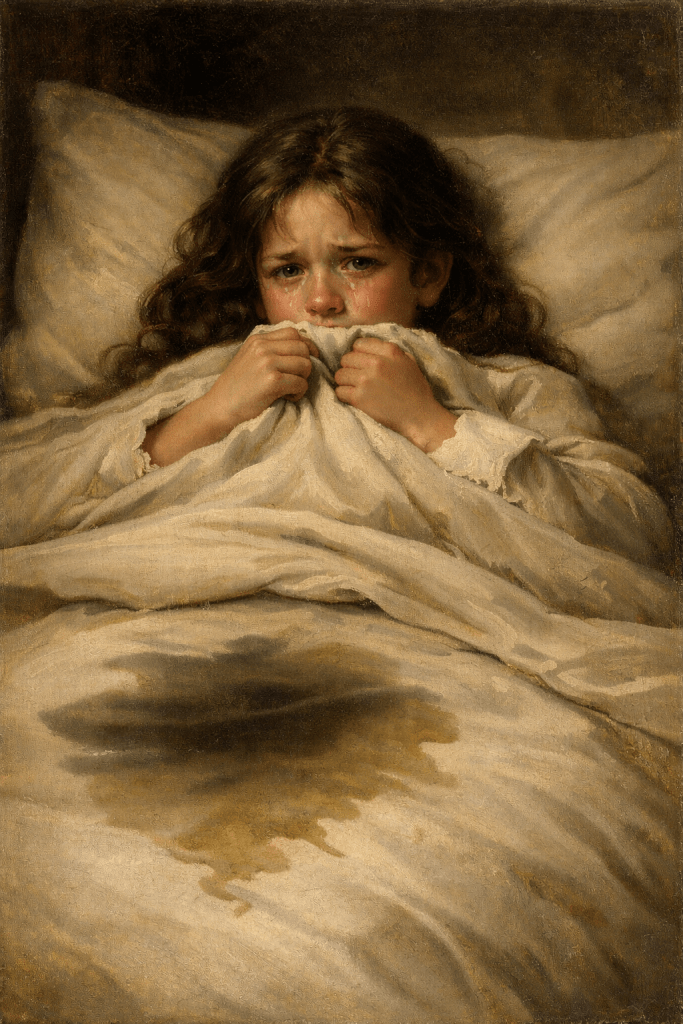
In the House of Beaverton, nighttime was governed by a single rule. Once the household retired, no one was to rise again for any reason. Not for water, sickness, or fear. Doors were to remain closed. Footsteps were forbidden. Voices were unthinkable. The Beaver King slept lightly and woke poorly. Disturbance was treated as disrespect. This rule applied to all.
Young Baylor the Bound was under ten when he learned what the rule actually meant. At that age, the body is still unreliable. Sleep breaks easily. Throats grow dry. Bladders fail without warning. Fear arrives unannounced. These were not considered exceptions. They were considered weaknesses.
If the Beaver King was awakened, the result was immediate and unmistakable. His voice carried. It filled corridors. It reached into rooms it was not addressing. Screaming was common. Yelling was guaranteed, and discipline followed.
It was understood within the household that waking him carried risk. Sometimes there was only shouting. Sometimes there was striking. Sometimes a beating or a whipping followed. There was no reliable way to predict which response would occur. This uncertainty was considered instructive.
There were no allowances made for circumstance. A child woken from a nightmare was not comforted. There was no gathering into arms, no quiet reassurance, no return to sleep. Distress was treated as disruption.
Illness received no exemption. If a child vomited in the night, the mess itself was considered the offense. Bedding was stripped without gentleness. Hands were washed quickly and without warmth. If the King had been disturbed, punishment could follow regardless of cause. No one was tucked back in. No one was told they were safe.
The household learned quickly that nighttime was not a period for needs. It was a test of control. The goal was not rest, but silence.
By the time Young Baylor the Bound was ten, he understood this completely. He did not fear the dark. He feared sound. He feared being the reason sound existed, so he learned to intercept it.
On the nights he woke needing the chamber pot, Baylor would sit upright in his bed and wait. He learned to measure time by his breathing. He learned how to stay perfectly still. He learned which aches could be ignored and which could not, but he was not permitted to act on that knowledge.
Sometimes the need passed. Sometimes it did not. On those nights, Baylor endured quietly. Baylor also recalls wetting the bed. It happened more than once. The choice was never unclear to him. Waking the Beaver King to ask permission to use the privy carried consequence. Wetting the bed carried consequence as well. There was no correct option, only the hope of choosing the quieter one.
Consequence followed regardless. Sometimes immediately. Sometimes later, when the offense had been discovered and recalled. The timing varied. The outcome did not. Baylor learned to leave the bedclothes where they were. He would rise in the morning without comment and go about his day as usual. At some point, while he was gone, the sheets would be changed. His mother did this quietly, without drawing attention to it, without explanation or comfort. The matter was not discussed.
This silence was not mercy. It was procedure.
Little Lord Bucker, younger and not yet fully instructed, did not always understand the rule. He slept heavily and dreamed often. On one occasion he woke crying out, disoriented, calling for help.
Baylor rose before the sound could carry. He crossed the room barefoot, moving with practiced care, and placed a hand over Bucker’s mouth, not hard, not cruel, just firm enough to still him. He whispered reassurances he had learned by imitation rather than comfort. He held him until the crying stopped.
Later, when the house remained undisturbed, Baylor returned to his bed. No one ever told him to do this. No one needed to.
Later, Baylor could account for countless nights like this. Nights where he lay awake calculating discomfort. Measuring thirst against consequence. Weighing the ache in his body against the certainty of confrontation. This was the beginning of what he would later recognize as a psychological inversion, the moment when a child learns that relief comes not from seeking a parent, but from avoiding one.
He would rather lie still, bladder burning, eyes open in the dark, than risk having to deal with his father. This was not a single night. It was a pattern. Repeated often enough to become instinct.
At ten years old, Baylor understood that adults were not inherently safe. He understood that parents could be navigated around. He understood that self-soothing was not a comfort skill but a survival one.
Children are meant to seek help automatically. Baylor learned to suppress that impulse. He did not consider it courage. He considered it efficiency. One night, he woke struggling to breathe.
He was hot and sweating, yet cold and clammy at the same time. His chest felt tight and shallow. Each breath came thin and weak, more effort than air. The sound he made frightened him: a rough, barking wheeze that scraped out of his throat and would not stop.
What he remembers most clearly is the sound of his own breathing. It was wrong. Too loud, then too small. He remembers counting breaths without knowing why. He remembers trying to make them quieter.
He lay still. This was not confusion. This was habit. Even as his body failed him, he did not call out. He remained where he was, alone in the dark, breathing as quietly as he could manage, waiting for it either to pass or to worsen. Eventually, he was discovered.
The Beaver King woke in the night to use the privy and heard the sound of wheezing, straining and the unmistakable cough of a child in respiratory distress. Even then, he did not go to the room. He did not check on the child. He did not speak to him.
Instead, he woke the mother.
She was ordered up and told to hitch the team. She was instructed to take Young Baylor to the physicker immediately, in the dead of night. In addition, she was tasked with reaching the Dowager Queen and securing her presence at the home before dawn, so that The Beaver King’s sleep would not be further interrupted. These arrangements were made quickly and without discussion.
Baylor did not return home the next morning. Fenrow kept him on site. One day passed. Then another. Nurses watched him through the night. His breathing remained unstable. Fever came and went.
In total, Baylor remained with the physicker Fenrow and the nurses for four days and three nights. He was a very sick little boy. Water was brought without him asking. Cloths were changed when they grew damp. Someone checked his breathing while he slept. When he woke frightened or disoriented, a voice answered him.
This was what care looked like.
The household at Beaverton adjusted in his absence. Duties were reassigned. Schedules continued. When Baylor was finally deemed stable enough to return, the night rule remained unchanged.
King Robert was not phased. There was no adjustment period. No allowance made for recovery. No acknowledgment that the rule had nearly cost the household a child. The incident was treated as resolved because the child had survived.
In Beaverton, survival was considered sufficient.
So Baylor returned to bed each night as before. He listened to his breathing. He calculated sound. He remained still.
Years later, he would understand something else about that night. Even while struggling for air, he never assumed help would come. His first response was not to seek aid, but to manage himself. To be quiet. To endure long enough for the situation to resolve without him becoming the problem.
This was not courage. It was the completed form of the psychological inversion.
Young Baylor the Bound survived. That is the sum of the outcome.
The rules did not change. King Robert’s precious sleep remained protected. It was not to be disturbed. No accommodation was made. No reconsideration followed. The household returned to order as it had always existed, organized around the preservation of that priority.
In Beaverton, a child nearly dying was insufficient cause for reform. Silence was still required. Endurance was still expected.
And that was that.
 The Beaver King, Cautionary Tales of Medieval Dysfunction
Leave a comment