Baylor the Bound began waking in the night. Not shouting. Not calling out. He woke already upright, breath caught, as though sleep had been interrupted by instruction rather than fear.
The dream came three times at first, then a fourth. It did not vary.
He found himself in a long interior hallway, narrow and spare, its length made uncertain by poor light. The air there carried sound poorly, as though the walls themselves held it close. From the far end came a thing, neither man nor beast, nor any spirit accounted for in parish teaching. Its shape resisted fixing, shifting just enough to remain unnamed. It ran low and fast, its movement wrong in a way the mind rejected before reason could follow.
Baylor did not flee. He stood facing it. Before it reached him, it stopped. It raised what could only be taken for an arm and pointed directly at him. Then it charged. Each time, he woke before it made contact.
The chamber was unchanged. The air lay still. No sound followed him from the dream. No footstep carried beyond the door. Sleep did not return easily after.
When Baylor first spoke of the dreams, Queen Brystal made no remark. As was her custom, she neither encouraged nor discouraged discussion of the matter. No inquiry was made. No instruction offered. This was not denial, nor disbelief, but absence, born of fatigue and long habit. The days continued. The nights followed.
Baylor continued to dream.
Two further nights brought the same vision, unchanged in form and ending. By then, repetition itself drew notice. Those who heard the account began to listen more closely. Concern gathered, quietly, without spectacle around the boy. He appeared tired in the mornings. He spoke less. He did not dramatize the matter, which lent it weight.
This attention did not go unnoticed.
It had been some time since King Robert occupied the center of concern. His ailments were quiet. His injuries mended. No fresh misfortune had arisen to draw sympathy toward him. Meanwhile, attention, once reliably his, had shifted.
Shortly thereafter, King Robert began to report disturbances of his own. These were said to occur during the day, when he was alone. Shadows where none should fall. Objects not where he recalled leaving them. Chills passing through rooms otherwise warm. No witness ever confirmed these events. They were reported afterward, never in the moment.
They did not produce the response he desired.
This period coincided with what was understood to be an on-again season between King Robert and the Revival. Any favor or attention granted by them was, in his accounting, a success. With nothing recent to satisfy his appetite for drama, he escalated.
He carried the matter directly to the Revival. He spoke of influence. Of presence. Of corruption dwelling within the Dowager Queen’s house. He used the word demon, or one near enough to demand response. He implied urgency, discernment, and danger beyond ordinary sight.
What King Robert hoped for was spectacle. He imagined public prayer, fasting proclaimed, crowds gathered, a tent raised and voices lifted. He imagined concern magnified and authority restored. He imagined himself placed squarely at the center, as witness, interpreter, and survivor.
He did not believe in exorcism. He believed in its entertainment value.
The Revival declined to perform. Instead, they dispatched a small contingent- quietly, without announcement or gathering. Their task was not expulsion, but assessment. They searched the house room by room.
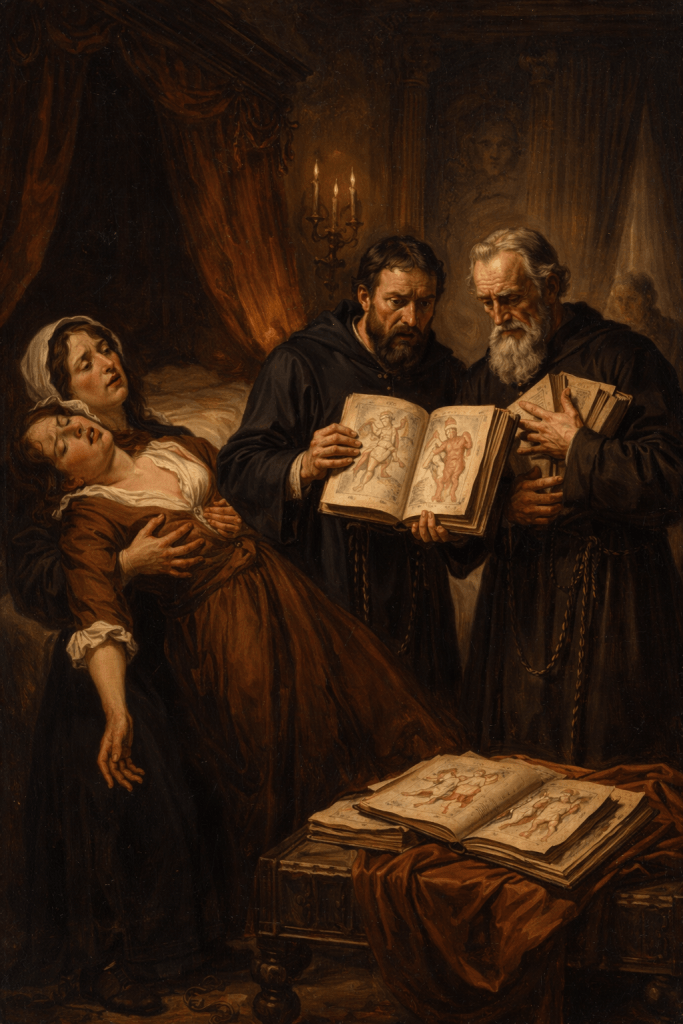
During this search, a chest set back from common view was opened. Within it were found a number of hand-drawn volumes, numbering near twenty. The books were not devotional, nor instructional, nor allegorical. Upon brief and unwilling examination, their purpose was immediately understood.
The drawings depicted acts forbidden by doctrine and custom alike. Men joined to men for indulgence. Women joined to women without restraint. These themes appeared repeatedly, without narrative or caution.
More grievously, several volumes depicted the collapse of natural order within the household itself. Grown men were shown at the breast of women rendered unmistakably as their mothers. Not in infancy. Not in need. The violation lay not in exposure, but in inversion, authority undone, kinship corrupted, dependence rendered obscene. The theme was repeated without ambiguity.
The reaction among the contingent was immediate. The men present released breath as though struck. One of the women collapsed without warning and was carried from the room. The remaining members closed the volumes at once. No further inspection was undertaken.
No one spoke of demons after that.
What had been found required no metaphysical explanation. It was not possession, nor visitation, nor influence from without. It was evidence of human corruption, sustained and curated, within the walls of the house.
Queen Brystal made no remark.
The search continued. Beneath the bed of Little Lord Baylor, a single book was found.
It was a small, well-illustrated volume, carefully kept. Its pages contained drawings of moons and stars, constellations traced and named, and speculative renderings of unknown creatures imagined to dwell beyond the firmament. The annotations were neat. The fear present was that of the distant sky, not of the household. Curiosity outweighed indulgence.
The book was returned to its place.
No action was taken regarding it.
The contingent remained only long enough to conclude their work. It is entered into record that several among them required time to recover from what had been encountered.
This event marked the beginning of a very off-again religious period for King Robert. Requests went unanswered. Invitations cooled. His urgencies were met with restraint. The Revival did not return his attention.
This entry is recorded as complete.
Postscript:
No demons were located, engaged, expelled, restrained, harmed, or otherwise involved in the events herein recorded.
 The Beaver King, Cautionary Tales of Medieval Dysfunction
Leave a comment