Framing Note
This Minstrelle sings this account using only the memories of Baylor the Bound and conclusions drawn from patterns that have since made themselves plain.Where detail is absent, it is because it was never given. Where motive is inferred, it is inferred from repetition and observable benefit. No attempt is made to soften what was unclear at the time, nor to exaggerate what later proved consistent.
What follows is not a reconstruction. It is a rendering.
This occurred during one of King Robert’s ON-again religious phases, later referred to in Beaverton records as the Revival years. The details are vague. Deliberately so.
Little Lord Baylor the Bound was young at the time, but what survives in the royal records—both in Beaverton and in Vireholt—is evasive and succinct, as though the matter were resolved by omission. That alone suggests there was more than was ever meant to be preserved.
We already understand something essential about King Robert: he was not a charitable man. He did nothing without benefit to himself, which is why this story did not align at first.
This period followed King Robert’s filing of his first Writ of Empty Hands. As a result, the family was forced to vacate their residence in Polaryn through bank repossession of assets. Though the loss was not framed publicly as such, the outcome was the same. Property was surrendered. Movement was required. The relocation was not a matter of choice.
The family was installed in the Dowager Queen’s former home in Beaverton. The house had been built for a single occupant. It was modest in size and narrow in design, never intended to house a king, a queen, and four children.
By that time, Queen Irenna had passed. The Dowager Queen resided elsewhere, at the seat of Beaverton itself—an established residence that would later acquire the log-cabin façade by which it became known. Her former home, available by circumstance rather than suitability, became the family’s residence.
It was small. Two bedrooms, limited common space and narrow halls. It already had unruly boys already inside it.
This was the environment of Baylor’s early childhood during the Revival years: close quarters, shared rooms, no privacy, nowhere to disappear.
At the same time, King Robert was actively positioning himself within the Beaverton Revival. Contemporary accounts and later analysis suggest he sought to displace Robertson as the recognized head of the movement. There is reason to believe this effort was supported by documentation of questionable origin—credentials that appeared abruptly, were referenced briefly, and vanished from the record once the attempt failed.
As part of this positioning, King Robert involved himself in youth pastoring. The Little Lords were too young to attend these gatherings. Whatever occurred within them, Baylor did not witness. He only knew that they existed somewhere beyond the house, among older children.
What Baylor remembers instead is the day the boys arrived. They were brought into his home. They were older than him. Significantly so. They occupied space that did not exist.
Baylor had never seen skin like theirs before. It was dark. Not tan. Not like anyone else in the house. It was simply darker than anything he knew a person could be.
They were thirteen and sixteen. The elder was called Jaimren. The younger was Kaelth.
Baylor was five.
All Baylor the Bound remembers hearing was that they were from a town near the Revival, called Patrick’s Barrow. That was all that he recalls offered as explanation. It was the only one he received.
With their arrival, the house rearranged itself. Beds were shifted. Spaces reassigned. Older boys slept where they could. Baylor remembers being moved without discussion, his place altered without explanation. What had been his – his corner, his routine, his sense of where he belonged – changed quietly and did not change back.
He does not remember resentment toward the boys. He remembers disorientation.
Later, Baylor learned more than he knew at the time. The boys had a mother. She lived alone. A man had left her, and what explanation was offered afterward was simple: she could not control them. That was how it was said.
It was also made known the boys’ mother also was a loyal attendee of The Revival That detail appears consistently, even where others do not.
This Minstrelle believes there were other mitigating factors. The absence of detail does not suggest simplicity; it suggests omission. There were no other boys of their color living in or near Beaverton. Their isolation would have been complete. It is equally possible that their mother lacked the means to support two adolescent boys, or that circumstances not recorded made refusal impossible. Poverty, too, has a way of being described as moral failure.
Baylor cannot remember being told any of this. The knowledge came later, pieced together from passing remarks and partial records. What survives is incomplete, and in places carefully thin.
What the record does show is this: the boys were not abandoned. They visited their mother often. From the outside, the arrangement appeared ill-fitting. It did not resolve into coherence until motive was considered.
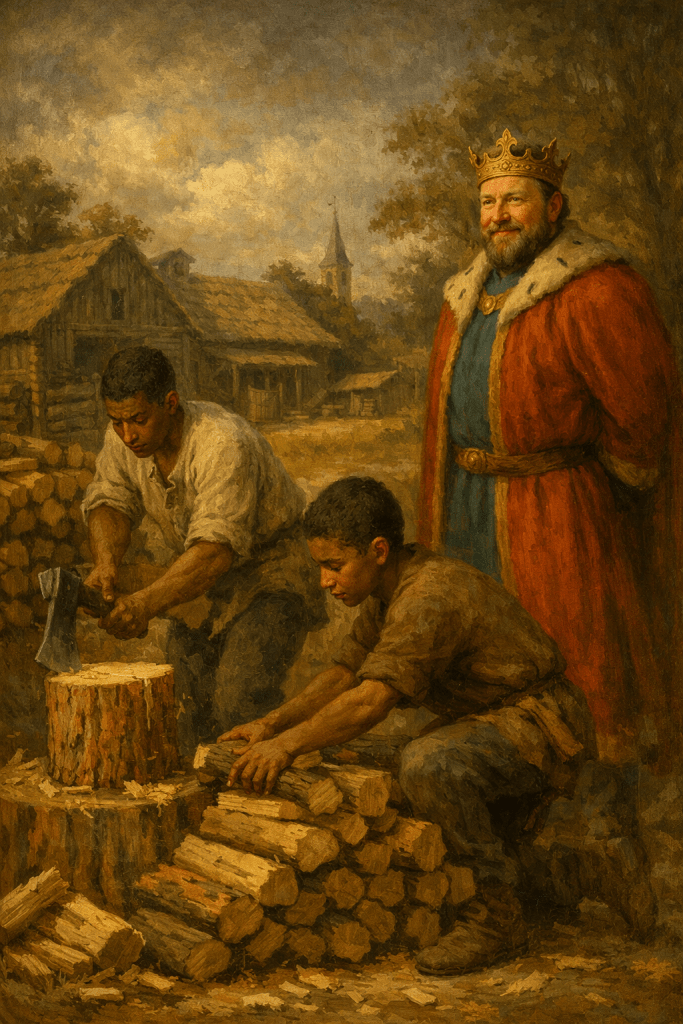
King Robert’s oldest was still young. The labor required by rural life was not. There were fences to mend, wood to haul, animals to tend, ground to clear. None of it was ceremonial. All of it was work. The Lord of Beavers was not inclined toward physical labor. Within that context, the presence of a thirteen-year-old and a sixteen-year-old ceased to be inexplicable. They were old enough to be useful, yet young enough to be controlled. If so, facto, that is what they did.
Baylor recalls hearing a phrase used more than once. King Robert told both boys that they owed him. The wording was not metaphorical. It was spoken plainly, as condition rather than reprimand. It was not tied to a single incident. It was used generally, as justification.
One day, not long after their arrival, Baylor witnessed something that unsettled him deeply. King Robert demanded that the boys call him Dad. There was no ceremony to it. No explanation offered. It was spoken as instruction, not invitation. The boys were not asked, they were told.
Baylor did not feel anger toward them. What he felt was loss. The word had always meant something fixed. It marked a place Baylor believed could not be reassigned without consequence. Hearing it redistributed made him feel suddenly smaller, less certain of where he stood. No one addressed this. No one reassured him. The feeling was left to settle on its own.
To those outside the household, the situation was unsettling. Within it, the pattern was treated as settled. What can be accounted for is what changed.
With the boys’ arrival, the household expanded without discussion. There were two more mouths to feed and two more sets of clothing to wash, mend, and replace. Meals grew heavier. Chores multiplied. The physical labor of keeping the house functioning increased immediately.
There is no indication the Queen Consort was consulted. Nothing in the record suggests she was asked. The decision appears to have been delivered as a foregone conclusion. This was to happen. The household would adjust, and so it did. Brystal, as always absorbed the additional work. If objection existed, it left no trace that reached the children. If disagreement occurred, it did not alter the outcome.
This was consistent with her position. She was, after all, the Duchess of Non-Intervention.
Over the years that followed, the boys’ relationships with the Beaver King diverged. Kaelth grew closer to him. Jaimren did not. Jaimren spoke openly about his contempt for the Beaver King and everything he represented. The conflict between them was visible and sustained, and it never softened into tolerance.
Kaelth, by contrast, settled into the role assigned to him. Though younger, he came to occupy the position of eldest son within the household. He accepted the labor expected of him and the narrow privileges that accompanied usefulness. The work gave him standing. The standing brought favor.
What stands out to Baylor now is the original justification for their presence. The boys had been brought into the household on account of behavioral issues, yet he does not remember a time when they were ever truly disruptive. They worked. They complied. They did not fracture the household. Whatever difficulties had been cited never manifested in any sustained or remarkable way. The issue, it seems, was not conduct.
Both boys left the household the moment they were legally permitted to do so. There was no hesitation. No attempt to stay. Whatever obligation had been named ended the instant the law allowed it.
Jaimren left first. He departed on his name day, immediately after the candles were blown out and the observance concluded. He relocated to the nearby town of Bloomridge and did not return to Beaverton for many years. During that time, he did not speak to the Beaver King. When he did eventually reappear, it was briefly and without reconciliation.
Jaimren later underwent a bond severance of his own. He has a child, a daughter, whom he does not support and does not see. He has not maintained stable employment. These facts are observable, whatever their cause.
Kaelth also left when he came of age. Unlike his brother, he did not go far. He returned to live with his mother in Patrick’s Barrow. He maintained intermittent contact with the family, and with the Beaver King himself. The communication was irregular, but it did not cease altogether. Kaelth did not maintain stable employment either. He struggled to hold work for any sustained period.
It was this shared instability that eventually led both boys to live with their mother.
At the time this account is sung, Kaelth is held in custody under the authority of the Concordant Standard and the Three, charged with grievous crimes against a child. He is not expected to return for some time.
If King Robert’s role in this arrangement was to raise the boys correctly on their mother’s behalf, to guide them, to correct their course, to prepare them for stable and lawful lives, then the outcomes require acknowledgment.
Measured against the paths both boys ultimately took, that charge was not fulfilled. Whatever authority was claimed, whatever obligation was demanded, whatever discipline was imposed, it did not result in stability, responsibility, or repair. If the task was stewardship, it failed. If the purpose was correction, it did not correct. If the justification was moral formation, the record does not support success.
That conclusion does not require speculation. It follows directly from the outcomes. No claim is made that these outcomes were caused by the Beaver King, however, if the unused orthotic shoe fits…
There remains one further possibility that must be addressed directly. If the arrangement involved material benefit from the Revival, coin, provisions, favor, or standing, then it would align with King Robert’s pattern of advantage-seeking during that period.
If the arrangement amounted to labor rendered in repayment for care, framed as correction or guidance, then it bore resemblance to indentured servitude. If that were the case, even informally, King Robert was treading on extremely serious illegal ground. Indentured Servitude had recently been explicitly outlawed in Thailuun and was never permitted under Solipsian law. There was no religious exemption, no corrective loophole, and no parental proxy under which such an arrangement could be justified.
No claim is made that such an arrangement was formally declared or recorded.
What is claimed is narrower and firmer:
Labor was extracted.
Obligation was named aloud.
Freedom was constrained.
The household benefited.
The Beaver King’s justification for the arrangement had been that the boys required firm guidance. That they needed to be managed. That they would be set right under his authority. Measured against outcomes, this claim does not hold.
At the end of the day, the story is remembered as deeply unsettling. This Minstrelle hears it that way. Baylor the Brave understands it that way now, after the Turning. Most of Solipsia who were aware recall it as another ill-considered episode to emerge from Beaverton.
Not a scandal properly named.
Not a justice properly pursued.
Just another troubling account, told quietly, then set aside.
That is often how such things endure within the orbit of the Beaver King.
 The Beaver King, Cautionary Tales of Medieval Dysfunction
Leave a comment