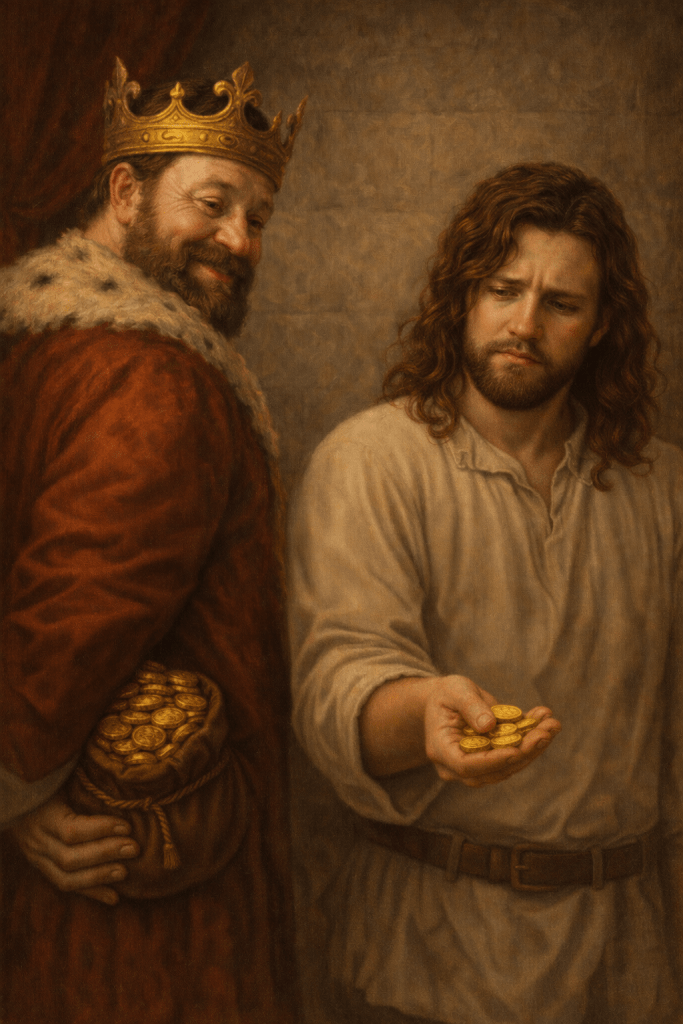
As has been established repeatedly, King Robert does not have interests. He has obsessions. They arrive suddenly, fully convinced of their own brilliance, and immediately displace all other responsibilities. Responsibilty becomes irrelevant. Planning becomes optional. Anyone nearby is expected to comply.
This enterprise occurred during one such period. It coincided with an off-again religious season, likely precipitated by the recent humiliation at the Revival…when King Robert attempted to feign a demonic possession and was instead exposed as performative and unconvincing. The episode produced no humility, it produced urgency. A new fixation was required to restore authority, righteousness, and attention without requiring reflection.
King Robert presented himself as a man of vision, misunderstood, adjacent to the divine. It was in this climate that he announced a business enterprise he assured all present would generate millions of virecrowns.
The idea came to him suddenly. He had seen something similar one day. The details shifted with retelling, but that was of no consequence. Without training, experience, or inquiry, King Robert became obsessed. He declared that iron spur carts, once repaired and modified, would command extraordinary value.
He described the look at length: severe, iron-heavy, authoritative. Decorative strength over practical function. Buyers, he insisted, would recognize quality instantly. Demand was assumed. Questions were discouraged.
These proclamations were delivered in the main room, recently altered by the installation of a decorative rug. King Robert defended the rug loudly. He gestured over it while outlining profits. He tripped over it more than once and continued speaking as though nothing had occurred.
The rug did not tie the room together. It did, however, explain the enterprise.
When King Robert brought Baylor (then still the Bound) into the venture, he did not present it merely as a transaction. He sold it as togetherness. He spoke of working side by side and building something together. He framed the project as an opportunity—not just for profit, but for connection. He implied that this was a moment of inclusion, a rare invitation into shared labor and mutual respect.
This mattered. Baylor had grown up with affection rationed. Approval was withheld as a means of control. Praise arrived conditionally, if at all. Emotional closeness was scarce and unpredictable. The promise of working together carried weight far beyond the cart. For Baylor, this was not simply a business idea. It felt like a chance to bond. A chance to earn proximity. A chance to finally stand beside his father rather than beneath him.
King Robert knew this. It was in this context that Baylor agreed.
King Robert informed Baylor that acquiring an iron spur cart would cost 1,200 Virecrown, the price required for them to own it together so it could be repaired and resold for profit. The number was presented as fixed and non-negotiable.
No receipt was produced. No proof of purchase was shared, and zero confirmation of the actual price was ever provided after The Beaver King brought home the project spur.
Baylor was told the venture would be 50/50 ownership. The Beaver King stated that he would handle the repairs and modifications himself, using materials he “had laying around.” No accounting was offered and no permission was sought from the other owner before changes were made. Decisions were unilateral and final.
Despite the promise of shared work, Baylor never worked alongside him. He never saw the cart completed. Work occurred out of view. Progress was reported verbally. Design changes were announced after the fact. The promised togetherness never materialized.
Then, like the decorative rug pulled cleanly out from under him, King Robert announced that the iron spur cart had been sold. There was no prior discussion, no shared decision.
Baylor was told he would receive only his original money back, with no profit, because Lord Huckster claimed he had “done all the work.” The 50/50 ownership agreement was ignored. The sale price was not disclosed. Any profit was retained entirely by King Robert.
What makes this conduct especially repulsive is not merely the deception. It is the method. King Robert did not only exploit money, he exploited hope.
At the time of this enterprise, King Robert had literally filed a writ of empty hands—twice. In Solipsian law, this is a formal declaration of bankruptcy. Two such filings stand in record. The analogy is therefore exact. He was bankrupt in purse and bankrupt in principle.
The aftermath was not loud. There was no apology. No explanation. No reckoning. The iron spur cart was never mentioned again.
Almost immediately, King Robert began speaking of another business.
Another idea. Another opportunity.
As before, it required Baylor’s involvement. As before, it benefited King Robert. This time, Baylor refused. King Robert did not argue. He did not reflect. He simply moved on, because The Beaver King t does not adjust his behavior in response to harm. He does not weigh impact. He does what he wants, when he wants, and anyone affected is expected to absorb the cost quietly.
Family does not restrain this impulse. Religion does not moderate it. Failure does not correct it. They are merely tools, taken up when useful, discarded when not.
King Robert will do whatever King Robert wants, regardless of this effect it will have on anyone else. Even his own flesh and blood. Especially his own flesh and blood. This is the Beaverton Betrayal at its finest.
 The Beaver King, Cautionary Tales of Medieval Dysfunction
Leave a comment