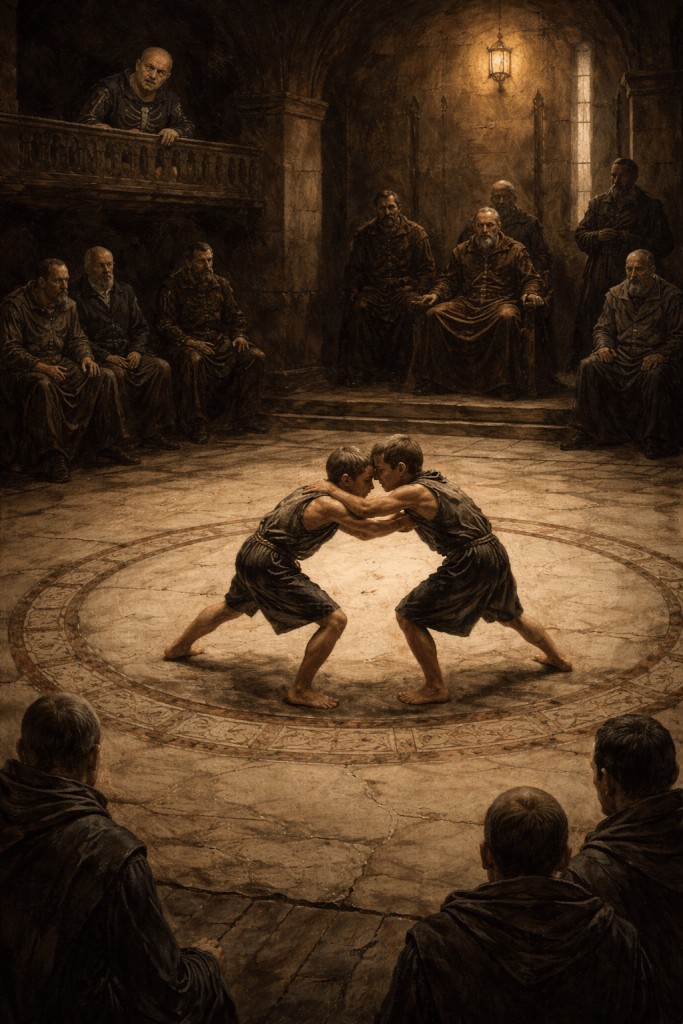
The Concordant Grappling Circles were a youth discipline program operating under the authority of the Concordant Standard. They were presented publicly as a corrective measure: a means of instilling fortitude, bodily control, restraint, and respect for hierarchy in boys approaching adolescence.
Participation was described as voluntary. In practice, refusal was noted.
The Circles were organized by age and size, divided into lower and upper tiers. Boys were paired into rounds of controlled grappling, overseen by appointed elders and, frequently, by fathers seated at the perimeter of the room. Instruction emphasized technique over endurance and compliance over outcome. Silence was expected. Correction was immediate.
Yielding was permitted, though remembered. Failure to hold was corrected publicly. Pain was reframed as progress.
There were no formal victories recorded. No scores were kept. A boy’s success was measured instead by comportment: his ability to endure pressure without complaint, to follow instruction without hesitation, and to accept physical domination without outward resistance. Those who met these expectations were praised as disciplined. Those who did not were advised to return better prepared.
Injuries were common and rarely remarked upon. Bruising, joint strain, and restricted breathing were treated as expected consequences of proper participation. Intervention by overseers was minimal and generally occurred only when a boy lost consciousness or disrupted the order of the Circle.
Fathers were encouraged to observe closely. A son’s conduct within the Circle was understood to reflect directly upon the household that sent him. Quiet endurance was read as good upbringing. Resistance suggested deficiency. The Circles, in this way, did not end when the room was cleared. What was observed there frequently followed boys home.
For many families, the Concordant Grappling Circles remained limited in scope. Attendance was occasional. Instruction was taken as advisory. The program functioned as it claimed to: a structured, if harsh, rite of passage that was entered, endured, and left behind.
For others, the Circles became something else. The structure of the CGC rewarded fixation. It offered repetition without oversight, authority without accountability, and a language of virtue capable of justifying harm without ever naming it. Men inclined toward obsession found in the Circles a system that did not restrain them, but affirmed them.
No one embodied this danger more fully than King Robert.
King Robert had never participated in the Circles himself, nor in any comparable undertaking. As a youth, he was barred from physical competition of any kind. The Dowager Queen Brynda would not permit it. She expressed persistent fear of injury and refused to tolerate physical risk to her son, whom she regarded as fragile and exceptional. This prohibition extended well beyond early childhood and was enforced with unusual consistency.
As a result, King Robert entered adulthood without having been tested in the very disciplines he would later come to revere.
When the Concordant Grappling Circles were established for his own sons, his interest was immediate and disproportionate. What could not be undertaken personally was pursued vicariously. Enrollment was not sufficient. Attendance was not sufficient. Observation was not sufficient. All four Little Lords were placed within the Circles.
Participation was framed as opportunity. In practice, it became expectation. Performance was monitored closely, discussed repeatedly, and weighed heavily. The standards applied within the Circle were not confined to its sanctioned bounds. They were carried back into the household and enforced beyond it.
This pattern mirrored King Robert’s earlier fixation on the Concordant Standard itself. In both cases, he attached himself to institutions that conferred authority, discipline, and moral justification, while requiring none of the personal risk he himself had been shielded from as a child.
The Concordant Grappling Circles did not create this impulse. They provided it with structure.
The Circles were not, in themselves, a crime. They were a mechanism. And in the hands of a man prone to fixation, they became a method.
 The Beaver King, Cautionary Tales of Medieval Dysfunction
Leave a comment