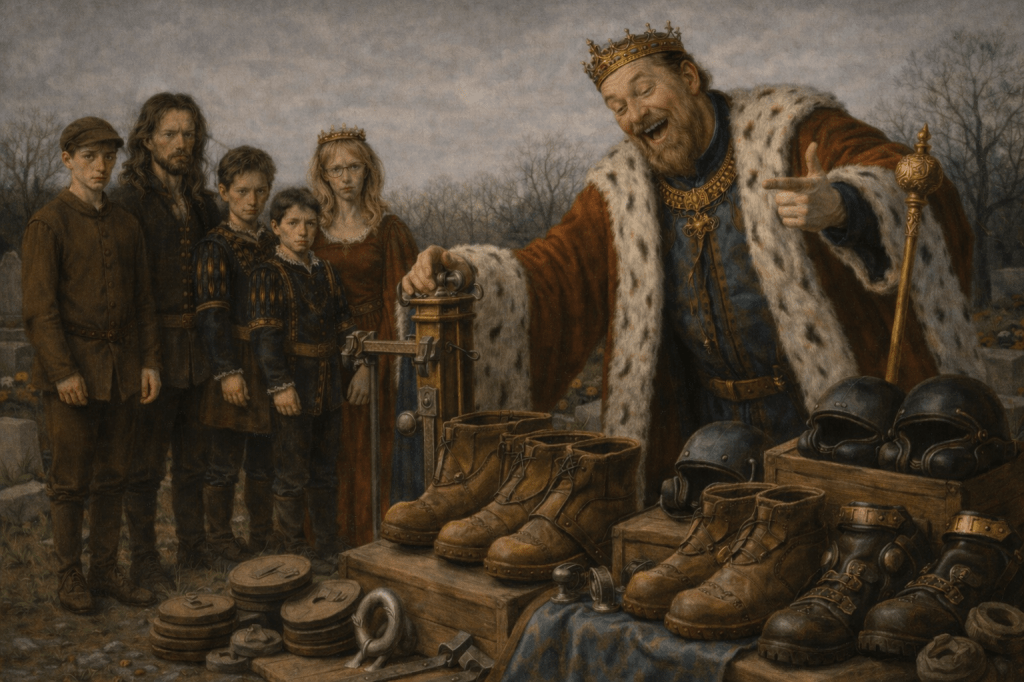
The Little Lords were not enrolled in the Concordant Grappling Circles according to age or readiness. They were enrolled all at once.
At the time, only the eldest boy would ordinarily have been enrolled in the organization. The others would have followed in stages, if at all. Instead, King Robert entered all four simultaneously. No distinction was made for size, development, or comprehension. The youngest, Brystin the I, was four years of age.
This decision followed King Robert’s first direct exposure to the Circles. On the day in question, young Baylor the Bound was playing Tussock Chase, a common parish game of pursuit and physical contest, held in the open commons. Oversight was provided by a Field Warder responsible for maintaining order during youth play. During conversation, the Field Warder mentioned the Concordant Grappling Circles. When asked, he stated that there was no minimum age for enrollment.
King Robert had long expressed interest in the Circles. As a youth, however, he had never been permitted to participate in physical trials of any kind. The Dowager Queen Brynda was openly fearful of injury and unwilling to tolerate physical risk to her son. Her protection extended well beyond early childhood and into later boyhood, including unusually prolonged physical caretaking practices. Records and family accounts indicate continued breastfeeding until approximately his seventh year. As a result, King Robert entered adulthood without having undergone the disciplines he later came to regard as essential. He spoke of them with familiarity and, at times, implied personal experience despite having none.
Once informed that the Concordant Grappling Circles carried no minimum age, he acted immediately. He returned home, gathered all four Little Lords, and conveyed them directly to the local Concordant Grappling Circle hall. No preparation was undertaken. No inquiry was made regarding suitability. No delay was observed.
Enrollment was immediate. What followed was fixation.
King Robert began spending money without pause or proportion. He purchased the most expensive Holdskins available, along with reinforced Grapple Boots and protective Head Wards for each boy. A private weight scale was acquired at a cost exceeding seven hundred Virecrowns. Training implements and exercise apparatus followed shortly thereafter. These purchases were made before any assessment of the boys’ interest, aptitude, or capacity to participate. Suitability was not considered and willingness was not asked. In King Robert’s view, the expenditure itself justified the undertaking.
At the time, the household was already under financial strain. The family was still recovering from the First Writ of Empty Hands, having only recently begun to stabilize after significant loss. Resources were limited. Necessities were sparse. Baylor recalls that there was often insufficient food, irregular clothing, and few provisions beyond the bare minimum.
During this period, Baylor the Bound overheard a conversation between The Queen Consort and King Robert. Brystal stated plainly that the household could not afford further purchases related to the Circles. King Robert dismissed the concern, stating that the expense did not matter and that she would need to “figure it out.” No alternative was offered. No reduction was proposed. True to established pattern, the purchase was completed.
Before formal training had even commenced, King Robert enrolled the Little Lords in every tournament scheduled for the year. No assessment preceded this decision and no preparation followed it.
The result was predictable. Baylor the Bound found the experience acutely distressing. He was repeatedly overmatched within the Circle, subjected to continuous physical dominance without instruction or recovery, and left with a clear impression of personal failure. His performance was observed. It was not contextualized.
Afterward, he was required to face his father. Rather than acknowledging the absence of training or the impropriety of the enrollment, King Robert chastised the boy for his performance. Responsibility was assigned wholly to the child. The experience of the Circle was followed immediately by reproach within the household.
In this way, harm was doubled: first publicly, then privately.
This sequence of actions—immediate enrollment, indiscriminate expenditure, premature tournament exposure, and subsequent chastisement—occurred before any meaningful instruction had taken place.
It establishes the pattern by which King Robert would later operate, enthusiasm without restraint, authority without preparation, and punishment without responsibility.
 The Beaver King, Cautionary Tales of Medieval Dysfunction
Leave a comment