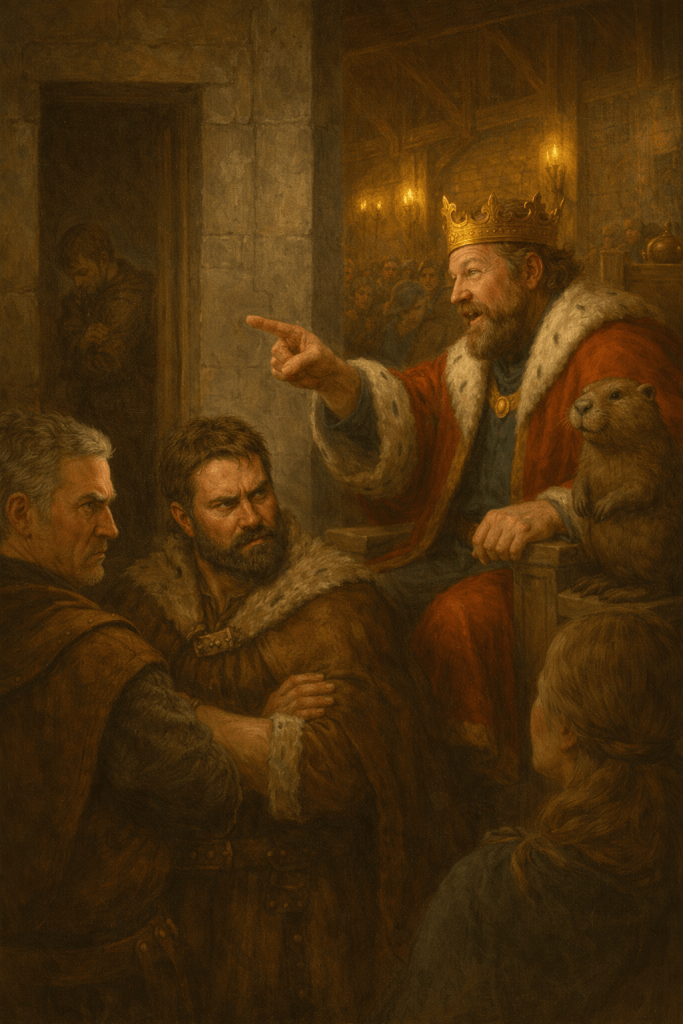
This exhibit records one incident among many, entered to document the extreme measures imposed upon Baylor the Bound, eldest of the Little Lords, by his father, King Robert, during a period of heightened fixation.
By the time of this incident, the patterns established in earlier exhibits were fully in place. Discipline no longer corrected, and control no longer adjusted. Physical exertion and deprivation had ceased to be means to an end and had become the method itself.
At the time, Baylor was in his sixteenth year, corresponding to what he recalls as his eighth season of participation in the Concordant Grappling Circles.
That winter was long and severe. During this period, Baylor fell ill. His symptoms were ordinary for the season: persistent coughing, fever, and physical weakness. His movements slowed. His breathing shortened. Strength arrived late and left early. The illness followed repeated winter practices that left him soaked with sweat and sent directly into frigid air.
The illness did not alter expectations. Dietary restriction continued. Fluid intake remained limited. No allowance was made for fever or recovery. The body was treated as though it were not ill.
The Dutchess of Non-Intervention, consistent with established pattern, took no action.
After two or three days of sickness, Baylor became aware that a competition was approaching. Given his condition, he expected reprieve. He anticipated being allowed to remain in bed and recover. Instead, he was ordered to rise.
No questions were asked. No assessment was made. He was told not to be a baby and informed that he would be grappling regardless of illness. The instruction was delivered as command.
Baylor complied. He dressed because refusal carried consequence. He rode to the Circle hall because delay invited punishment. His head remained low. His body was already depleted.
The hall was cold. The air held dust, sweat, and damp wool. As he warmed up, his coughing pulled against his chest. His reactions lagged. His limbs answered a moment too late, as though effort had to travel farther to reach them.
When pairings were posted, there was no adjustment. Under the CGC ranking system, he was matched according to standing, not condition. His opponent was solid and alert. The boy across from him breathed evenly. His posture was upright. His movements were clean.
The opening exchange revealed the difference. Baylor reached and missed. His grip slid. His foot placement faltered. When contact came, it came cleanly for the other boy. Baylor absorbed it without counter. He was late to sprawl. Late to recover. Each transition cost breath he did not have.
The Circle did not slow for sickness. He fought through the rounds with his vision narrowing at the edges. His lungs burned. Strength arrived half-formed and left quickly. He knew the holds. His body could not execute them in time.
The match ended on points. He lost by two.
The margin was small. The cost was not.
Baylor left the Circle exhausted. His legs trembled as he stepped off the mat. His chest pulled inward with each breath. He focused on remaining upright, on keeping his feet under him, on not letting his body show how close it was to giving way.
He was instructed to follow his father. They moved away from the open hall and into a smaller training room used for drills. The door closed behind them. The air was still. The floor was bare. Baylor expected instruction. He believed he was being taken aside for correction, for a private word, for guidance. He stood facing forward, shoulders rounded, hands at his sides, waiting.
The first impact came without warning. A blow landed squarely in his abdomen. The force folded him inward and drove the air from his lungs in a sharp, involuntary release. His vision flashed white at the edges.
Instinct intervened. He brought his arms down and in, curling forward to shield his midsection. He did not fall. He did not drop to his knees. He remained upright, planting his feet hard against the floor. Staying on his feet mattered. He understood, without conscious calculation, that going down would invite escalation. The floor was not safety.
His chest heaved, searching for breath that would not come. Sound narrowed. The room tilted slightly. He stayed upright.
When the pummeling ceased, King Robert stepped back. He looked at his son, his eldest child, and spoke once. He told Baylor “You are a disgrace to the family name.” Then he turned away and left the room.
No instruction followed.
No correction was offered.
No care was extended. Baylor remained standing where he had been left.
The Minstrelle’s Margin
This Minstrelle interjects:
Well. If disgrace were hereditary, Robert, you secured the lineage all on your own.
You called your son a stain on a family name that had already been dragged through the mud, pissed on, and propped back up pretending it was a banner. Everyone in Beaverton knows what you are. They always have. You mistake fear for respect and silence for agreement.
So I’m unclear which name you believed was being defended in that room. Because it wasn’t honor. It wasn’t strength, and it certainly wasn’t legacy. It was just you, frightened, small, and swinging downward because it was the only direction left that made you feel tall.
Afterward, while Baylor struggled to steady his breathing and collect himself, King Robert returned to the main hall. There, within earshot of Field Wardens and other adults, he recounted what he had done to his son. He spoke of it openly. He framed it as correction. He spoke with pride.
The response was immediate. Field Wardens and other grapplers’ families reacted with visible disgust. They stated plainly that such conduct was awful and unacceptable. Several expressed hope that the account was a lie, citing King Robert’s established pattern of falsehoods.
Through gloating, gossip, and admonishment from other families, the incident spread quickly. The Queen Consort learned of it almost immediately. She did nothing. No inquiry was made. No intervention occurred. No protection was extended. In the judgment of this Minstrelle, such inaction constitutes guilt equal to allowance.
Within the household, events resolved according to the pattern known as the Beaverton Betrayal: when King Robert commits harm, the persecuted party is required to recover quickly and without acknowledgment. Sympathy was not offered. Discussion was not permitted. Emotional response was treated as inconvenience.
Normalcy resumed. Not because healing had occurred— but because King Robert, lacking sympathy or remorse, required the matter to be forgotten.
The following week, upon Baylor’s return to practice, he was summoned privately by the Elder Field Warden. The Elder spoke plainly. He stated that what had occurred on CGC grounds was a disgrace. He offered, without condition, to contact the Capitol, the Magistrate, or the Concordant Standard on Baylor’s behalf.
Baylor considered the offer carefully. He declined. He understood that intervention would not change the conditions awaiting him at home.
Later, the Elder confronted King Robert directly. He warned him that any recurrence of such conduct on CGC grounds would result in immediate reporting and a permanent ban from the organization.
The boundary was explicit. It was not set by the household. It was set by outsiders.
Closing
Baylor has never forgotten this incident. He has never forgiven it—not out of bitterness, but because forgiveness requires acknowledgment, and acknowledgment has never been offered. King Robert has never apologized. He has never expressed regret. He has never named the harm.
In the absence of accountability, memory remains. This incident did not end when the room emptied. It did not end when the household returned to normal. It continued forward, carried intact, because nothing was done to resolve it.
Exhibit C is entered as record of violence compounded by denial, and harm preserved through refusal to account.
 The Beaver King, Cautionary Tales of Medieval Dysfunction
Leave a comment