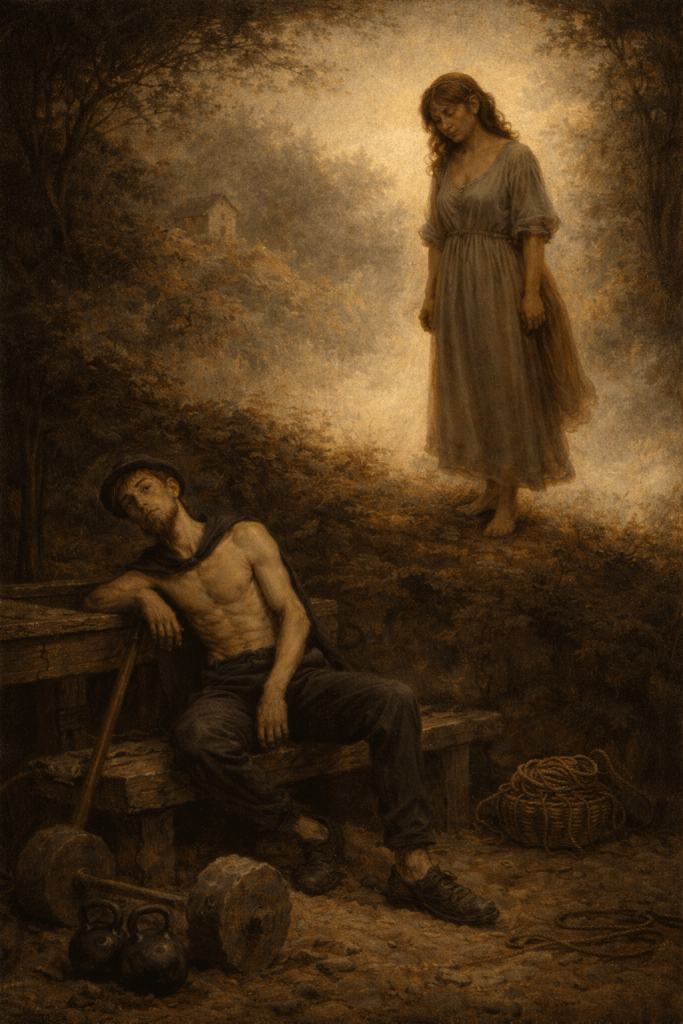
Nanwen of Mills Creek stands now in the Quiet Meadow of the Ancestral Plain, restored to the form she carried before illness hollowed her bones and dimmed her strength. The wasting that once bound her body has no authority there. She is slender again, steady, and free of pain, the woman she had been before the long decline.
From that place, the living are seen without distortion.
In time, her attention settles on Little Lord Bucker.
She had loved him once … not indulgently, but with the cautious hope reserved for a child who might yet grow beyond the failings of the household that shaped him. From the Meadow, she sees how thoroughly that hope has been squandered.
It is not merely that he has failed. Failure can be instructive. It is that he has learned nothing from it.
His brief tenure within the Concordant Standard had been spoken of as a turning point, a place where discipline might compensate for the absence of it at home. Instead, he treated it as a costume to be worn briefly, a story to repeat afterward as though proximity to structure were the same as submitting to it. When effort was demanded without praise, he retreated. When correction came without gentleness, he sulked. Even now he speaks of that time as though the institution failed him, too dull to recognize that it simply continued functioning once he stopped trying.
There is, she realizes, a particular stupidity in men who believe themselves misunderstood rather than inadequate.
Work followed the same weary pattern — positions obtained through sympathy or connection, abandoned when persistence was required. Each departure was accompanied by elaborate explanations that grew more self-protective and less believable with repetition. He mistook excuses for insight, convinced that narrating his failures cleverly transformed them into something other than what they were.
From the Quiet Meadow, the truth is unmistakable: he is not thwarted, not tragic, not even particularly unlucky.
He is lazy.
Worse, he is content in that laziness, padding it with just enough bluster to avoid recognizing it for what it is.
His marriage to Jessalyn Slumthumb, the Backwards Pawn, had seemed, briefly, the one responsibility that might force him into adulthood. Nanwen had hoped that loving another person would demand the constancy he had never demanded of himself. Instead, he approached it as he had everything else — expecting devotion without reciprocation, stability without effort, admiration without earning it. When it faltered, he was genuinely confused, as though relationships should endure on intention alone, maintained by the other person’s labor while he drifted comfortably above consequence.
But it is his fatherhood that wounds her most deeply to witness.
In life, Nanwen carried the quiet sorrow of a body that would not grant her children. She endured the consultations, the unanswered questions, the gradual silence that settles when hope becomes too painful to discuss. She had made peace with it as best she could, pouring her care into those placed temporarily in her path, loving them without the certainty of permanence.
From the Quiet Meadow, where pretense cannot survive, she sees what he was given and how carelessly he has handled it.
The absence of presence.
The impatience.
The small cruelties born of inconvenience.
The astonishing dullness required to mistake provision for parenting.
Of all the emotions permitted in that tranquil place, this is the one that sharpens into something like disgust — not loud, not theatrical, but cold and absolute. That he, who was granted what she was denied, should treat it as a burden rather than a sacred trust is an offense she cannot soften with understanding.
She would have given anything to be entrusted with what he has squandered.
He does not even recognize its value.
In this, more than any other failing, he reveals himself fully as his father’s son — not merely idle, not merely unreliable, but small in spirit and incurious in mind, a man who drifts through life convinced that the problem is always elsewhere because it has never occurred to him to examine himself honestly.
Nanwen does not curse him.
She does something worse.
She withdraws the last of her sympathy.
After a long while, she turns her gaze away, not in anger but in a grief too old to remain sharp. The valley continues below her, unchanged by what she now understands.
And in the Quiet Meadow, where nothing is hidden and nothing can be repaired, she lets him go.
 The Beaver King, Cautionary Tales of Medieval Dysfunction
Leave a comment