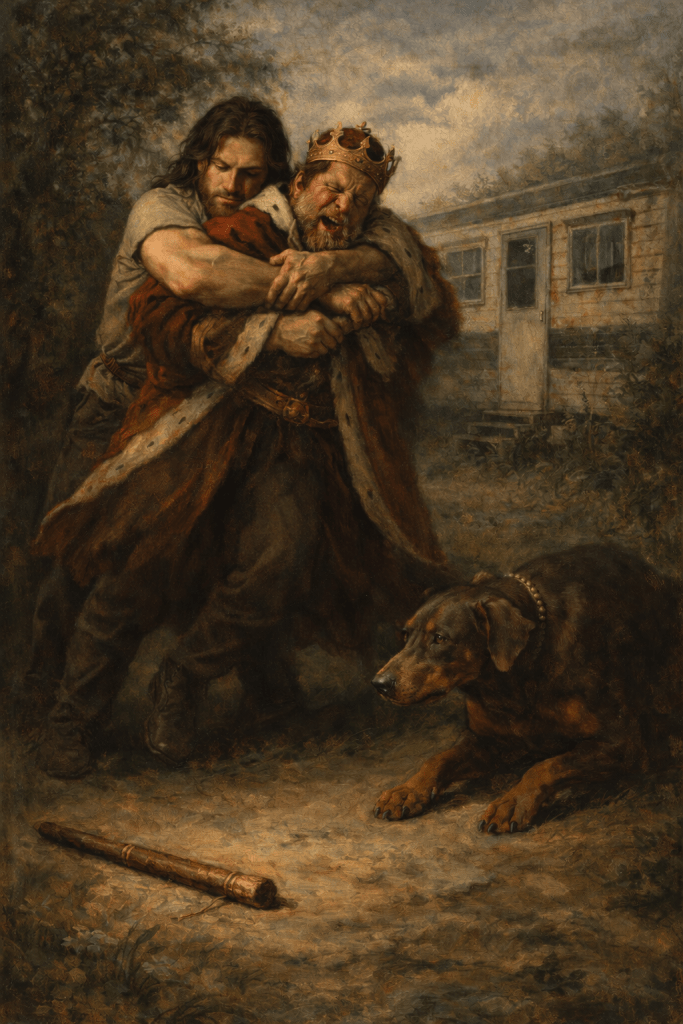
King Robert governed his world through escalation. If challenged, he raised his voice. If resisted, he raised it further. In his estimation, authority was not proven through steadiness but through sheer force of presence. Whoever was loudest, longest, controlled the outcome.
To outsiders, the tactic appeared formidable. Volume creates the illusion of certainty. Many yielded simply to end the confrontation, mistaking noise for power and fury for conviction.
To those who knew him well, the display revealed something else.
The outbursts were reflexive, almost juvenile in their predictability. The louder he became, the clearer it was that control had already slipped. What he believed to be intimidation often exposed strain instead, the behavior of a man attempting to overpower situations he could not govern by any other means.
Not all were susceptible. This Minstrelle observed early that the spectacle lost its force once recognized as performance. Without fear to sustain it, the noise collapsed into something closer to embarrassment than dominance.
Within his own household, however, the King did not rely on volume alone. There he maintained a second doctrine: fear as a method of fatherhood.
He believed that if his sons feared him deeply enough from an early age, none would grow into men bold enough to challenge him. Respect was uncertain. Affection unreliable. Fear, once established, would hold.
Thus discipline arrived without warning. A boy could be singled out for a perceived slight and struck before he understood the offense. The blows came in succession, chest, stomach, the side of the head, less to correct behavior than to overwhelm resistance. If the child recoiled, the force followed. If he bent forward, it drove him lower. Retreat itself became further defiance.
The words were as deliberate as the strikes.
Quit crying.
Stop acting like a baby.
You want something to cry about?
The commands could not be satisfied. Pain does not obey instruction. Yet silence was demanded immediately, as though suffering itself were a choice.
So the boys learned. They learned to go rigid instead of curling inward. To hold their breath until dizziness overtook panic. To swallow every sound before it escaped their throats. Tears were wiped away quickly, not for comfort but as proof of submission. The faster they could present stillness, the sooner the ordeal might end.
They did not cry out so he would stop. They learned not to cry at all.
Baylor would later observe that the practice shifted with each child. What began with older boys crept steadily downward. Brystin the One was still very small when it began. Baylor himself was older, but not old enough to understand why endurance had suddenly become the price of peace.
The King achieved the quiet he desired. The house stilled when he entered. Compliance was immediate.
But fear is brittle. It produces silence, not loyalty, distance rather than respect, and it carries within it the certainty of eventual failure.
Recorded Incidents from the Household, as Recalled by Baylor the Brave
Baylor recalled being forced to stand facing a corner for long stretches, a punishment intended less for correction than for humiliation. On one occasion, when he shifted before being permitted to move, the King drove him forward with such violence that his head struck the wall hard enough to break through the plaster. The damage to the wall was treated as the offense, not the act that caused it.
Little Lord Brentin endured a punishment that extended beyond anger into routine. For months he remained in the corner as though assigned there permanently, leaving only for school, meals, and sleep before returning again. The arrangement became so normalized that it ceased to be remarked upon.
Most striking to Baylor was the absence of intervention. The Queen spoke no objection. The Duchess of Non-Intervention lived up to her title completely. Silence functioned as approval.
There was no appeal.
The Moment the Doctrine Failed
By eighteen, Baylor had entered the wider world and discovered that authority did not have to shout to be real. Men commanded respect without spectacle. Order could exist without fear.
The realization was still forming when the moment arrived that ended the old order entirely.
Madria, the Doberman of the household, ran in wide, joyful circles through the yard, inviting play, unaware of the tension gathering behind her. She darted close, bounded away, returned again, trusting the world to be what it had always been.
The King interpreted it as defiance.
The stick appeared in his hand. Commands were shouted the dog could not understand. When Madria veered away instead of freezing, the blows followed, striking ground, fence, then her body as she tried to escape the confusion she could not name.
Baylor moved before thought caught up.
He came in from behind, wrapping the King in a bear hold, pinning arms and stick alike. The sudden loss of control triggered rage immediately.
Let me go.
Baylor held.
When he loosened his grip, the King spun, raising the stick high with unmistakable intent. Baylor closed the distance again, lifting him entirely off the ground, locking the hold tighter than before. Each time the King drew breath to shout, Baylor tightened his arms, not enough to injure, only enough to remind him that air was no longer guaranteed.
Baylor spoke calmly.
I will let you go. But if you raise that stick again, I will put you into the ground.
For the first time, the King was forced into stillness.
When Baylor released him, the stick remained lowered. The fury collapsed into sullen retreat. He turned away, stomping back toward the house, muttering, diminished by the simple fact that resistance had not broken.
Madria crept forward cautiously, uncertain whether the danger had passed.
Baylor understood then what fear had been hiding.
It ends the moment someone refuses to carry it.
On the Measure of the King
In the final accounting, King Robert’s rule within his household had depended less on strength than on proximity. His authority filled confined spaces, drawing its force from the inability of others to leave them. Once distance entered the equation, the effect diminished rapidly.
The sons he had worked hardest to keep small eventually encountered a world that did not operate according to his rules. There they discovered that respect could exist without fear, that authority could be quiet, and that stability did not require domination.
What they had endured was not the natural order of things. It had simply been the only one available to them at the time.
The incident in the yard with Madria did not overthrow the King. It demonstrated that his power functioned only under conditions he could control. Remove those conditions, and the performance faltered.
He had always been loud. What had been mistaken was the assumption that volume indicated magnitude.
History would not remember the day his authority ended, because it did not end in a single moment. It diminished gradually, each time someone refused to be governed by fear, each time distance made his methods irrelevant, each time the world proved larger than the boundaries he had enforced.
In the end, nothing had changed about the Bark.
Only the listeners had changed.
And once they no longer mistook noise for power, the absence at its center became impossible to ignore.
 The Beaver King, Cautionary Tales of Medieval Dysfunction
Leave a comment