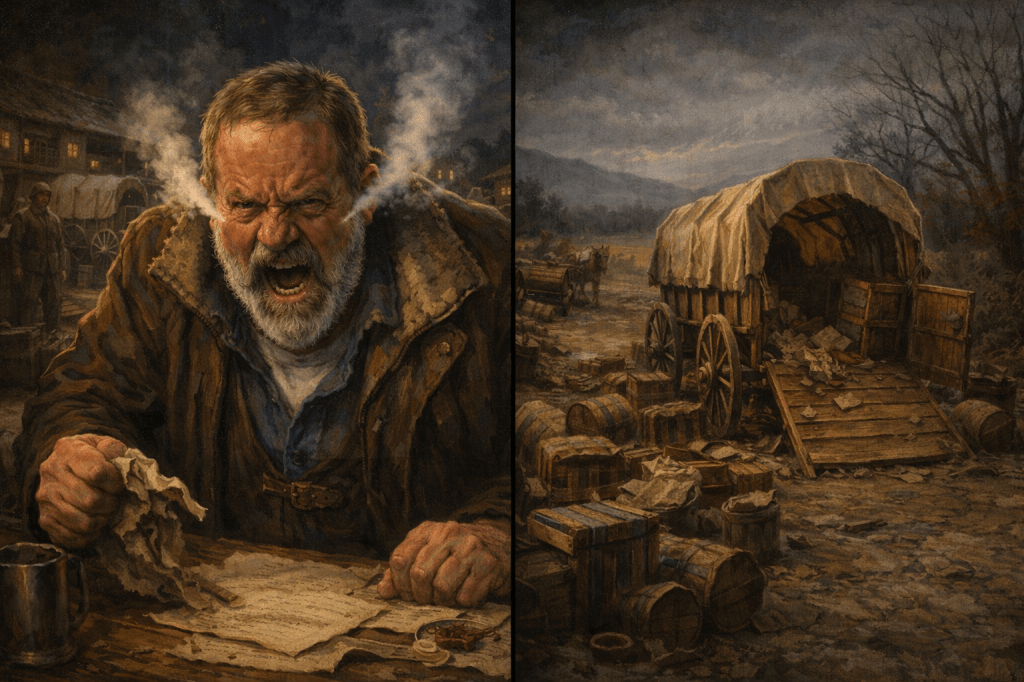
Before the Crown’s meddling reached the ClayLands, there stood a man who had built his life on order rather than appetite.
Duke Dougal, Warden of Clayton Yard, had established a carting enterprise that much of Solipsia quietly depended upon. He hauled food, goods, and wares across the realm based on need, the unglamorous labor that allowed markets to function and settlements to endure. Over the years he built both his business and his reputation until he commanded ten heavy wagons and earned a very good living from honest work.
One of the pillars of his success was distance. Dougal kept himself far removed from Beaverton and its faction, understanding that proximity to that court often turned prosperity into liability.
His lineage, however, tied him to it nonetheless. He was brother to Roderic of ArthurAlley, the Dowager Queen Brynda’s first husband — a man shaped by the sewage-runoff side of Vireholt, a place of foul water and generational poverty. Roderic grew up angry, uneducated, and mean. Evil recognizes its own. Roderic drank heavily and often. He cared only for his pipes and his ale. Brynda was drawn to the collapse of restraint, the volatility, the intensity, the familiarity of it.
Dougal chose differently. Where his brother leaned into chaos, Dougal built structure. Where ArthurAlley stagnated, Clayton Yard functioned. Where others relied on bravado, Dougal relied on consistency.
About ten years before this song was sung, the Beaver King found himself out of a job again. Solipsia permitted a man only two Writs of Empty Hands in a lifetime, and he had already spent both. Writing off his debts was no longer an option.
The Crown’s need for yet another post did not arise from misfortune, but from pattern.
When work demanded consistency, he failed. When corrected, he erupted. He stormed. He sulked. He threatened to quit and abandon jobs mid-repair, and at times he followed through, leaving rigs unfinished, schedules ruined, and others to clean up his mess.
So he did what he always did when the ground began to burn beneath him. He went looking for steadier hands. He made a special in-person visit to Clayton Yard.
The records there clearly state that Dougal saw this coming, because the Beaver King only comes calling when he wants something. Dougal would have preferred the Crown remain a distant rumor, a problem kept safely on the other side of the realm.
But at that exact season, Clayton Yard was stretched thin. Dougal was in desperate need of wagon drivers. Routes were waiting. Loads were stacking. Work does not pause while men behave badly. And so, against his better judgment, he hired him.
Doing his due diligence, Uncle Dougal was very specific about what he required and what performance would be needed. He already knew enough about the Beaver King that he felt this needed to be stated, plainly and without ambiguity.
For six full moons, the arrangement held.
Then the same old patterns began showing themselves. It started small and childish, the way it always does.
Dougal’s son-in-law also worked at the carting business, but as a mechanic of sorts, not a driver. The Beaver King, in an entirely different position, began pouting and throwing fits that it “wasn’t fair” he had to work harder than the son-in-law. The distinction between roles did not matter to him. The reality of need did not matter to him. What mattered was the familiar grievance: someone else, in his view, had it easier.
The pouting became disruption. The disruption became tension. And the tension reached a breaking point. It all came to a head one day, and Robert decided to show his ass.
He was three days’ ride away from Clayton Yard, almost to the borders of Beaverton, in StillPoint, when he made the ridiculous decision to abandon the oxen, abandon the wagon full of goods, and catch a ride home back to Beaverton.
This was the worst thing possible.
The load was broken into. And it was a very long time before Dougal would even get word that this had happened and come retrieve his property. The goods never made it to Terra Firma.
It was a very, very big loss for Dougal. The Beaver King didn’t care.
On to the next one. Another job search. Another beginning. Another set of proclamations, as if what he had just left behind belonged to no one.
But for Clayton Yard, what was abandoned did not simply vanish. The aftermath was not one clean loss, paid and closed. It was the slow bleed that follows a rupture in the middle of a living operation. A delivery missed is not merely a delivery missed — it becomes contracts strained, routes disrupted, schedules rewritten, men overworked, and trust quietly eroded. Clayton Yard had built its name on reliability. The incident at StillPoint struck at the very thing that had taken Dougal years to earn.
And in the center of it stood the Duke himself, forced to reckon with what he already knew when he first opened the gates. He saw it coming. He stated his expectations. He hired the Crown anyway, because necessity corners even the wise. And still, the pattern arrived right on time.
For the Beaver King, it was merely another stop along a wandering path.
For Duke Dougal, it was proof that some men do not change, they simply move on before the consequences can catch them. And thus the lesson of Clayton Yard was recorded for any who would later consider opening their gates to the Crown:
Not every plea for opportunity is a sign of reform. Sometimes it is only the prelude to repetition.
 The Beaver King, Cautionary Tales of Medieval Dysfunction
Leave a comment